5-3 Valve Center Functions
5/3 Valve Center Functions: Closed, Exhaust, or Pressure Center — How to Choose
-
17 Apr, 2025

-

5/3 Valve Center Functions: Closed, Exhaust, or Pressure Center — How to Choose
Pneumatic Technology Explained · Solenoid Valve Series
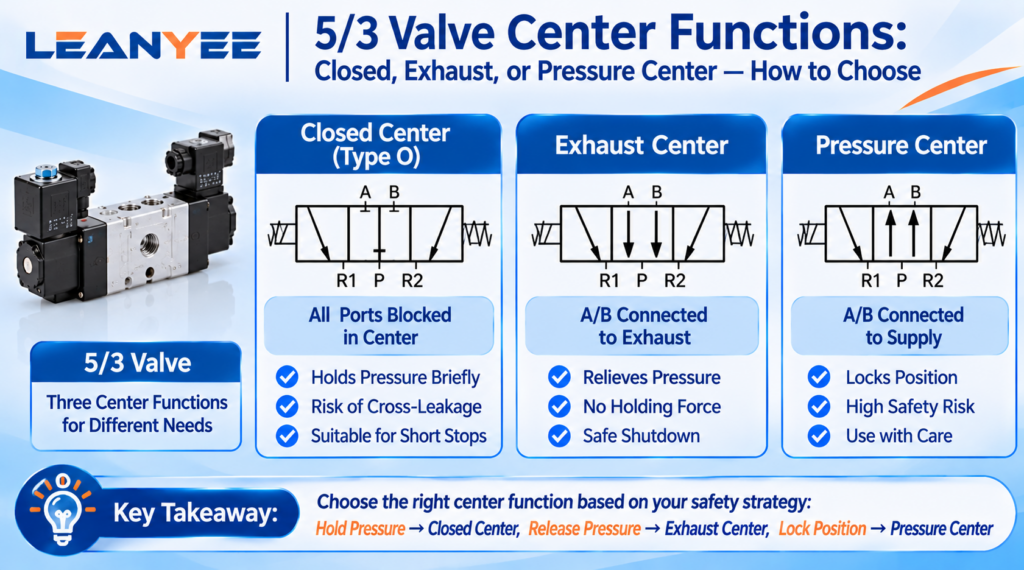
The short answer: the whole point of a 5/3 valve lies in its center function — the center envelope decides what the cylinder does when power is lost. Closed center (all ports blocked) holds pressure but positions loosely; exhaust center (ports to atmosphere) relieves pressure safely but loses holding force; pressure center (ports to supply) locks the piston rigidly but carries its own safety risk. Which one you pick depends on whether you need to hold or to relieve.
The Essence of the Three Center Functions
Closed center (type O): in the center position all ports are blocked, so the cylinder stops mid-stroke and retains pressure. But air can cross-leak between the two piston chambers and positioning is soft, so it suits short-term pressure holding only.
Exhaust center (center position vented to atmosphere): in the center position ports A and B are connected to exhaust and the cylinder is depressurized. Safe, but with no holding force — the right choice where a safe pressure release is required.
Pressure center: in the center position ports A and B are connected to supply, so both chambers are pressurized and the piston is locked. Positioning is good, but opposing pressure and safety hazards mean it must be used with care.
Telling Closed, Exhaust, and Pressure Center Apart
| Item | Closed center (O) | Exhaust center | Pressure center |
| Center state | All ports blocked | A/B connected to exhaust | A/B connected to supply |
| Characteristic | Short-term pressure holding | Safe pressure relief | Rigid locking and positioning |
| Risk | Soft positioning, cross-leakage | Loss of holding force | Opposing pressure / safety hazard |
| Best suited to | Short stops | Safe shutdown | Precision positioning |
Field Notes: Mistakes We Have Seen
- Choosing exhaust center when pressure must be held. The moment power is lost the cylinder depressurizes and the position is gone.
- Using pressure center where it does not belong. Pressure opposes on both sides and can damage components.
- Treating closed center as accurate positioning. Closed center positions loosely; precision work needs pressure center or a mechanical lock.
- Overlooking cross-leakage in the center position. A closed-center valve loses pressure over time through internal leakage — do not expect it to lock a load indefinitely.
Frequently Asked Questions (FAQ)
Q1: What do closed, exhaust, and pressure center actually mean? They are the three ways the two working ports A and B can be connected in the center position of a 5/3 valve when de-energized. Closed center (type O) blocks both A and B: both cylinder chambers are sealed, pressure is held briefly, and the piston stops mid-stroke. Exhaust center connects both A and B to the exhaust port: both chambers are vented and the piston can be pushed by an external force. Pressure center connects both A and B to the supply port: both chambers are pressurized simultaneously and the piston is locked by opposing pressure. These three functions determine the force state of the cylinder at the instant power is lost — the key decision in selecting a 5/3 valve. Always read the center envelope on the symbol before choosing.
Q2: Which center function holds pressure after power loss? Closed center (type O). With A and B blocked, the air on both sides of the piston is trapped in the chambers, so pressure can be maintained and the piston stays where it is for a short time — suitable for “hold position briefly after power loss.” But note that closed center is not an absolute seal: the piston seals leak slowly, and over time pressure drops and the position drifts, so it can only hold for a limited period. If you need accurate pressure holding over a long period or under load, closed center is not enough — combine it with a mechanical lock, pressure center, or a dedicated pressure-holding arrangement. Do not treat closed center as a permanent lock.
Q3: Why is closed-center positioning not accurate? Because closed center works by trapping pressure behind blocked ports, and a cylinder is not perfectly sealed. The piston seals have a small internal leak, so the pressures on both sides gradually equalize and decay, and the position drifts with them. On top of that, air is compressible, so the cylinder behaves like a spring and the position moves when an external force disturbs it. Closed center therefore only achieves “roughly stops, holds briefly” — it cannot deliver accurate positioning. For accuracy you need pressure center to lock the piston against opposing pressure, a mechanical lock, or a mechanism with its own positioning; closed center alone will not give you the precision.
Q4: What are the safety risks of pressure center? Pressure center supplies both A and B at once and locks the piston by opposing the two pressures. The risks are these: the two pressures must be accurately balanced, and if one side fluctuates or a cylinder seal leaks internally, the piston will drift to one side and you lose control instead of gaining it. The cylinder is also permanently pressurized against itself, which can accelerate seal fatigue over time. More importantly, if the system is poorly designed, pressure center can make the cylinder move suddenly during maintenance or parts replacement and cause injury. Pressure center is therefore used mainly in precision applications with a genuine need for opposing-pressure locking, and it must come with safety measures — it is not a casual choice.
Q5: Can two 2-position 5-port valves replace one 3-position 5-port valve? Not fully. A 5/3 valve has a defined center state (closed, exhaust, or pressure center when de-energized), whereas two 5/2 valves each reset independently on power loss, and their combination will not necessarily reproduce the center function you want — it also adds complexity and more failure points. The value of a 5/3 valve is exactly this: one valve, one defined center, predictable behavior on power loss. If you genuinely need more complex logic, use a valve manifold or a combined valve, but that is a different design — you cannot simply wire two 5/2 valves together to imitate a 5/3 center function.
Prepared by the LEANYEE pneumatics technical team based on hands-on commissioning experience, for reference by industry peers.
Technical Disclaimer
The fitting selection, thread types, and technical parameters discussed in this article are based on applicable international standards, including ISO 4414 (Pneumatic Fluid Power — General Rules and Safety Requirements), ISO 8573 (compressed air quality), ISO 6358 (flow characteristics), and relevant thread standards such as ISO 7-1, ISO 228-1, and ANSI/ASME B1.20.1, together with publicly available technical information from international manufacturers such as SMC, Festo, and Parker.
This article is intended for general technical reference only. Actual performance may be affected by cylinder bore size, load, operating pressure, temperature, piping layout, and other application-specific factors.
On-site testing and commissioning are recommended where necessary. Always refer to the product documentation and technical parameters confirmed by the manufacturer for the specific product being used.
LEANYEE Technical Team
More News & Insights
-
Leanyee
 29 Oct, 2026Pneumatics in Electronics CleanroomsPneumatics in Electronics and Semiconductor Cleanrooms: Cleanliness and ESD ProtectionRead Article
-
Leanyee
 22 Oct, 2026Pneumatics in Automotive Welding LinesPneumatics in Automotive Welding Lines: Clamping, Location, and Spatter ResistanceRead Article
-
Leanyee
 15 Oct, 2026Pneumatics for Food and Beverage LinesPneumatics on a Food and Beverage Line: Oil-Free, Hygienic, Washdown-ReadyRead Article