Pneumatics in Electronics Cleanrooms
Pneumatics in Electronics and Semiconductor Cleanrooms: Cleanliness and ESD Protection
-
29 Oct, 2026

-

Pneumatics in Electronics and Semiconductor Cleanrooms: Cleanliness and ESD Protection
In electronics and semiconductor cleanrooms, a single particle of dust, a trace of oil, or a spark of static can ruin an entire batch. Every pneumatic component there has to be clean, oil-free, and static-safe. This article covers cleanroom pneumatics, focused on oil-free low-particle generation and ESD protection.
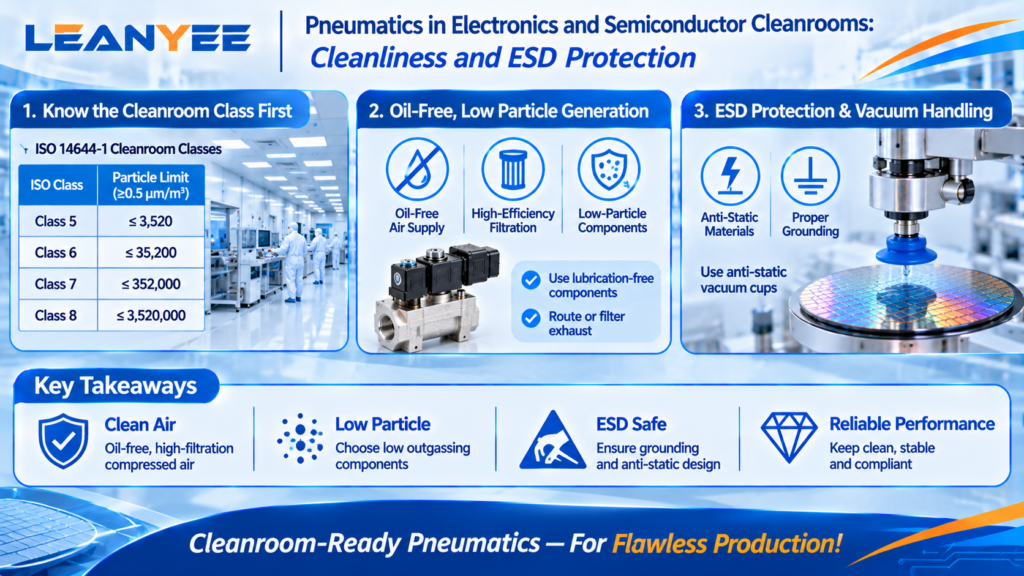
1. Know the Cleanroom Class First
Cleanrooms are classified by airborne particle concentration, per ISO 14644-1: the lower the class number, the cleaner the room (ISO Class 5 is cleaner than ISO Class 7). The higher the class, the stricter the limits on particle generation and exhaust from pneumatic components. Confirm the site’s cleanliness class before selecting components.
2. Oil-Free, Low Particle Generation
Cleanroom pneumatics must be oil-free and low-particle: use an oil-free compressor with high-efficiency filtration for the air supply, and lubrication-free components. Exhaust should be routed out of the clean zone or discharged after silencing and filtration, so particles carried by the exhaust do not contaminate the environment. Choose low-outgassing seals and grease.
3. ESD Protection and Vacuum Handling
Wafers and electronic components are sensitive to static, so pneumatic components must be static-safe: specify anti-static materials, and components and tubing with good grounding, to avoid charge generated by friction. Wafers, glass substrates, and other thin fragile parts are usually handled with vacuum cups, and those cups must be anti-static, mark-free, and clean.
Field Notes: Three Lessons from the Line
- An oil-containing air supply piped into the cleanroom — oil contaminates the environment. Cleanrooms require an oil-free supply and lubrication-free components.
- Exhaust discharged straight into the clean zone — exhaust particles contaminate the environment. Route it out or filter it first.
- ESD protection overlooked — friction charging damages components. Specify anti-static materials and ground them reliably.
Conclusion
The keywords for cleanroom pneumatics are “clean + static-safe”: oil-free air supply, low-particle components, exhaust routed away, and proper ESD grounding. Tick these off class by class and pneumatics will not hold back the clean environment.
Suggested Illustrations
- Cleanroom classes (ISO 14644) matched to pneumatic component selection.
- Piping layout for routed or filtered exhaust discharge.
- Anti-static suction cups handling a wafer.
The above content was compiled by the LEANYEE pneumatic technical team from hands-on commissioning experience, for reference by industry peers.
Technical Disclaimer
The fitting selection, thread types, and technical parameters discussed in this article are based on applicable international standards, including ISO 4414 (Pneumatic Fluid Power — General Rules and Safety Requirements), ISO 8573 (compressed air quality), ISO 6358 (flow characteristics), and relevant thread standards such as ISO 7-1, ISO 228-1, and ANSI/ASME B1.20.1, together with publicly available technical information from international manufacturers such as SMC, Festo, and Parker.
This article is intended for general technical reference only. Actual performance may be affected by cylinder bore size, load, operating pressure, temperature, piping layout, and other application-specific factors.
On-site testing and commissioning are recommended where necessary. Always refer to the product documentation and technical parameters confirmed by the manufacturer for the specific product being used.
LEANYEE Technical Team
More News & Insights
-
Leanyee
 22 Oct, 2026Pneumatics in Automotive Welding LinesPneumatics in Automotive Welding Lines: Clamping, Location, and Spatter ResistanceRead Article
-
Leanyee
 15 Oct, 2026Pneumatics for Food and Beverage LinesPneumatics on a Food and Beverage Line: Oil-Free, Hygienic, Washdown-ReadyRead Article
-
Leanyee
 08 Oct, 2026Overpressure Protection and Safety ValvesThe "Safety Valves" in a Pneumatic System: Overpressure Protection Basics Explained at OnceRead Article