Pneumatics in Automotive Welding Lines
Pneumatics in Automotive Welding Lines: Clamping, Location, and Spatter Resistance
-
22 Oct, 2026

-

Pneumatics in Automotive Welding Lines: Clamping, Location, and Spatter Resistance
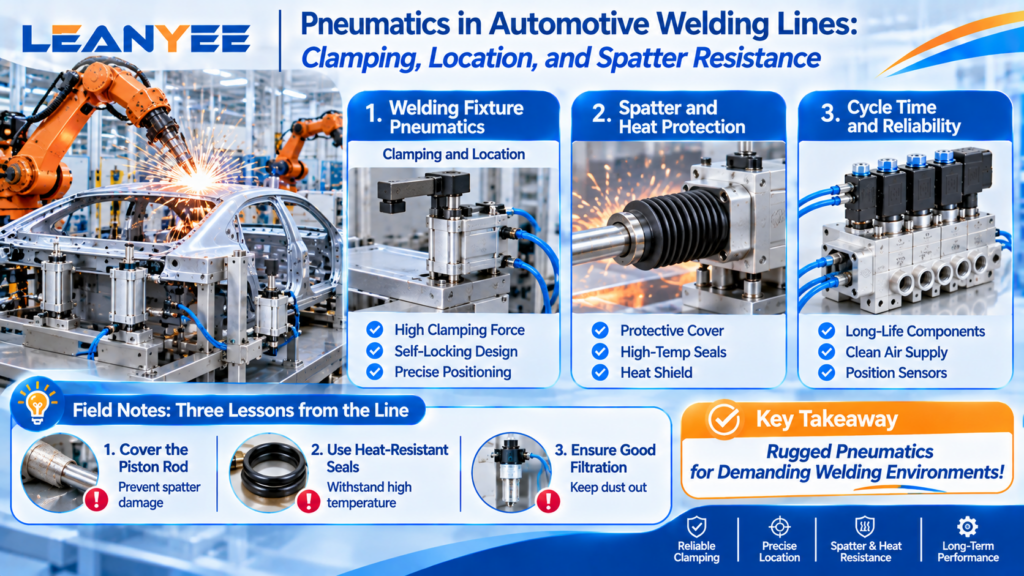
On an automotive body-in-white line, pneumatic components work continuously under flying weld spatter, high temperature, and dust — while still clamping reliably and locating precisely. This line demands more of pneumatics than almost any other industry. This article covers how to select and how to protect pneumatics for welding shops.
1. Welding Fixture Pneumatics: Clamping and Location
Welding fixtures use pneumatic clamp cylinders to hold sheet-metal parts and locating pins to position them, and the motion has to clamp firmly and locate accurately. Choose clamp cylinders with enough clamping force and with self-locking or holding capability, so welding vibration cannot loosen the clamp; locating pins must resist wear and impact.
2. Spatter and Heat Protection
Weld spatter and heat are the natural enemies of pneumatic components: spatter sticking to piston rods and seals scratches and jams them. Countermeasures: fit a protective cover or bellows boot on the piston rod, specify high-temperature seals, add a heat shield to the component, use cylinders with a wiper ring where necessary, and clean on a schedule.
3. Cycle Time and Reliability
Welding lines run fast and continuously, so pneumatic components must be high-cycle and highly reliable: choose long-life, maintenance-free cylinders and valves, with good cushioning, and keep the air supply clean (welding shops are dusty, so filtration has to be up to it). On critical stations, add sensors to confirm end position and prevent false actuation.
Field Notes: Three Lessons from the Line
- A bare piston rod in the spatter zone — seals get scratched by spatter and leak. A protective cover or wiper ring is mandatory.
- Seals that cannot take the heat — near the weld spot they age and leak. Specify high-temperature materials.
- Inadequate air filtration — dust enters the valve body and jams the spool. Welding environments need fine enough filtration and frequent element changes.
Conclusion
The key to welding-line pneumatics is ruggedness: reliable clamping, precise location, resistance to spatter and heat, and clean air. Do these properly and pneumatics will survive continuous production on the welding line.
Suggested Illustrations
- Typical layout of clamp cylinders and locating pins on a welding fixture.
- Piston rod protective cover and wiper ring as spatter protection.
- Installation of high-temperature seals and a heat shield.
The above content was compiled by the LEANYEE pneumatic technical team from hands-on commissioning experience, for reference by industry peers.
Technical Disclaimer
The fitting selection, thread types, and technical parameters discussed in this article are based on applicable international standards, including ISO 4414 (Pneumatic Fluid Power — General Rules and Safety Requirements), ISO 8573 (compressed air quality), ISO 6358 (flow characteristics), and relevant thread standards such as ISO 7-1, ISO 228-1, and ANSI/ASME B1.20.1, together with publicly available technical information from international manufacturers such as SMC, Festo, and Parker.
This article is intended for general technical reference only. Actual performance may be affected by cylinder bore size, load, operating pressure, temperature, piping layout, and other application-specific factors.
On-site testing and commissioning are recommended where necessary. Always refer to the product documentation and technical parameters confirmed by the manufacturer for the specific product being used.
LEANYEE Technical Team
More News & Insights
-
Leanyee
 29 Oct, 2026Pneumatics in Electronics CleanroomsPneumatics in Electronics and Semiconductor Cleanrooms: Cleanliness and ESD ProtectionRead Article
-
Leanyee
 15 Oct, 2026Pneumatics for Food and Beverage LinesPneumatics on a Food and Beverage Line: Oil-Free, Hygienic, Washdown-ReadyRead Article
-
Leanyee
 08 Oct, 2026Overpressure Protection and Safety ValvesThe "Safety Valves" in a Pneumatic System: Overpressure Protection Basics Explained at OnceRead Article