Pneumatics for Food and Beverage Lines
Pneumatics on a Food and Beverage Line: Oil-Free, Hygienic, Washdown-Ready
-
15 Oct, 2026

-

Pneumatics on a Food and Beverage Line: Oil-Free, Hygienic, Washdown-Ready
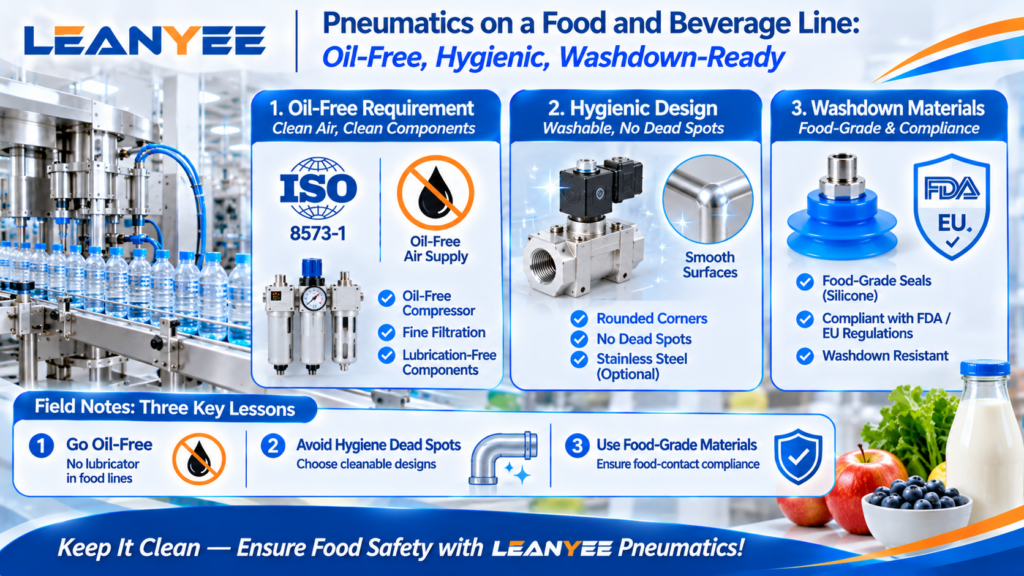
Pneumatic components on a food and beverage line touch the product directly or indirectly, and oil, dust, and hygiene dead spots are all red lines. Selection for this kind of line always comes back to three keywords: oil-free, hygienic, and washdown-ready. This article explains how to specify food-grade pneumatics.
1. The Oil-Free Requirement: Clean Air, Clean Components
A food line must first be oil-free: compressed air must not contain oil, or it will contaminate the product. Specify the air supply to an ISO 8573-1 class with zero (or extremely low) oil content — typically an oil-free compressor plus fine filtration. Choose lubrication-free pneumatic components as well, so a lubricator never carries oil mist into the air path.
2. Hygienic Design: Washable, No Dead Spots
Food environments are washed and sanitized constantly, so pneumatic components must be easy to clean and free of hygiene dead spots: smooth surfaces and rounded corners, avoiding threaded crevices and recesses where soil collects. Where necessary, specify stainless steel housings and corrosion-resistant materials, following hygienic design guidelines such as EHEDG.
3. Washdown Materials and Food-Contact Regulations
Parts that contact food (suction cups, seals) need food-grade materials — food-grade silicone, or materials compliant with FDA / EU food-contact requirements — and must withstand washing and sanitizers. Confirm the material’s food-contact compliance at selection; each export market has its own regulation.
Field Notes: Three Lessons from the Line
- A standard oil-lubricated compressor plus a lubricator — oil contaminates the product directly. Food lines need an oil-free air supply and lubrication-free components.
- Hygiene dead spots overlooked — threaded crevices trap soil that washing cannot reach, causing contamination. Choose cleanable designs.
- Standard rubber for seals — it does not resist sanitizers or meet food-contact requirements. Specify food-grade materials.
Conclusion
Food and beverage pneumatics are all about “clean”: oil-free air supply, hygienic structure, food-grade materials. Get all three right and pneumatics will not become a food-safety hazard.
Suggested Illustrations
- Air path for a food line: oil-free supply plus lubrication-free components.
- Cleanable design (rounded, smooth) compared with a hygiene dead spot.
- Material callouts for food-grade seals and suction cups.
The above content was compiled by the LEANYEE pneumatic technical team from hands-on commissioning experience, for reference by industry peers.
Technical Disclaimer
The fitting selection, thread types, and technical parameters discussed in this article are based on applicable international standards, including ISO 4414 (Pneumatic Fluid Power — General Rules and Safety Requirements), ISO 8573 (compressed air quality), ISO 6358 (flow characteristics), and relevant thread standards such as ISO 7-1, ISO 228-1, and ANSI/ASME B1.20.1, together with publicly available technical information from international manufacturers such as SMC, Festo, and Parker.
This article is intended for general technical reference only. Actual performance may be affected by cylinder bore size, load, operating pressure, temperature, piping layout, and other application-specific factors.
On-site testing and commissioning are recommended where necessary. Always refer to the product documentation and technical parameters confirmed by the manufacturer for the specific product being used.
LEANYEE Technical Team
More News & Insights
-
Leanyee
 29 Oct, 2026Pneumatics in Electronics CleanroomsPneumatics in Electronics and Semiconductor Cleanrooms: Cleanliness and ESD ProtectionRead Article
-
Leanyee
 22 Oct, 2026Pneumatics in Automotive Welding LinesPneumatics in Automotive Welding Lines: Clamping, Location, and Spatter ResistanceRead Article
-
Leanyee
 08 Oct, 2026Overpressure Protection and Safety ValvesThe "Safety Valves" in a Pneumatic System: Overpressure Protection Basics Explained at OnceRead Article