Air Supply Energy Saving and Smart Monitoring
VFD, Heat Recovery, and Smart Monitoring: Where the Air Supply Is Heading in Energy and Intelligence
-
20 Nov, 2025

-

VFD, Heat Recovery, and Smart Monitoring: Where the Air Supply Is Heading in Energy and Intelligence
Pneumatic Technology Explained · Air Supply Series
Let’s get straight to the conclusion: the air supply is one of a plant’s biggest energy consumers (commonly 10%–20% of industrial electricity), so the savings potential is enormous. Three directions — VFD (produce air on demand), heat recovery (use the compression heat), and smart monitoring (find leaks, optimize operation). Cutting energy costs beats swapping equipment.
Three Paths to Efficiency and Intelligence
VFD: the compressor automatically adjusts speed to air demand, avoiding the waste of idling and load/unload cycling. Heat recovery: the heat generated in compression is recovered to heat water or space. Smart monitoring: monitor pressure, flow, energy, and leaks; optimize operation and predict maintenance.
These directions move the air supply from “rough energy consumption” to “fine-grained efficiency”.
Three Paths to a Smarter, Leaner Air Supply
| Direction | VFD | Heat recovery | Smart monitoring |
| Function | Produce air on demand | Recover heat | Optimize + predict |
| Benefit | Electricity saved | Reused energy | Leak-finding + easier maintenance |
Field Notes: Mistakes We Have Seen
- Keeping a fixed-speed machine despite wild demand swings. Idling waste is huge.
- Ignoring compression heat. Vented for nothing, when a big share could be recovered.
- Leaving leaks untreated. Air leakage is the biggest hidden waste of all.
- Buying a smart system blindly. Run the numbers on returns before investing.
Frequently Asked Questions (FAQ)
Q1: How much electricity can a VFD compressor save?
It depends on how much your air demand fluctuates — the bigger the swings, the bigger the savings. A VFD compressor adjusts speed to actual demand, avoiding the idling and load/unload waste of a fixed-speed machine. Where consumption swings strongly (multiple shifts, many devices starting and stopping), savings of 20%–40% are common; where demand is steady and the machine runs near full load year-round, the room to save is small. So there is no blanket figure of “VFD always saves X” — evaluate against your own consumption curve. The practical approach: record air volume and energy for a period, calculate the VFD payback, and invest only if it’s worth it.
Q2: How does heat recovery work?
A compressor releases large amounts of heat while compressing air (roughly 70%–90% of input energy is dissipated as heat). Heat recovery captures that heat for reuse: typically a recovery unit transfers heat from the compressed air or the lubricating oil to water, used for workshop heating, domestic hot water, or process preheating. It adds almost no energy consumption yet yields free heat, with fast payback. To judge suitability, look at whether the plant has a steady demand for hot water or heating — with such demand, heat recovery is highly worthwhile; venting that heat away is a pure loss.
Q3: How are piping leaks found?
As mentioned earlier: listening, soapy water, and ultrasonic leak detectors. For energy saving, leak surveys are especially valuable — air leakage is a hidden “energy black hole”, and many plants leak 10%–30% of their compressed air, meaning a large share of electricity is compressed only to escape. Schedule a system-wide leak survey regularly (e.g. quarterly), focusing on joints, quick couplings, hoses, and valves, supported by smart monitoring to flag abnormal pressure points in real time. Fixing leaks is low-cost and fast-paying — usually the first and most cost-effective step in air-supply energy saving.
Q4: What can smart monitoring do?
A smart monitoring system collects pressure, flow, temperature, energy, and dew point data in real time. It can do several things: monitor operating status in real time and detect abnormal pressure and leaks; analyze energy composition and locate waste (idling, overpressure, leaks); support predictive maintenance, forecasting filter clogging and equipment anomalies from data trends and scheduling service ahead of time; and automatically optimize multi-compressor group control, dispatching several machines on demand. It turns the air supply from “repair after failure” into “data-driven, proactive optimization” — the core of intelligent air management.
Q5: Where does air-supply energy saving pay back fastest?
Follow the order “fix leaks first, then lower pressure, then VFD, then heat recovery” — the fastest payback comes from leaks and pressure. Step one: survey and seal leaks — small investment, quick return. Step two: check whether pressure settings are too high; each 0.1 MPa reduction saves roughly 6%–8% of energy, and many plants run over-pressurized, so turning it down saves electricity immediately. Step three: consider bigger investments such as VFD retrofit and heat recovery. The order is “small investments first, large ones after evaluation” — steadier than jumping straight to big equipment, and easier to land.
Conclusion
VFD, heat recovery, and smart monitoring are the three major directions of air-supply energy saving — but on the ground, fix leaks first, then lower pressure, then VFD, advancing in the order of “small investments, quick wins”.
Suggested Illustrations
- Air supply energy composition: the share of idling, compression, leakage, and overpressure waste in total energy.
- VFD savings principle: the waste curve of a fixed-speed machine idling vs on-demand VFD production.
The above content was compiled by the LEANYEE pneumatic technical team from hands-on commissioning experience, for reference by industry peers.
Technical Disclaimer
The fitting selection, thread types, and technical parameters discussed in this article are based on applicable international standards, including ISO 4414 (Pneumatic Fluid Power — General Rules and Safety Requirements), ISO 8573 (compressed air quality), ISO 6358 (flow characteristics), and relevant thread standards such as ISO 7-1, ISO 228-1, and ANSI/ASME B1.20.1, together with publicly available technical information from international manufacturers such as SMC, Festo, and Parker.
This article is intended for general technical reference only. Actual performance may be affected by cylinder bore size, load, operating pressure, temperature, piping layout, and other application-specific factors.
On-site testing and commissioning are recommended where necessary. Always refer to the product documentation and technical parameters confirmed by the manufacturer for the specific product being used.
LEANYEE Technical Team
Topic: Energy-saving and intelligence trends | Target readers: technical management, R&D, decision makers
More News & Insights
-
Leanyee
 29 Oct, 2026Pneumatics in Electronics CleanroomsPneumatics in Electronics and Semiconductor Cleanrooms: Cleanliness and ESD ProtectionRead Article
-
Leanyee
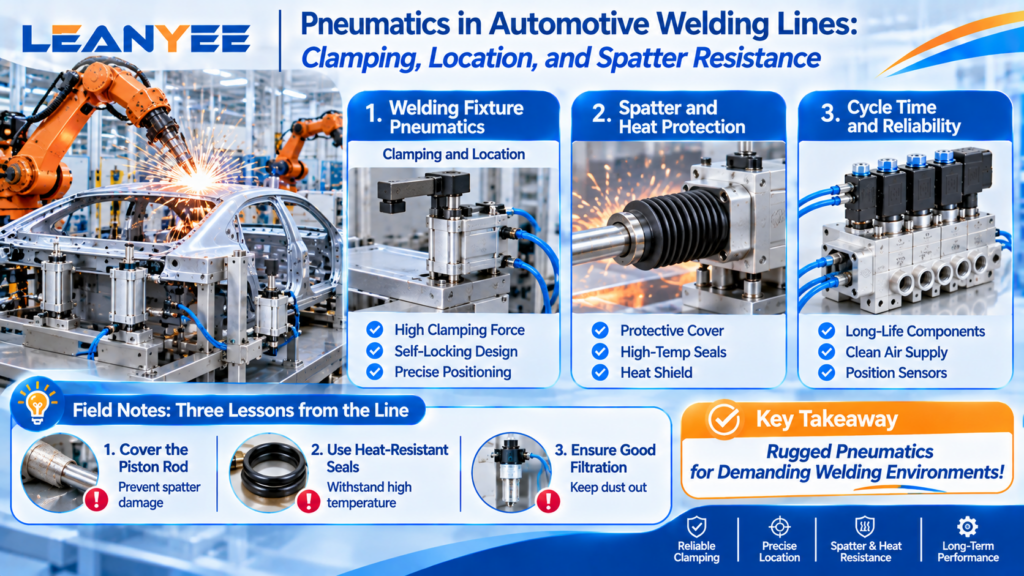 22 Oct, 2026Pneumatics in Automotive Welding LinesPneumatics in Automotive Welding Lines: Clamping, Location, and Spatter ResistanceRead Article
-
Leanyee
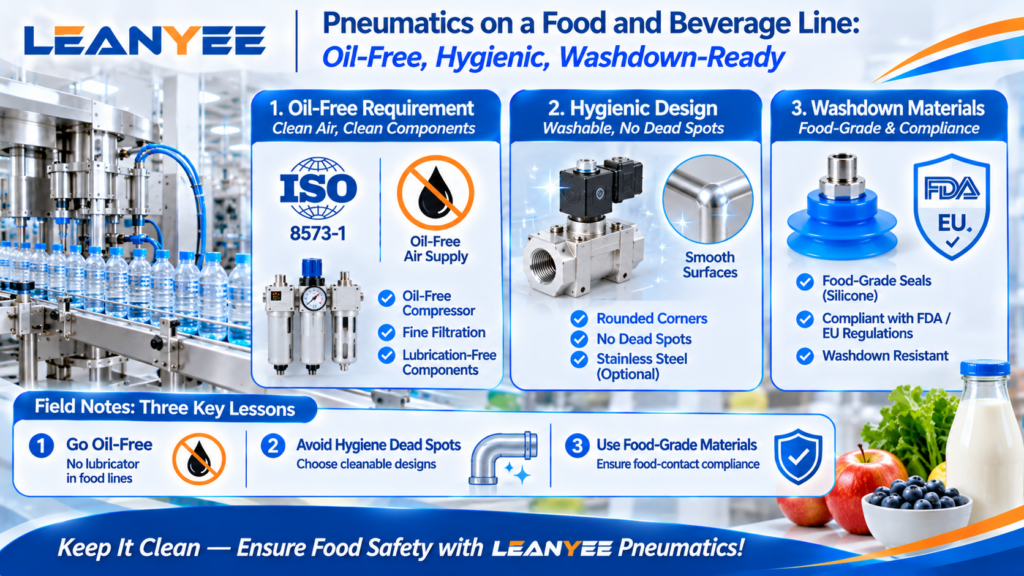 15 Oct, 2026Pneumatics for Food and Beverage LinesPneumatics on a Food and Beverage Line: Oil-Free, Hygienic, Washdown-ReadyRead Article