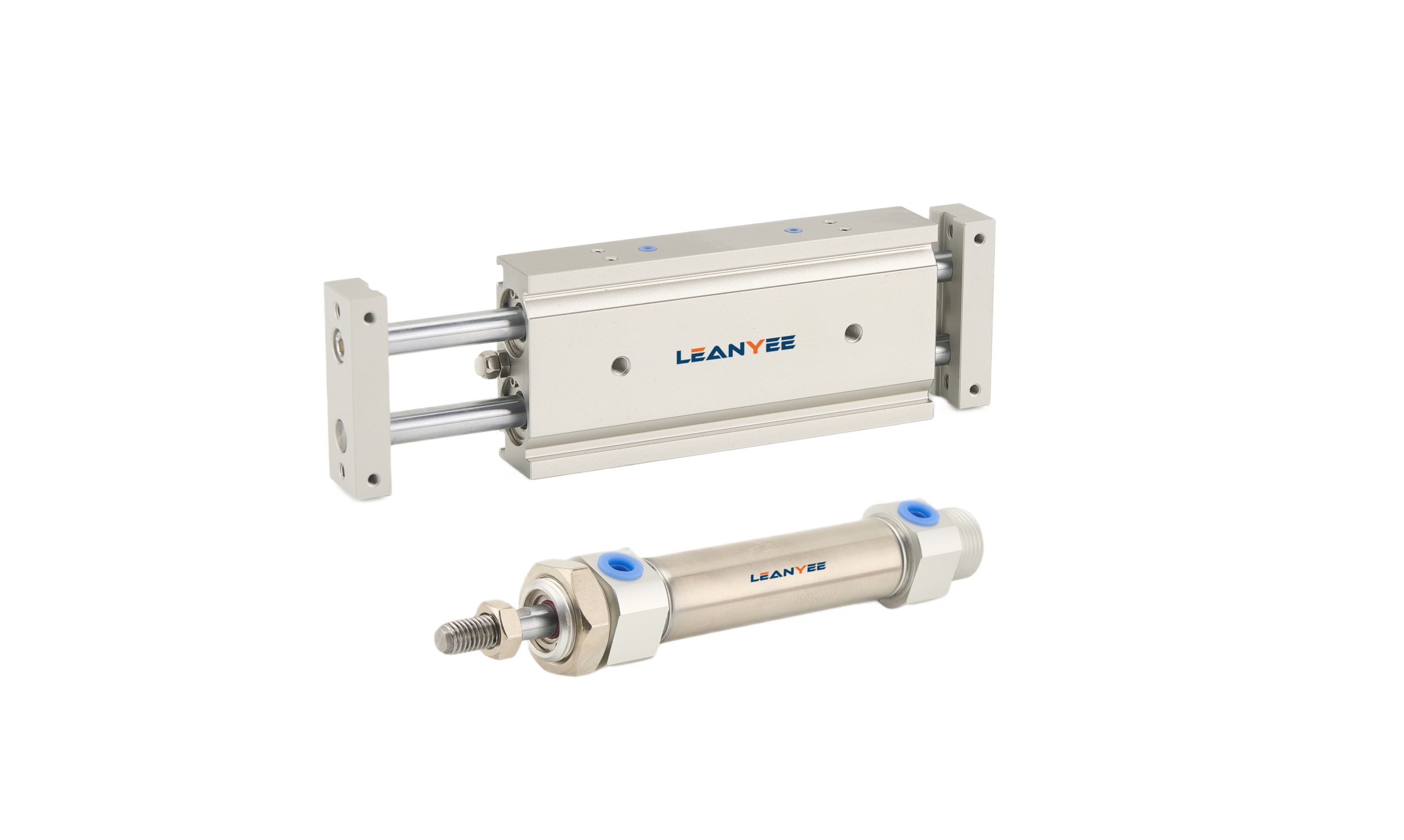
Alignment and Tightening
Leaks and Jerky Motion Right After Installation? Alignment and Tightening Matter
-
17 Jul, 2025

-

Leaks and Jerky Motion Right After Installation? Alignment and Tightening Matter
Pneumatic Technology Explained · Pneumatic Cylinder Series
The short answer: when a freshly installed cylinder leaks, jerks, or bends its rod, half the time it is the installation, not the cylinder. Two things decide it: alignment (keeping the load force axial, with no side force) and tightening (torque to spec, not beyond). Install it correctly and the cylinder will hold up.
Why Alignment and Tightening Are Critical
A cylinder takes axial force only — any radial or side force wears the piston rod and seals unevenly. Installation must keep the axes of body, rod, and load in line (alignment, parallelism), and the fixing bolts must be torqued to spec and secured, neither loose nor over-tight.
Piping and fitting orifices must match as well; an undersized supply shows up as slow motion and is easily misread as a cylinder problem. ISO 4414 sets general safety requirements for pneumatic installation and connections, and can be followed as a reference.
Poor Alignment vs. Good Alignment
| Item | Poor alignment | Good alignment |
| Rod loading | Side force, uneven wear | Pure axial |
| Seal life | Short, leaks | Long |
| Motion | Jerky, stick-slip | Smooth |
| Unusual noise | Present | None |
Field Notes: Mistakes We Have Seen
- Using the piston rod as a guide rail. The rod bends and wears on one side — leaks and jerky motion follow.
- Flange bolts not tightened diagonally in stages. The body sits skewed and permanently stressed.
- Ignoring the parallelism of the mounting plate. Even with the cylinder aligned, a skewed plate still loads it off-center.
- Undersized tubing and too many fittings. Starved supply gets blamed on the cylinder. If you are unsure after following this article, ask the manufacturer’s technical team to review the installation and selection remotely — better than treating an installation fault as a product fault.
Frequently Asked Questions (FAQ)
Q1: How do I tell whether the installation has side force? Several signs: the rod visibly shakes or swings to one side when running slowly unloaded; after some running, a one-sided polished wear band appears on the rod; on strip-down, the guide bushing and seals show one-sided wear; motion is jerky with knocking at end of stroke. Any of these points to side force. Fix: re-align, add guides to share the radial force, and check the mounting plate’s parallelism. Catch alignment problems early — otherwise the seals and rod keep wearing unevenly. Routine inspection finds these before they become expensive.
Q2: How tight should the fixing bolts be? Torque to the manufacturer’s recommendation. Without data, follow “even loading, never excessive”: tighten diagonally in stages so one side is not pulled dead first and the body skewed; snug down and stop — do not wrench it tight. Over-tightening crushes the mounting face and stretches the threads; under-tightening lets things work loose. Where spring washers or lock nuts are specified, fit them as required. For critical joints, use a torque wrench to the catalog torque. After mounting, run unloaded, watch for skew or noise, then load-test. When unsure, consult the manufacturer’s torque table — working to spec is the safer route.
Q3: It stick-slips right after installation — is the cylinder broken? Not necessarily; check the installation first. Freshly installed stick-slip (jerky, stop-start motion) commonly comes from side force or misalignment in the mounting; meter-in throttling (which should be meter-out); or insufficient lubrication and dirty air. If a new cylinder is removed and its seals are intact, the cause is almost always installation or piping. Try switching to meter-out throttling, recheck alignment and lubrication, then run unloaded to see whether the stick-slip persists. Do not return or replace the cylinder at the first stick-slip — eliminating installation factors first usually saves the day. Rule out the installation before suspecting the product.
Q4: How do I keep a long-stroke cylinder aligned? On long strokes the extended rod deflects substantially, so alignment and guiding are even more critical. Steps: connect the rod end to the load so the force stays axial, avoiding off-center loading; add external linear guides to support the load, leaving the cylinder to push and pull; use a thicker rod to reduce deflection; and during installation, check the body’s parallelism to the guides with a straightedge or dial indicator. For long-stroke duty, the guides are nearly as important as the cylinder itself — without them the rod bends quickly and the seals wear out fast. Fit the guides as part of the package.
Q5: Should locking washers or thread locker be used on mounting accessories? Depends on the duty. In high-vibration applications, add spring washers, lock nuts, or thread locker to the mounting bolts and accessories to prevent loosening; in ordinary, steady service, correct tightening is enough. Caution: do not overdo the locking — too much thread locker or excessive tightening makes disassembly hard and damages threads. Rod-end connections (clevis, fittings) also work loose under vibration and should be inspected together. Check fastener condition at every inspection, and shorten the interval in vibrating service. In vibration duty, anti-loosening is never optional — it is a matter of machine safety.
Prepared by the LEANYEE pneumatics technical team based on hands-on commissioning experience, for reference by industry peers.
Technical Disclaimer
The fitting selection, thread types, and technical parameters discussed in this article are based on applicable international standards, including ISO 4414 (Pneumatic Fluid Power — General Rules and Safety Requirements), ISO 8573 (compressed air quality), ISO 6358 (flow characteristics), and relevant thread standards such as ISO 7-1, ISO 228-1, and ANSI/ASME B1.20.1, together with publicly available technical information from international manufacturers such as SMC, Festo, and Parker.
This article is intended for general technical reference only. Actual performance may be affected by cylinder bore size, load, operating pressure, temperature, piping layout, and other application-specific factors.
On-site testing and commissioning are recommended where necessary. Always refer to the product documentation and technical parameters confirmed by the manufacturer for the specific product being used.
LEANYEE Technical Team
[Topic] Alignment and tightening in installation | [Intended readers] Assembly and maintenance personnel
More News & Insights
-
Leanyee
 29 Oct, 2026Pneumatics in Electronics CleanroomsPneumatics in Electronics and Semiconductor Cleanrooms: Cleanliness and ESD ProtectionRead Article
-
Leanyee
 22 Oct, 2026Pneumatics in Automotive Welding LinesPneumatics in Automotive Welding Lines: Clamping, Location, and Spatter ResistanceRead Article
-
Leanyee
 15 Oct, 2026Pneumatics for Food and Beverage LinesPneumatics on a Food and Beverage Line: Oil-Free, Hygienic, Washdown-ReadyRead Article