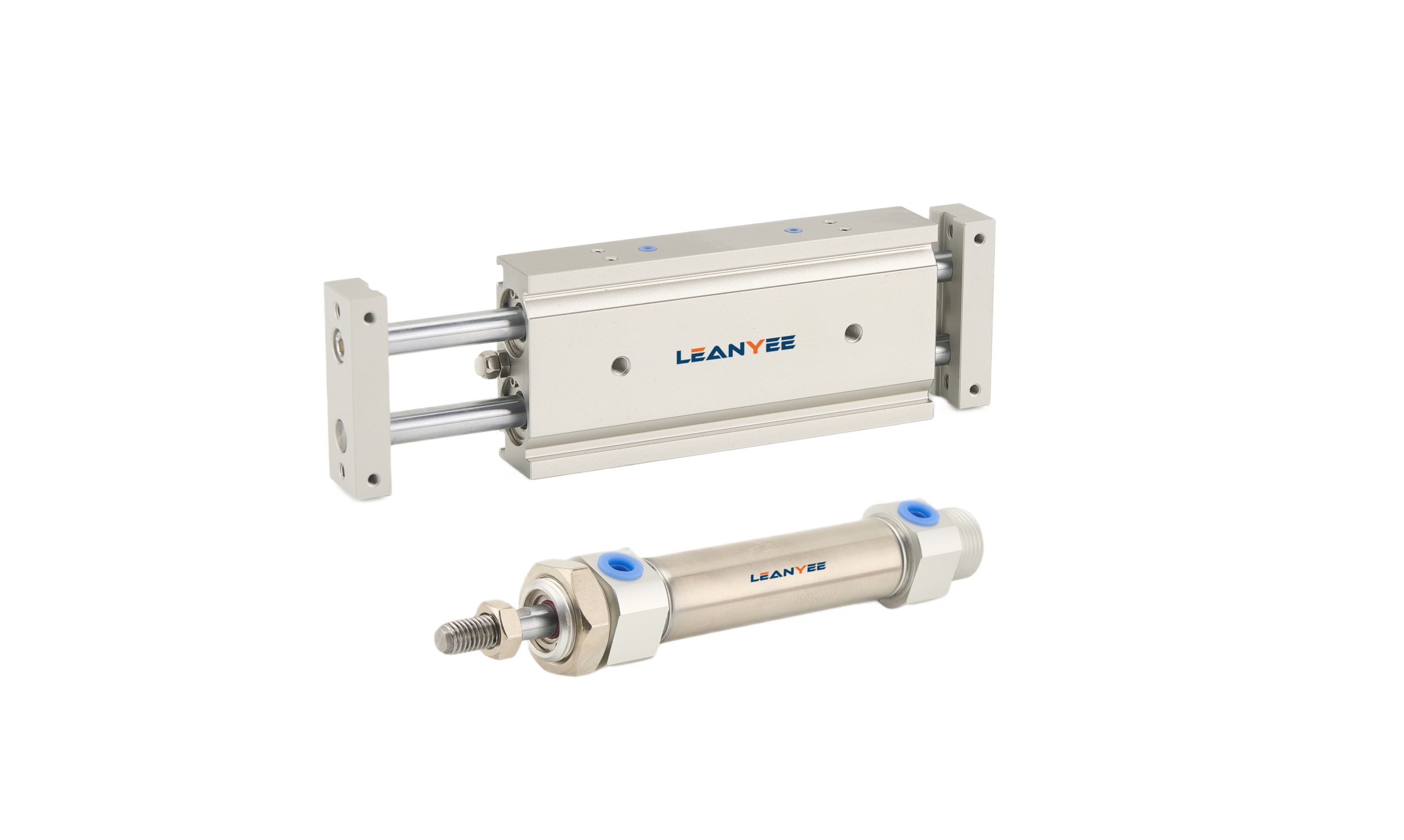
Cylinder Mounting Forms
Wrong Mounting, Shorter Life: How to Choose Flange, Trunnion, and Foot Bracket Mounting
-
03 Jul, 2025

-

Wrong Mounting, Shorter Life: How to Choose Flange, Trunnion, and Foot Bracket Mounting
Pneumatic Technology Explained · Pneumatic Cylinder Series
The short answer: half of how well a cylinder performs comes down to its mounting. Flange, trunnion, foot bracket, and clevis each carry load differently, and the wrong choice puts side loads on the piston rod, wearing out seals and the rod ahead of time. Choosing a mounting form is really choosing “how to keep the load force traveling along the rod axis.”
How the Four Mounting Forms Carry Load
Foot bracket (front/rear): fixes the cylinder body so the rod does pure axial push-pull — the cleanest load path. Flange (front/rear): suits rigid alignment between the cylinder body and the load. Trunnion (center or head): lets the body pivot about the trunnion pin, accommodating changes in load angle. Clevis (rod end): pairs with a pivot pin to let the rod end swing.
The key: a cylinder is designed to take axial force only. Any radial or side force causes uneven wear on rod and seals. ISO 15552 defines standard mounting accessories and interchange dimensions, making like-for-like replacement easy.
Telling the Four Mounting Forms Apart
| Item | Foot bracket | Flange | Trunnion | Clevis |
| Load characteristic | Axial push-pull | Rigid alignment | Body can pivot | Rod end can swing |
| Side force | Small | Small (when aligned) | Guiding still needed | Guiding still needed |
| Best suited to | In-line push-pull | Precise alignment | Changing load angles | Articulated rod end |
| Watch out for | Secure fixing | Alignment accuracy | Pivot center | Pivot pin fit |
Field Notes: Mistakes We Have Seen
- Letting the piston rod carry radial loads directly. Without guiding, the rod soon leaks oil and air.
- Flange mounting out of alignment. The body is permanently stressed and wears unevenly.
- Using rigid mounting where the load angle changes. The body or rod takes bending loads and life drops.
- Ignoring rod-end droop on long strokes. An intermediate guide or a thicker rod is needed. Mounting accessories built to ISO 15552 share dimensions with the originals, so tooling usually needs no change when a cylinder is swapped.
Frequently Asked Questions (FAQ)
Q1: Can a piston rod take side loads? No. A piston rod is designed for axial force only; radial or side loads bend the rod and wear the guide bushing and seals unevenly — showing up as leakage, stick-slip, and rod wear, with a drastic loss of life. Where side loads exist, use a guided cylinder type (slide table, guided cylinder) or add external linear guides to take the radial force, leaving the cylinder to do pure axial push-pull. This is the first rule of cylinder installation: the load must travel along the rod axis — otherwise even the best cylinder will not last. Lesson one of selection.
Q2: How do I ensure alignment in flange mounting? The key is to make the cylinder axis coincide with the axis of the load’s motion. Steps: machine the mounting face flat and align the holes; tighten the bolts diagonally in stages to avoid skewing; after mounting, run slowly with no load and watch for rod vibration, uneven wear, or unusual noise; check parallelism with a dial indicator or straightedge where necessary. The classic symptom of poor alignment is jerky motion with a one-sided polished wear band on the rod. When alignment is right, flange mounting delivers excellent rigidity and repeatability. The extra time spent aligning is well worth it.
Q3: When is trunnion mounting the right choice? When the load’s path of motion changes angle relative to the cylinder axis, or the body must pivot about a support. A trunnion lets the cylinder swing about its pivot, following angle changes instead of forcing side loads into the rod. Typical applications: swinging and tilting mechanisms, and setups that must compensate for angular misalignment. Note that the trunnion should sit near the actual pivot center, and side forces in the swing direction still need guides to carry them. Trunnion versus foot bracket or flange comes down to whether the load angle changes.
Q4: What about rod-end droop on long-stroke cylinders? On long strokes the extended rod sags under its own deflection plus the load, causing off-center loading and uneven wear. Countermeasures: use a thicker rod for better bending stiffness; add an intermediate guide or external linear guides to support the rod end and the load; and where possible shorten the stroke or lighten the rod-end load. The longer the stroke and the heavier the load, the more the guiding matters. Consider stroke, load, and mounting attitude together at selection, and ask the manufacturer for a rod deflection and stability check where needed. Do not wait for the rod to bend before fixing it.
Q5: Are mounting accessories interchangeable between brands? Accessories built to the same international standard are generally interchangeable. ISO 15552 defines the mounting dimensions of standard cylinders (foot, flange, and trunnion hole patterns and mounting faces), so accessories for the same standard and bore work across brands; ISO 6432 covers small cylinders. Buying by standard number therefore makes cross-brand accessory replacement practical. Non-standard or manufacturer-proprietary accessories are not necessarily interchangeable — verify hole patterns before substituting. Accessories from mainstream manufacturers that follow the same standard can usually be swapped with the originals’ standard parts.
Prepared by the LEANYEE pneumatics technical team based on hands-on commissioning experience, for reference by industry peers.
Technical Disclaimer
The fitting selection, thread types, and technical parameters discussed in this article are based on applicable international standards, including ISO 4414 (Pneumatic Fluid Power — General Rules and Safety Requirements), ISO 8573 (compressed air quality), ISO 6358 (flow characteristics), and relevant thread standards such as ISO 7-1, ISO 228-1, and ANSI/ASME B1.20.1, together with publicly available technical information from international manufacturers such as SMC, Festo, and Parker.
This article is intended for general technical reference only. Actual performance may be affected by cylinder bore size, load, operating pressure, temperature, piping layout, and other application-specific factors.
On-site testing and commissioning are recommended where necessary. Always refer to the product documentation and technical parameters confirmed by the manufacturer for the specific product being used.
LEANYEE Technical Team
[Topic] Mounting forms and installation | [Intended readers] Design and assembly engineers
More News & Insights
-
Leanyee
 29 Oct, 2026Pneumatics in Electronics CleanroomsPneumatics in Electronics and Semiconductor Cleanrooms: Cleanliness and ESD ProtectionRead Article
-
Leanyee
 22 Oct, 2026Pneumatics in Automotive Welding LinesPneumatics in Automotive Welding Lines: Clamping, Location, and Spatter ResistanceRead Article
-
Leanyee
 15 Oct, 2026Pneumatics for Food and Beverage LinesPneumatics on a Food and Beverage Line: Oil-Free, Hygienic, Washdown-ReadyRead Article