Applications and Trends in the Pneumatic Fittings Industry
From Automotive Manufacturing to Semiconductors Industry-Specific Pneumatic Fitting Requirements and Future Trends
-
20 Mar, 2025

-


From Automotive Manufacturing to Semiconductors Industry-Specific Pneumatic Fitting Requirements and Future Trends
LEANYEE Technical Guide · Pneumatic Systems Series
The Key Takeaway
Although pneumatic fittings may look similar, their requirements can differ significantly across automotive welding, electronics assembly, food packaging, lithium battery manufacturing, and semiconductor production.
Fitting selection should not rely on a one-size-fits-all approach. Instead, it must take into account the specific operating conditions and industry requirements, including pressure, cleanliness, corrosion resistance, temperature, and vibration.
Looking ahead, key development trends include tool-free installation, error-proof connection designs, improved corrosion resistance, and intelligent monitoring capabilities.
Different Industries Have Different Core Requirements
Each industry imposes different constraints on pneumatic fitting selection.
- Automotive welding: Fittings must withstand vibration and impact.
- Electronics and semiconductor manufacturing: Cleanliness and low outgassing are critical.
- Food and pharmaceutical production: Fittings must resist corrosion and allow easy cleaning.
- Lithium battery manufacturing: Copper and zinc contamination must be prevented.
- Outdoor and cold-storage applications: Resistance to ultraviolet (UV) exposure and temperature cycling is important.
Because these requirements differ, the priorities for fitting selection must also differ.
The recommended selection sequence is:
- Identify the industry’s specific operating and compliance requirements.
- Select suitable materials and connection structures.
- Determine the required specifications and dimensions.
Getting this sequence wrong can create serious problems. For example, using components with excessive outgassing in a cleanroom or fittings containing copper in a lithium battery production area may compromise product quality and process safety.
Special Pneumatic Fitting Requirements Across Different Industries
| Comparison Item | Automotive Welding | Electronics / Semiconductors | Food / Pharmaceuticals | Lithium Batteries |
|---|---|---|---|---|
| Core requirement | Vibration and impact resistance | Cleanliness and low outgassing | Corrosion resistance and easy cleaning | Prevention of copper and zinc contamination |
| Recommended materials | High-strength metals | Cleanroom-grade engineering plastics or stainless steel | Stainless steel with food-grade seals | Copper-free and zinc-free materials |
| Typical fitting types | Metal compression fittings or tapered-thread fittings | Cleanroom-compatible push-in fittings | Stainless steel push-in or compression fittings | Specialized copper-free fittings |
| Key considerations | Vibration resistance and anti-loosening performance | Particle generation and material outgassing | Cleaning and disinfection | Material compliance |
Common Pitfalls When Selecting Fittings for Specific Industries
1. Do Not Use Copper-Containing Fittings in Lithium Battery Production Areas Where Copper Is Prohibited
Copper and zinc contamination can be critical concerns in lithium battery manufacturing. Select fittings that meet the production area’s material restrictions, and verify that the entire fitting assembly complies with the required specifications.
2. Use Food-Grade Sealing Rings in Food Applications
Food and pharmaceutical applications may require sealing materials that meet specific hygiene and regulatory requirements. Ordinary rubber seals should not be assumed to be suitable.
Always verify the applicable food-contact or sanitary requirements before selecting a fitting.
3. Select Low-Outgassing Materials for Semiconductor Cleanrooms
Semiconductor cleanrooms are sensitive to particle contamination and material outgassing. Ordinary fittings may introduce unwanted particles or contaminants.
Choose products designed for the relevant cleanroom environment and verify that their cleanliness and material characteristics meet the facility’s requirements.
4. Consider Temperature and UV Exposure in Outdoor and Cold-Storage Applications
Outdoor installations and cold-storage environments may expose fittings to UV radiation and temperature cycling. Ordinary plastic components can age or deteriorate under unsuitable conditions.
Select fitting materials according to the actual operating temperature range, UV exposure, and environmental conditions.
What is the most demanding fitting requirement in your industry? Share your experience with us.
Frequently Asked Questions (FAQ)
Q1: Why Are Copper-Containing Fittings Prohibited in Lithium Battery Manufacturing?
Lithium battery production is highly sensitive to metallic contamination. If copper, zinc, or other unwanted metal contaminants enter electrode materials, they may contribute to internal micro-short circuits, increased self-discharge, reduced battery life, or potential safety risks.
For this reason, many lithium battery production environments impose restrictions on copper and zinc. Pneumatic fittings used in these areas must comply with the relevant material requirements.
Consider the following selection principles:
- Choose suitable materials: Use specialized fittings made from copper-free and zinc-free materials, such as appropriately specified stainless steel or certain engineering plastics.
- Check sealing components: Ensure that seals and other components also comply with the applicable material restrictions.
- Verify the product specification: Look for manufacturer-designated copper-free or copper-and-zinc-free models.
- Request material documentation when necessary: Confirm compliance through the manufacturer’s material declarations or certificates.
Do not substitute an ordinary nickel-plated brass fitting when the application requires copper-free and zinc-free components. The entire assembly must meet the production area’s contamination-control requirements.
Q2: What Special Requirements Do Pneumatic Fittings Need to Meet in the Food Industry?
Food, beverage, and pharmaceutical applications generally place emphasis on three main requirements.
1. Corrosion resistance and cleanability
Fittings should resist corrosion and withstand the cleaning procedures used in the facility. Stainless steel is commonly considered for applications requiring these properties.
2. Suitable sealing materials
Sealing components may need to meet specific food-contact or sanitary requirements and must not release unacceptable substances into the process environment.
3. Hygienic structural design
Where hygiene is critical, fittings should have smooth surfaces and designs that minimize inaccessible areas where residues or contaminants could accumulate. This makes cleaning and disinfection easier.
Ordinary nickel-plated brass fittings and standard rubber sealing rings should not automatically be considered suitable for food or pharmaceutical applications.
During selection, verify the relevant food-grade or sanitary certifications and confirm compatibility with the cleaning agents and high-temperature disinfection procedures used in the facility.
The manufacturer’s hygienic product range and applicable certifications should be the basis for final selection.
Q3: How Should Pneumatic Fittings Be Selected for Semiconductor Cleanrooms?
Semiconductor cleanrooms are particularly sensitive to particle contamination and material outgassing. Fittings must therefore be selected according to the cleanliness requirements of the specific process.
Material selection
Consider cleanroom-grade engineering plastics or electropolished stainless steel, where appropriate. Materials and surface finishes should be selected to minimize particle generation and unwanted contamination.
Sealing components
Use specialized sealing materials with suitable low-outgassing characteristics for the application.
Connection design
Avoid designs that may generate metal particles or other contaminants during installation, disassembly, or maintenance.
Additional requirements
Some applications may require in-line inspection capabilities or error-proof connection designs to prevent incorrect connections.
Choose products specifically identified by the manufacturer for cleanroom or semiconductor applications. Verify that the product’s cleanliness classification meets the facility’s requirements and conduct outgassing or particle-generation validation when necessary.
The final selection should be based on the manufacturer’s technical documentation and the cleanliness requirements of the actual production process.
Q4: How Can Pneumatic Fittings Be Prevented from Loosening in High-Vibration Automotive Applications?
Automotive welding environments can expose pneumatic connections to substantial vibration and impact. Preventing fittings from loosening is therefore an important part of maintaining system reliability.
Consider the following measures.
1. Select a vibration-resistant connection method.
Metal compression fittings or threaded fittings with suitable anti-loosening features may provide better vibration resistance than ordinary push-in fittings in some applications. The correct choice depends on the tubing, pressure, installation conditions, and manufacturer specifications.
2. Use an appropriate thread-sealing method.
For compatible threaded connections, a suitable thread sealant may provide more durable sealing under vibration than PTFE tape in certain applications. Always follow the fitting manufacturer’s recommendations.
3. Secure the tubing with clamps.
Use appropriate tube clamps or supports to reduce movement and minimize vibration-related forces at the connection.
4. Mark and inspect critical connections.
Apply suitable witness marks to critical connections where appropriate, and include them in routine inspection procedures. These marks can help identify movement or loosening during subsequent inspections.
When selecting fittings, review the manufacturer’s vibration-resistance and impact-resistance specifications. After installation, verify performance under representative operating conditions.
Actual performance should be confirmed through testing in the intended application.
Q5: What Are the Future Development Trends for Pneumatic Fittings?
Several important development directions are emerging in pneumatic fitting technology.
1. Tool-free installation
Push-in fittings are continuing to evolve toward faster installation and removal, while maintaining reliable tubing retention and sealing performance. Easier installation can reduce maintenance time and simplify equipment assembly.
2. Error-proof connection designs
Structural features or color coding can help prevent incorrect insertion and connection errors. These designs can reduce human error during assembly, maintenance, and component replacement.
3. Corrosion-resistant and application-specific materials
Specialized materials and fitting designs are increasingly important for industries such as food processing, lithium battery manufacturing, and semiconductor production. Material selection must meet each industry’s specific cleanliness, contamination-control, and environmental requirements.
4. Intelligent monitoring
Future pneumatic systems may increasingly integrate pressure, flow, and leakage sensors into fittings or connected piping systems. These capabilities can support online monitoring, earlier fault detection, and predictive maintenance.
International manufacturers such as SMC, Festo, and Parker already offer related product lines and technologies.
When selecting fittings, consider not only their immediate mechanical and sealing performance but also maintainability and monitoring capabilities. Planning for these factors can help prepare production lines for future digitalization.
Technical Disclaimer
The fitting selection, thread types, and technical parameters discussed in this article are based on applicable international standards, including ISO 4414 (Pneumatic Fluid Power — General Rules and Safety Requirements), ISO 8573 (compressed air quality), ISO 6358 (flow characteristics), and relevant thread standards such as ISO 7-1, ISO 228-1, and ANSI/ASME B1.20.1, together with publicly available technical information from international manufacturers such as SMC, Festo, and Parker.
This article is intended for general technical reference only. Actual performance may be affected by cylinder bore size, load, operating pressure, temperature, piping layout, and other application-specific factors.
On-site testing and commissioning are recommended where necessary. Always refer to the product documentation and technical parameters confirmed by the manufacturer for the specific product being used.
LEANYEE Technical Team
More News & Insights
-
Leanyee
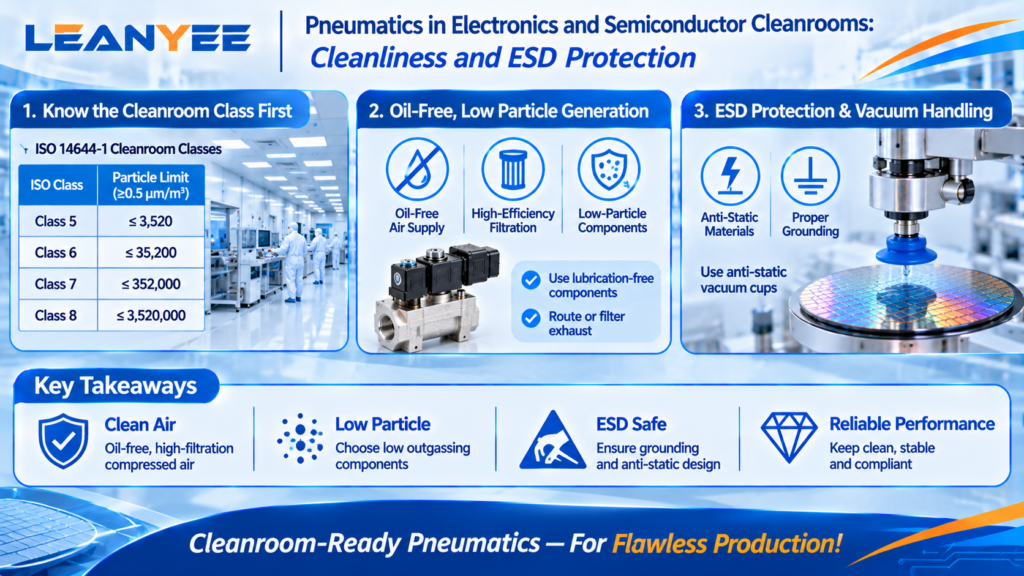 29 Oct, 2026Pneumatics in Electronics CleanroomsPneumatics in Electronics and Semiconductor Cleanrooms: Cleanliness and ESD ProtectionRead Article
-
Leanyee
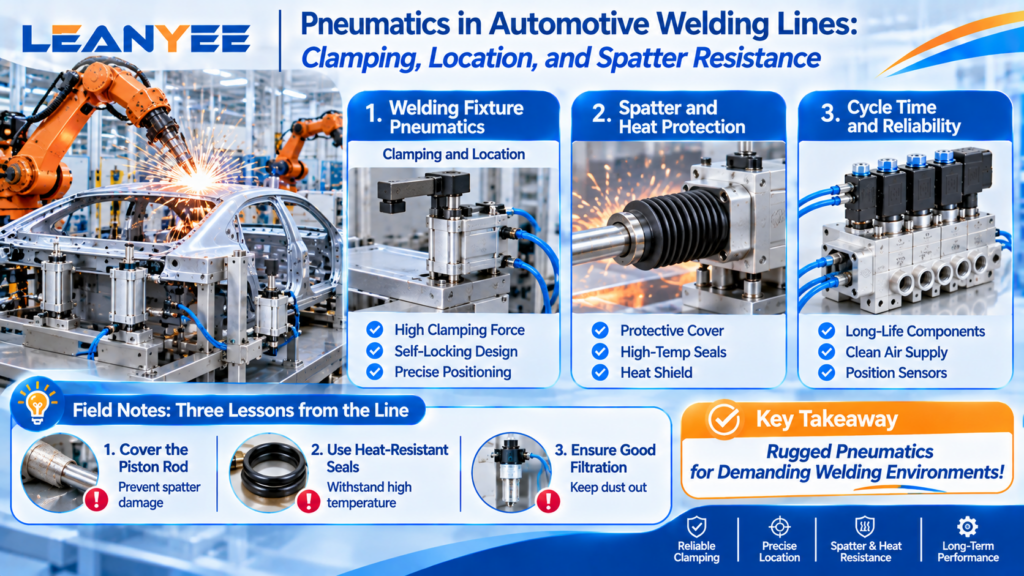 22 Oct, 2026Pneumatics in Automotive Welding LinesPneumatics in Automotive Welding Lines: Clamping, Location, and Spatter ResistanceRead Article
-
Leanyee
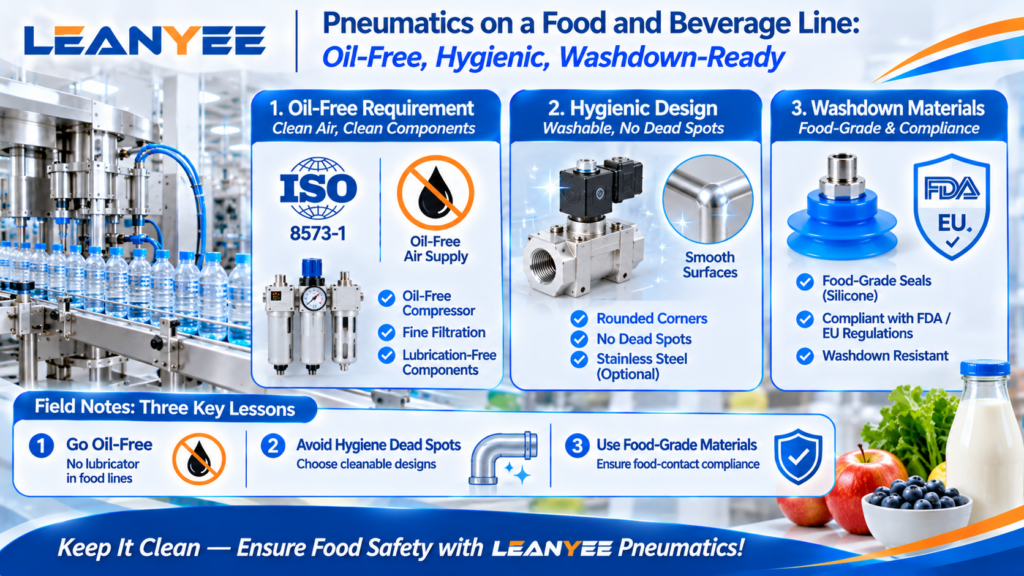 15 Oct, 2026Pneumatics for Food and Beverage LinesPneumatics on a Food and Beverage Line: Oil-Free, Hygienic, Washdown-ReadyRead Article