How a Solenoid Valve Shifts
How Does a Solenoid Valve Shift? Coil, Spool, Spring, and Pilot Operation Explained
-
31 Mar, 2025

-

How Does a Solenoid Valve Shift? Coil, Spool, Spring, and Pilot Operation Explained
Pneumatic Technology Explained · Solenoid Valve Series
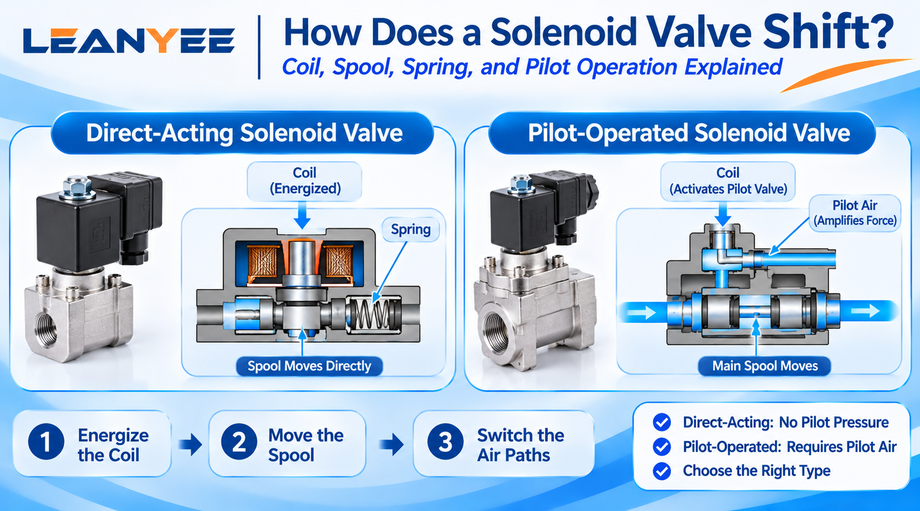
The short answer: a solenoid valve shifts in three steps — the coil is energized and generates a magnetic force → the force pushes the spool (directly, or via pilot air) to change position → the air paths switch over. A direct-acting valve uses electromagnetic force to move the spool directly, while a pilot-operated valve uses pilot air to amplify the force. Understand this, and you can explain why a pilot-operated valve “cannot shift at low pressure.”
The Shifting Process: From Coil to Spool
Direct-acting: when the coil is energized, the moving armature travels under magnetic force and drives the spool (sliding or poppet type) directly to switch the air paths; when power is removed, a spring returns it. The structure is simple and no pilot pressure is needed, but the coil’s actuating force is limited, so this type suits small orifices.
Pilot-operated: the coil first opens a small pilot valve, and the pilot air then pushes the main spool to change position — in effect, “a small force controlling a large force.” This suits large orifices and high flow, and responds quickly; the trade-off is a required minimum pilot pressure, so it will not work at low pressure or zero differential pressure.
Direct-Acting vs. Pilot-Operated
| Item | Direct-Acting | Pilot-Operated |
| Actuating force | Coil electromagnetic force | Pilot air |
| Minimum pressure | None required | Pilot pressure required |
| Suitable orifice size | Small | Medium to large |
| Response speed | Moderate | Fast |
Field Notes: Mistakes We Have Seen
- Installing a pilot-operated valve in a zero-differential application. With no pilot pressure the spool simply does not move, and the valve gets wrongly condemned as faulty.
- Ignoring coil voltage. DC 24 V and AC 220 V coils are not interchangeable — wire them wrong and the coil burns out immediately.
- Mounting a spring-return valve at an arbitrary angle. If gravity acts in the wrong direction, the return action suffers.
- Leaving the coil energized for long periods so it heats up. For high-duty applications, choose a low-power coil or add cooling to prevent the coil from overheating and aging prematurely.
Frequently Asked Questions (FAQ)
Q1: How does the shifting process differ between direct-acting and pilot-operated? Direct-acting is “one push all the way”: the coil is energized, electromagnetic force moves the main spool directly and switches the air paths without any air supply, so it works even at zero differential pressure — but the coil force is limited, so it only suits small orifices. Pilot-operated works as “a small force driving a large force”: the coil first actuates a small pilot valve, and the pilot air then pushes the main spool, amplifying the force. It suits large orifices and high flow and responds faster, but it requires a certain pilot pressure. In one sentence: direct-acting relies on electricity; pilot-operated relies on electricity plus air in relay.
Q2: Why do pilot-operated solenoid valves have a minimum operating pressure? Because the main spool of a pilot-operated valve is driven by pilot air, and that pilot air is taken from the inlet port. If system pressure falls below the minimum pilot pressure stated by the manufacturer, the pilot air cannot generate enough force to move the main spool, and the valve will not shift. This is an inherent characteristic of pilot operation, not a fault. That is why low-pressure or zero-differential applications must use a direct-acting valve instead, or an external pilot air source within the range permitted by the datasheet. Always check the minimum pilot pressure when selecting a valve — it is a parameter that catches many people out.
Q3: How do I choose the coil voltage? Simply match the control system’s power supply. DC 24 V is the most common in industrial applications — safe and fast-responding; AC 110 V / AC 220 V are also available. Points to check: first, the voltage must match the control output (PLC, relay) so no additional converter is needed; second, confirm supply stability, since large voltage fluctuations make the coil pull-in unreliable; third, AC and DC coils are not interchangeable — wiring an AC coil to DC will burn it out because of its low impedance. Confirm coil voltage, power rating, and ingress protection together when selecting, and follow the datasheet.
Q4: Will a solenoid valve always return to its original position after power is cut? Not necessarily — it depends on the reset method. A single-solenoid (spring-return) valve returns to its initial position by spring force when de-energized, so it always resets. A double-solenoid valve has no spring to force it back and stays in its last position when de-energized — it does not reset automatically. Note also the mounting orientation of a direct-acting spring-return valve: spring return is affected by gravity, so if the valve is mounted upside-down or at too steep an angle, the return becomes slow or incomplete. So “resets on power loss” holds only for single-solenoid valves; double-solenoid valves “hold position on power loss.” Keep this distinction clear and you will not select the wrong type.
Q5: Why does the coil heat up, and should I worry? A coil is an inductive load and will always rise in temperature when energized — that is normal. But if the temperature rise is excessive (hot to the touch), be alert: common causes are supply voltage too high, the coil energized continuously for long periods, a jammed pilot valve causing sustained high current, or high ambient temperature with poor heat dissipation. Long-term overheating accelerates insulation aging and eventually burns out the coil. Countermeasures: verify the voltage matches, choose a low-power coil for high-duty applications, improve ventilation and heat dissipation, and shorten continuous energization time where necessary. Abnormal temperature rise is an early warning of failure — investigate it promptly.
Prepared by the LEANYEE pneumatics technical team based on hands-on commissioning experience, for reference by industry peers.
Technical Disclaimer
The fitting selection, thread types, and technical parameters discussed in this article are based on applicable international standards, including ISO 4414 (Pneumatic Fluid Power — General Rules and Safety Requirements), ISO 8573 (compressed air quality), ISO 6358 (flow characteristics), and relevant thread standards such as ISO 7-1, ISO 228-1, and ANSI/ASME B1.20.1, together with publicly available technical information from international manufacturers such as SMC, Festo, and Parker.
This article is intended for general technical reference only. Actual performance may be affected by cylinder bore size, load, operating pressure, temperature, piping layout, and other application-specific factors.
On-site testing and commissioning are recommended where necessary. Always refer to the product documentation and technical parameters confirmed by the manufacturer for the specific product being used.
LEANYEE Technical Team
More News & Insights
-
Leanyee
 29 Oct, 2026Pneumatics in Electronics CleanroomsPneumatics in Electronics and Semiconductor Cleanrooms: Cleanliness and ESD ProtectionRead Article
-
Leanyee
 22 Oct, 2026Pneumatics in Automotive Welding LinesPneumatics in Automotive Welding Lines: Clamping, Location, and Spatter ResistanceRead Article
-
Leanyee
 15 Oct, 2026Pneumatics for Food and Beverage LinesPneumatics on a Food and Beverage Line: Oil-Free, Hygienic, Washdown-ReadyRead Article