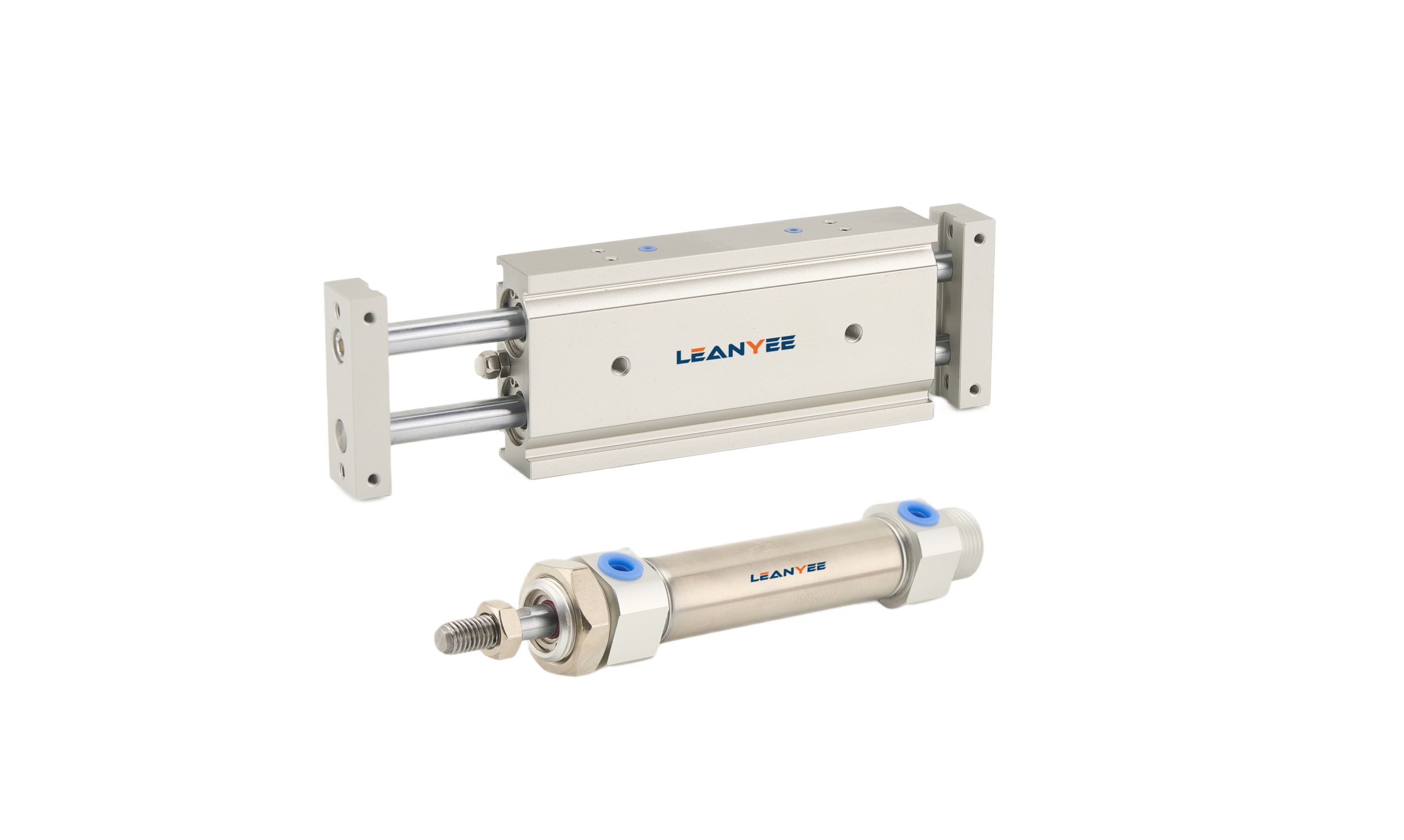
How Is Cylinder Thrust Calculated
How Is Cylinder Thrust Calculated? Understanding Cylinder Construction and Working Principle
-
19 Jun, 2025

-

How Is Cylinder Thrust Calculated? Understanding Cylinder Construction and Working Principle
Pneumatic Technology Explained · Pneumatic Cylinder Series
The short answer: cylinder thrust is not guessed from the size of the cylinder — it is calculated: theoretical thrust = working pressure × effective piston area. And the retract force is always smaller than the extend force, because the piston rod takes up area. Get the force right before selecting, otherwise the cylinder either cannot move the load or wastes air.
Where Thrust Comes From, and How to Calculate It
Extend thrust F = P × A, where A is the full piston area (πD²/4). Retract thrust F = P × (A − rod area), because on retraction the rod side of the cylinder loses the area occupied by the rod. Example: with a 40 mm bore at 0.5 MPa, the theoretical extend thrust is about 628 N; with a 16 mm rod, the retract thrust is about 527 N — noticeably smaller.
For actual selection, subtract friction, allow margin for acceleration, and apply a safety factor of 20–50% on the load. ISO 4414 sets general requirements for pneumatic system selection and safety boundaries, and can be followed as a reference.
Extend Force vs. Retract Force
| Item | Extend thrust | Retract thrust |
| Effective area | Full piston area | Piston area − rod area |
| Relative magnitude | Larger | Smaller (roughly 70–80%) |
| Application note | Use extension to push loads | Size pull loads by retract force |
| Formula | F = P × πD²/4 | F = P × (πD²/4 − πd²/4) |
Field Notes: Mistakes We Have Seen
- Forgetting that retract force is smaller. Selecting a pull load by extend force — it can push but cannot pull.
- No margin for friction and acceleration. The theoretical value is enough but the actual output is short, and the motion feels limp.
- Leaning on ever-higher pressure. More pressure is not better — over-pressure is unsafe and wastes air. Leave a proper margin.
- Upsizing the bore beats forcing the pressure. When thrust falls short, increase the bore first rather than blindly raising system pressure. Proper catalogs publish output tables for every bore at various pressures — looking them up is faster and more accurate than plugging into formulas.
Frequently Asked Questions (FAQ)
Q1: How far is actual thrust from the theoretical value, and how much margin should I leave? Theoretical thrust assumes zero friction. Actual thrust subtracts the friction of the piston and rod seals and must cover acceleration at start-up; the effective output is typically about 70–85% of the theoretical value. In engineering practice, select a theoretical thrust of 1.3–1.5 times the load — a 30–50% margin — and leave more when loads vary widely or starts are frequent. Do not size against the load with the raw theoretical value, or the installed cylinder will fail to move the load or move it slowly. For friction figures and margins, follow the output tables in the manufacturer’s catalog.
Q2: Why is the retract force smaller than the extend force? Because on retraction, the rod occupies part of the effective area on the rod side. Extension uses the full piston face; retraction uses the rod-side area, which equals piston area minus rod area — the thicker the rod, the smaller the retract force. So at the same bore and pressure, retract output is always lower than extend output. When a pull load or retraction is the main working stroke, always verify against retract force — never against extend force. This is the root cause of the “won’t retract” problem many people overlook. Keep it in mind and selection will not stumble here.
Q3: How do I convert bore, pressure, and thrust quickly? Remember F = P × A with consistent units (pressure in Pa and area in m², or MPa × mm² ÷ 1000 = N). For quick estimates, memorize that at 0.5 MPa each 10 mm of bore corresponds to roughly 39 N of extend thrust — or simply consult the manufacturer’s “pressure–bore–output” table. Most catalogs include a quick-reference output table: find the bore and pressure and read the force, faster and less error-prone than hand calculation. In international contexts, watch the pressure units (bar vs. MPa) and never mix them.
Q4: The load is too heavy to move — add pressure or a bigger cylinder? Prefer a bigger cylinder. Thrust scales with the square of the bore but only linearly with pressure: increasing the bore from 40 to 50 mm raises thrust by about 56%, more than raising pressure from 0.5 to 0.8 MPa, and it does not eat into the safety margin. Adding pressure is limited by the system’s rated pressure and air consumption, and over-pressure is dangerous. So when the load will not move, first check bore and margin, then consider a moderate pressure increase — both must stay within the rated ranges of the cylinder and the system, per the manufacturer’s catalog.
Q5: Should I calculate thrust with absolute pressure or gauge pressure? Use gauge pressure (the pressure-gauge reading, also called relative pressure), because one side of the cylinder is normally open to atmosphere and the effective force comes from the difference between supply pressure and atmospheric pressure. In engineering calculation, F = gauge pressure × effective area is enough — no need to add one atmosphere. Keep units consistent (bar with bar, MPa with MPa) and the result is the usable theoretical thrust; then apply the margin factor. This is easily confused with absolute pressure, but gauge pressure is the standard practice for cylinder force calculations.
Prepared by the LEANYEE pneumatics technical team based on hands-on commissioning experience, for reference by industry peers.
Technical Disclaimer
The fitting selection, thread types, and technical parameters discussed in this article are based on applicable international standards, including ISO 4414 (Pneumatic Fluid Power — General Rules and Safety Requirements), ISO 8573 (compressed air quality), ISO 6358 (flow characteristics), and relevant thread standards such as ISO 7-1, ISO 228-1, and ANSI/ASME B1.20.1, together with publicly available technical information from international manufacturers such as SMC, Festo, and Parker.
This article is intended for general technical reference only. Actual performance may be affected by cylinder bore size, load, operating pressure, temperature, piping layout, and other application-specific factors.
On-site testing and commissioning are recommended where necessary. Always refer to the product documentation and technical parameters confirmed by the manufacturer for the specific product being used.
LEANYEE Technical Team
[Topic] Cylinder construction and thrust calculation | [Intended readers] Design newcomers, assembly and maintenance personnel
More News & Insights
-
Leanyee
 29 Oct, 2026Pneumatics in Electronics CleanroomsPneumatics in Electronics and Semiconductor Cleanrooms: Cleanliness and ESD ProtectionRead Article
-
Leanyee
 22 Oct, 2026Pneumatics in Automotive Welding LinesPneumatics in Automotive Welding Lines: Clamping, Location, and Spatter ResistanceRead Article
-
Leanyee
 15 Oct, 2026Pneumatics for Food and Beverage LinesPneumatics on a Food and Beverage Line: Oil-Free, Hygienic, Washdown-ReadyRead Article