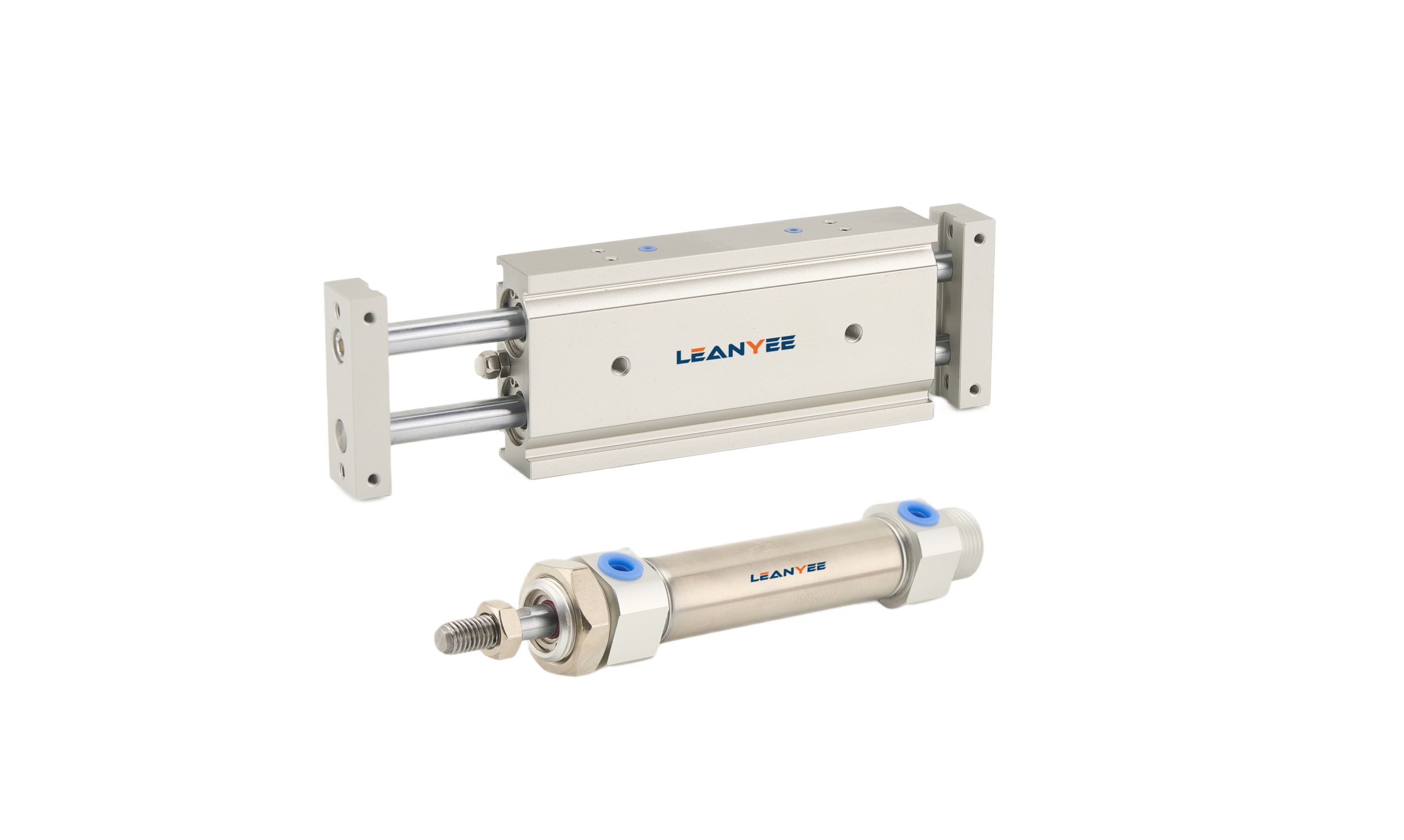
How Many Types of Pneumatic Cylinders Are There
How Many Types of Pneumatic Cylinders Are There? Single-Acting, Double-Acting, Rodless, and Slide Tables Explained at Once
-
12 Jun, 2025

-

How Many Types of Pneumatic Cylinders Are There? Single-Acting, Double-Acting, Rodless, and Slide Tables Explained at Once
Pneumatic Technology Explained · Pneumatic Cylinder Series
The short answer: cylinders all look much alike, but by actuation, construction, mounting, and function they split into dozens of types — and choosing the wrong type causes far more trouble than choosing the wrong parameter. First sort out single-acting vs. double-acting, then standard vs. compact vs. rodless vs. slide table, and the vast majority of selections will stay on track.
Four Ways to Classify Cylinders
By actuation: a single-acting cylinder uses air to push in one direction only and returns by spring or load — it saves air but has no pneumatic force on the return. A double-acting cylinder is pushed and pulled by air on both strokes and is the most versatile.
By construction: standard cylinders (ISO 15552 / ISO 6432), compact cylinders (ISO 21287 — short body, space-saving), rodless cylinders (piston and carriage in one body, half the installation length), slide table cylinders (with guide, resistant to side loads), plus grippers, guided cylinders, and more.
By mounting: flange, trunnion, foot bracket, clevis. By function: with locking, with integrated valve, multi-position, and so on.
Telling the Four Main Types Apart
| Item | Single-acting | Double-acting | Rodless | Slide table |
| Actuation | Air in one direction | Air in both directions | Both directions, carriage rides the piston | Both directions with guide |
| Characteristics | Simple structure, saves air | Force in both directions, most versatile | Half the installation length | Resists side loads, well guided |
| Best suited to | Spring return, short strokes | The vast majority of applications | Long strokes, tight spaces | Side loads present |
| Reference standard | Manufacturer models | ISO 6432 / 15552 | Manufacturer models | Manufacturer models |
Field Notes: Mistakes We Have Seen
- Using a single-acting cylinder as if it were double-acting. With no pneumatic force on the return, even retraction under a heavy load is a struggle.
- Forcing a standard cylinder into a tight space. A rodless or compact cylinder would save a large part of the installation length; squeezing in a standard one leaves hidden problems.
- Letting the piston rod take radial loads instead of choosing a guided slide table. The rod soon wears, leaks, and binds.
- Choosing the mounting form by convenience rather than by load path. Flange, trunnion, and foot bracket each have their place. Check the classification against the catalog line by line and the type rarely goes wrong.
Frequently Asked Questions (FAQ)
Q1: How do I choose between single-acting and double-acting? Look at the motion and the load. For short-stroke duties where force is needed in one direction only (ejecting, returning), a single-acting cylinder saves air and keeps the structure simple. Where force and control are needed in both directions, use double-acting. The key test: if the return must be driven pneumatically, or the return load is heavy, do not use single-acting — its return depends on the spring or the load alone and delivers little force. Most automation lines default to double-acting. When unsure, confirm the direction of the load first, and follow the manufacturer’s catalog.
Q2: Compared with a standard cylinder, what does a rodless cylinder offer — and what does it cost? In a rodless cylinder the piston and carriage are one body, with no rod protruding, so for the same stroke it needs roughly half the installation length — ideal where space is tight and strokes are long. The price: a more complex and expensive structure, higher demands on radial load capacity and protection, and seals and guides that need maintaining. A standard cylinder is simpler, cheaper, reliable, and delivers force directly at the rod end. If space allows and the stroke is not extreme, the standard cylinder is the better value; consider rodless only when space is genuinely tight. Weigh installation space against budget, and confirm figures against the manufacturer’s catalog.
Q3: Can compact and standard cylinders be swapped directly? Mostly not. Compact cylinders follow ISO 21287, while standard cylinders follow ISO 15552 (medium) or ISO 6432 (small) — the mounting hole patterns and overall dimensions differ. A compact cylinder is a short-body design: for the same bore the body is shorter and the envelope smaller, but cushioning and guiding differ accordingly. When replacing, re-verify the mounting holes and stroke — never swap on bore size alone. Identify the standard number at selection; interchangeability is realistically only within the same standard series, confirmed against the manufacturer’s dimension drawings.
Q4: When is a guided slide table cylinder a must? Whenever the load carries side forces, radial forces, or needs accurate positioning. An ordinary piston rod takes axial force only; under radial load it wears unevenly, leaks, and hesitates in motion. Typical cases: gripping, pressing, positioning, and handling with off-center loads. A slide table cylinder has its own guide mechanism, resisting side loads and repeating position well. For pure in-line push-pull with a centered load, an ordinary cylinder is enough — no need to pay for a slide. The selection criterion is simply whether the load is radial.
Q5: What do ISO 6432 / 15552 / 21287 on a cylinder mean? These are the international dimensional interchange standards for cylinders. ISO 6432 covers small round-body cylinders (bores roughly 8–25 mm), ISO 15552 covers medium detachable-mounting cylinders (bores roughly 32–320 mm), and ISO 21287 covers compact cylinders (bores roughly 20–100 mm). Cylinders of the same specification under the same standard share mounting dimensions and interfaces, making replacement straightforward. For cross-border purchasing and like-for-like substitution, these standard numbers are more reliable than any single brand. Major manufacturers label their products to these standards, so parts can be matched and interchanged with the originals.
Prepared by the LEANYEE pneumatics technical team based on hands-on commissioning experience, for reference by industry peers.
Technical Disclaimer
The fitting selection, thread types, and technical parameters discussed in this article are based on applicable international standards, including ISO 4414 (Pneumatic Fluid Power — General Rules and Safety Requirements), ISO 8573 (compressed air quality), ISO 6358 (flow characteristics), and relevant thread standards such as ISO 7-1, ISO 228-1, and ANSI/ASME B1.20.1, together with publicly available technical information from international manufacturers such as SMC, Festo, and Parker.
This article is intended for general technical reference only. Actual performance may be affected by cylinder bore size, load, operating pressure, temperature, piping layout, and other application-specific factors.
On-site testing and commissioning are recommended where necessary. Always refer to the product documentation and technical parameters confirmed by the manufacturer for the specific product being used.
LEANYEE Technical Team
| [Topic] Cylinder types and classification | [Intended readers] Design newcomers, assembly and maintenance personnel |
More News & Insights
-
Leanyee
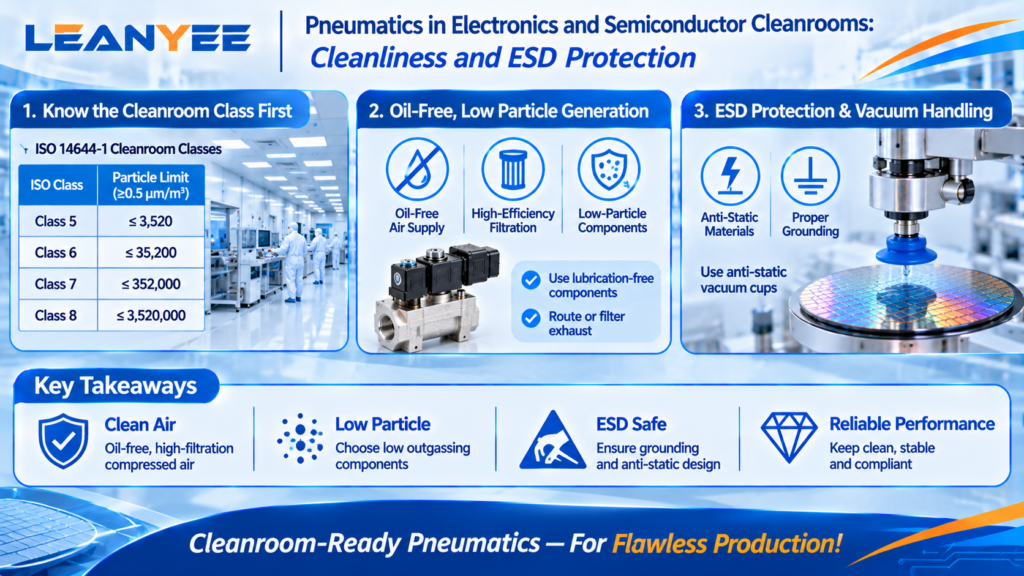 29 Oct, 2026Pneumatics in Electronics CleanroomsPneumatics in Electronics and Semiconductor Cleanrooms: Cleanliness and ESD ProtectionRead Article
-
Leanyee
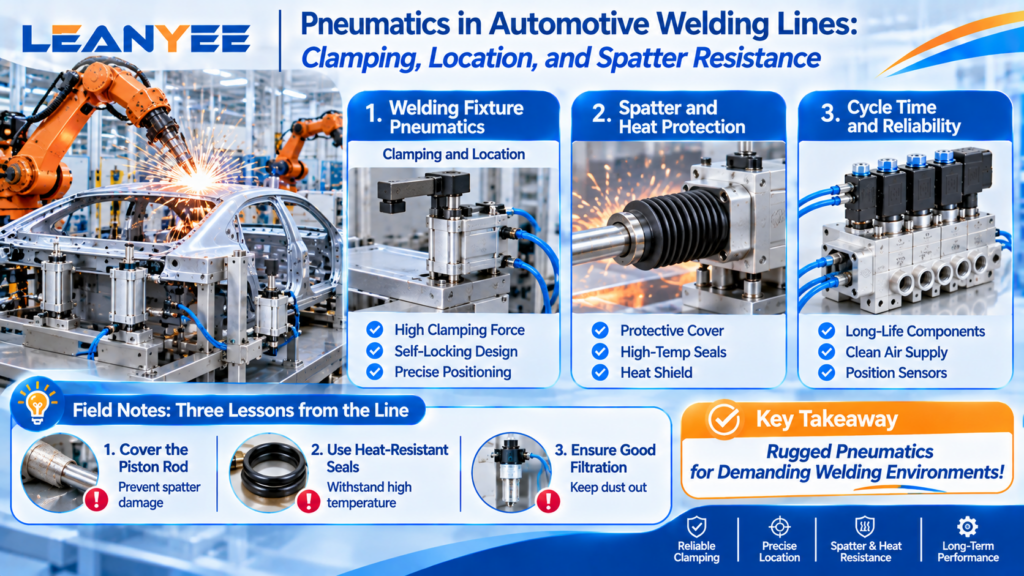 22 Oct, 2026Pneumatics in Automotive Welding LinesPneumatics in Automotive Welding Lines: Clamping, Location, and Spatter ResistanceRead Article
-
Leanyee
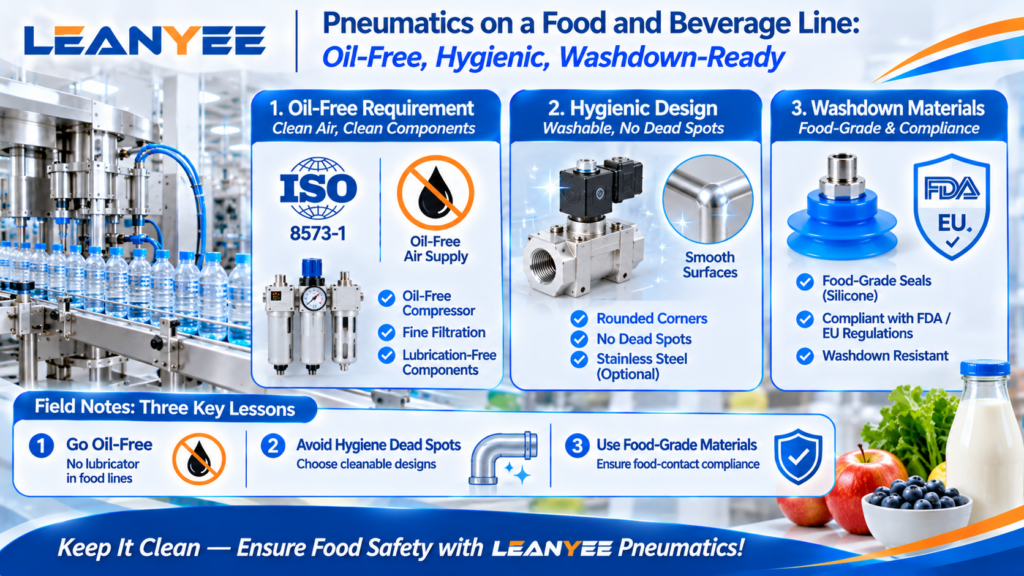 15 Oct, 2026Pneumatics for Food and Beverage LinesPneumatics on a Food and Beverage Line: Oil-Free, Hygienic, Washdown-ReadyRead Article