Solenoid Valve Types Explained
How Many Types of Solenoid Valves Are There? Direct-Acting, Pilot-Operated, and 5/2 Valves Explained at Once
-
24 Mar, 2025

-

How Many Types of Solenoid Valves Are There? Direct-Acting, Pilot-Operated, and 5/2 Valves Explained at Once
Pneumatic Technology Explained · Solenoid Valve Series
The short answer: a solenoid valve may look like just a “small block with a coil,” but by actuation method, ports and positions, valve function, and reset method, it splits into dozens of types — and choosing the wrong type causes far more trouble than choosing the wrong specifications. Get clear on direct-acting vs. pilot-operated first, then on 2/2, 3/2, 5/2, and 5/3, and most valve selections will stay on track.
Four Ways to Classify Solenoid Valves
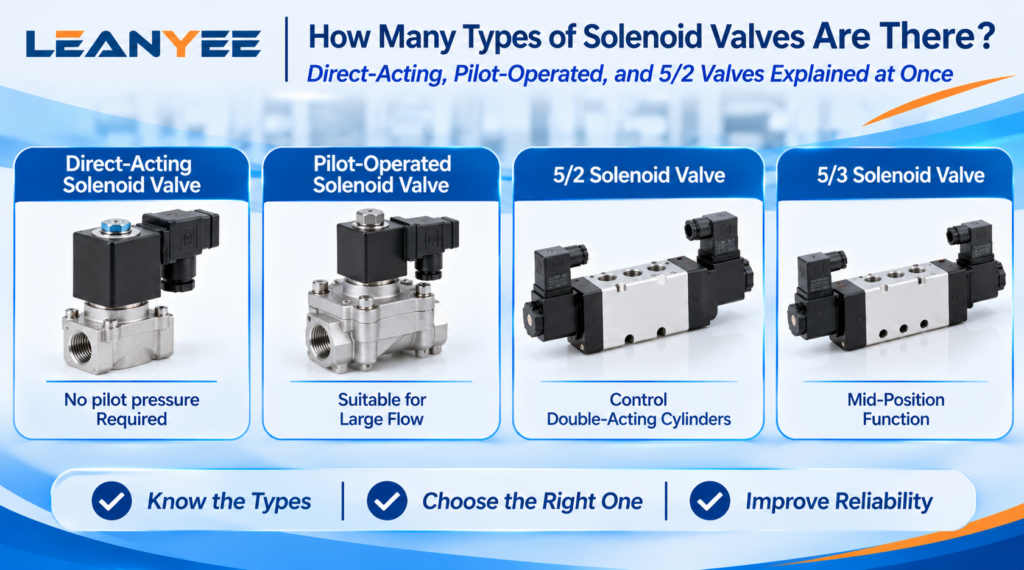
By actuation method: a direct-acting solenoid valve uses the coil’s electromagnetic force to move the spool directly. It needs no pilot pressure, works at zero differential pressure, and suits small orifices. A pilot-operated valve uses pilot air to drive the main spool — fast response, suited to large orifices and high flow — but it requires a minimum pilot pressure.
By ports and positions: 2/2 is two-port, two-position (on/off shut-off); 3/2 is three-port, two-position (controls single-acting cylinders); 5/2 is five-port, two-position (controls double-acting cylinders); 5/3 is five-port, three-position (with a mid-position function). Then sort by function — normally open vs. normally closed — and by reset method: single solenoid (spring return) or double solenoid (pulse-held, position memory).
How Do the Four Main Types Differ?
| Item | Direct-Acting | Pilot-Operated | 5/2 Double Solenoid | 5/3 Three-Position |
| Actuation | Electromagnetic force, direct | Pilot air | Electrical pulse signal | Electrical signal |
| Key feature | Works at zero differential pressure | Large orifice, fast response | Holds position on power loss | Mid-position function |
| Best for | Small orifices / low pressure | High flow | Holding a double-acting cylinder | Mid-stop / pressure holding |
| Reference standard | Manufacturer models | ISO 5599 / 15407 | Manufacturer models | Manufacturer models |
Field Notes: Mistakes We Have Seen
- Don’t mix up direct-acting and pilot-operated. A pilot-operated valve will not shift at low pressure or zero differential — installed under such conditions, it simply goes silent.
- Don’t pick a 3/2 valve to control a double-acting cylinder. A 3/2 only handles single-acting cylinders; a double-acting cylinder needs a 5/2 — without enough ports, you cannot even connect it.
- Don’t choose single solenoid when you need position-holding after power loss. A single-solenoid valve spring-returns automatically when de-energized; only a double-solenoid valve holds its current position.
- Get the port count right. When reading a pneumatic symbol, count the ports first, then the positions — never order by gut feeling.
Frequently Asked Questions (FAQ)
Q1: Direct-acting or pilot-operated — how do I choose? Look at orifice size and minimum operating pressure. Small orifices, low pressure, or zero-differential conditions (vacuum, low-pressure systems) call for direct-acting, because it pushes the spool with electromagnetic force alone and does not rely on pilot pressure. For large orifices and high flow, pilot-operated is preferred: pilot air amplifies the actuating force, giving fast response and high capacity. Rule of thumb: if your system pressure can drop very low or to zero, do not use a pilot-operated valve — it will not shift. Most medium and large-orifice automation applications use pilot-operated valves; always confirm the minimum pilot pressure in the manufacturer’s datasheet.
Q2: What do 2/2, 3/2, and 5/2 each control? Count the ports. A 2/2 valve has only an inlet and an outlet — the “switch” of an air line, used for shut-off or venting. A 3/2 adds an exhaust port and can extend and retract a single-acting cylinder. A 5/2 has one inlet, two working ports, and two exhausts, and moves a double-acting cylinder in both directions. So: 3/2 for single-acting cylinders, 5/2 for double-acting cylinders. Count how many motions you need to control first, then fix the port count — not the other way round.
Q3: Single solenoid vs. double solenoid — what is the difference? It comes down to the de-energized state. A single-solenoid valve has one coil: energize to shift, and a spring returns it automatically when power is cut, so it always goes back to a fixed position — right for applications where the valve must return to a safe position on power loss. A double-solenoid valve has two coils; a pulse to one coil shifts it, and it stays put when power is cut — right for applications where the valve must hold its position. Which one you need depends on where the cylinder should sit during a power failure or emergency stop: safe return → single solenoid; hold in place → double solenoid.
Q4: Normally open or normally closed — how to choose? Judge by the de-energized state, not the energized one. Normally open (NO) means the air path is open when de-energized and closes when energized; normally closed (NC) means it is closed when de-energized and opens when energized. Decide by what the equipment should do when power is lost: if the cylinder must vent and relieve force on power loss, choose the NO version; if the air supply must be cut off to stay safe, choose NC. Define your fail-safe strategy first, then select the valve function — that is the least error-prone way to order.
Q5: What do ISO 5599 / 15407 on a solenoid valve mean? They are international standards for the interchangeable mounting-interface dimensions of five-port directional control valves: ISO 5599-1 defines the mounting surfaces and port positions of larger sizes (e.g., 32 mm) and valve islands, while ISO 15407-1 defines the 18 mm and 26 mm compact-valve interfaces. Valves of the same size built to the same standard share identical mounting faces and port layouts, so different brands can be swapped directly. For cross-border procurement and like-for-like replacement, matching these standard numbers is more reliable than matching a single brand. Products from mainstream manufacturers normally carry these standard markings and can be cross-replaced with OEM parts.
Prepared by the LEANYEE pneumatics technical team based on hands-on commissioning experience, for reference by industry peers.
The parameters and recommendations above are based on current international standards (ISO 5599-1 mounting surfaces for five-port directional control valves, ISO 15407-1 18/26 mm mounting surfaces, ISO 4414 general rules and safety requirements for pneumatic systems, ISO 6358 flow characteristics, ISO 8573 compressed-air quality, ISO 7-1 / ISO 228-1 pipe threads, IEC 60529 ingress protection) and public technical documentation from international manufacturers such as SMC, Festo, Parker, and Norgren. They are for reference only; actual performance depends on flow, pressure, voltage, media, temperature, and other factors. On-site commissioning is recommended, and the product datasheet and manufacturer-confirmed specifications shall prevail.
Technical Disclaimer
The fitting selection, thread types, and technical parameters discussed in this article are based on applicable international standards, including ISO 4414 (Pneumatic Fluid Power — General Rules and Safety Requirements), ISO 8573 (compressed air quality), ISO 6358 (flow characteristics), and relevant thread standards such as ISO 7-1, ISO 228-1, and ANSI/ASME B1.20.1, together with publicly available technical information from international manufacturers such as SMC, Festo, and Parker.
This article is intended for general technical reference only. Actual performance may be affected by cylinder bore size, load, operating pressure, temperature, piping layout, and other application-specific factors.
On-site testing and commissioning are recommended where necessary. Always refer to the product documentation and technical parameters confirmed by the manufacturer for the specific product being used.
LEANYEE Technical Team
More News & Insights
-
Leanyee
 29 Oct, 2026Pneumatics in Electronics CleanroomsPneumatics in Electronics and Semiconductor Cleanrooms: Cleanliness and ESD ProtectionRead Article
-
Leanyee
 22 Oct, 2026Pneumatics in Automotive Welding LinesPneumatics in Automotive Welding Lines: Clamping, Location, and Spatter ResistanceRead Article
-
Leanyee
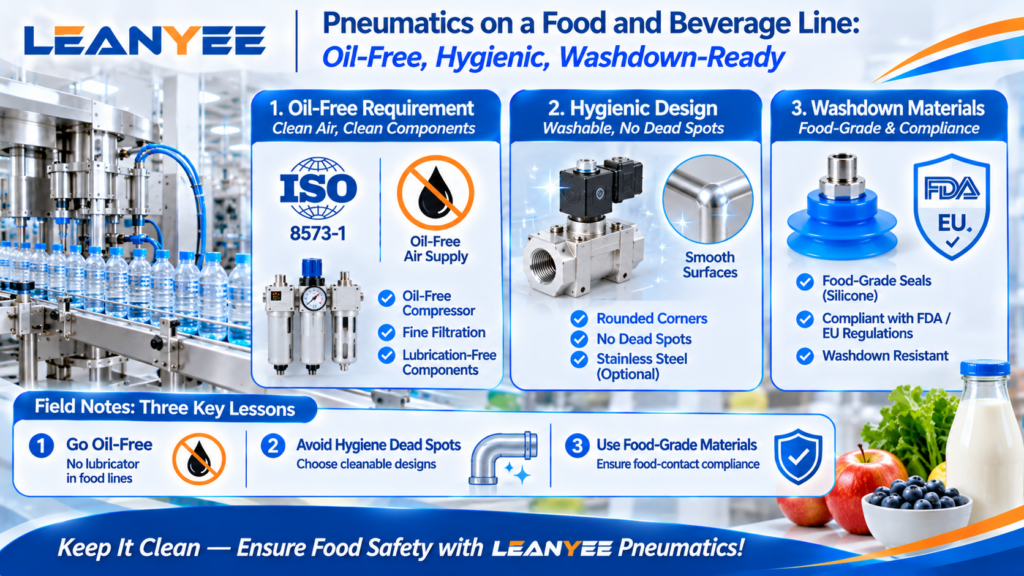 15 Oct, 2026Pneumatics for Food and Beverage LinesPneumatics on a Food and Beverage Line: Oil-Free, Hygienic, Washdown-ReadyRead Article