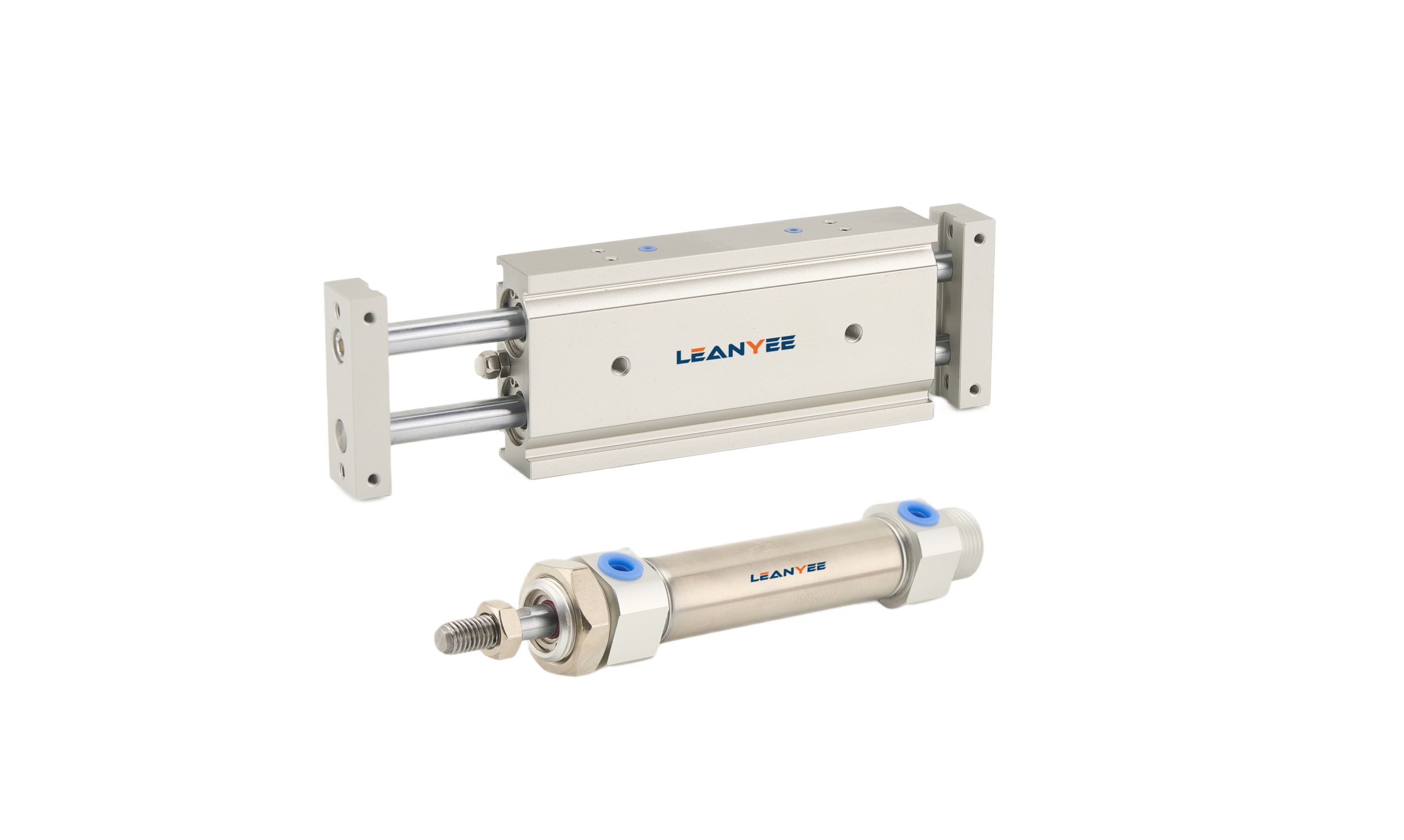
How to Choose a Rodless Cylinder
How to Choose a Rodless Cylinder: Mechanical vs Magnetic Coupling — Which Way to Go
-
11 Dec, 2025

-


How to Choose a Rodless Cylinder: Mechanical vs Magnetic Coupling — Which Way to Go
When the stroke is long and installation space is tight, a rodless cylinder halves the “cylinder length” — it has no protruding piston rod; the piston slides inside the barrel and, through a coupling, drives an external carriage, so stroke equals cylinder length. Sounds great — but choosing between the mechanical-coupling and magnetic-coupling routes directly decides whether it will work in your application.
1. Why Rodless Cylinders “Save Space”
A conventional cylinder, once extended, occupies roughly twice “body + stroke” in total length. In a rodless cylinder the piston slides inside the barrel and the external carriage follows it, so overall length is about the stroke plus the two ends of the body — ideal for long strokes where space on both sides is limited: transfer, sorting, sealing, and the like.
2. Mechanical Coupling vs Magnetic Coupling
| Aspect | Mechanical coupling | Magnetic coupling |
| Coupling method | Mechanical connection (band / integral slot) | Magnetic coupling of inner and outer magnet rings |
| Load capacity | Strong, high rigidity | Limited; excessive load can decouple |
| Sealing | Sealing band; watch for dust | Barrel fully sealed, no external leakage |
| Cleanliness | Ordinary | Good; suits clean environments |
| Watch out for | Dust and chips on the sealing band | Strong magnetic interference and overloads |
For heavy loads and needed rigidity, choose mechanical coupling; for high cleanliness and light loads (e.g. transferring small parts), choose magnetic. A magnetically coupled carriage “decouples and slips” when the load exceeds the magnetic force limit — leave ample load margin at selection and keep clear of strong magnetic fields.
3. Load, Eccentric Load, and Stroke
Rodless cylinders are especially sensitive to eccentric and side loads: the external carriage must run on guides, and the load’s center of gravity should sit as close to the carriage center as possible. For long strokes, also consider barrel deflection and support — with very long strokes add intermediate supports or step up to a larger bore to preserve rigidity.
Field Notes: Three Lessons from the Line
- Estimating the magnetic-coupling load to the limit — at start-up shock or jamming the carriage decouples and “spins in place”. Leave at least 30% load margin at selection.
- Chips entering the mechanical sealing band — the band is cut and leaks. Add a dust boot or choose a dust-protected design, and clean it regularly.
- Buying the cylinder without guides — letting the rodless carriage carry all the eccentric load wears the guides fast and causes sticking. Guides are mandatory, not optional.
Conclusion
Rodless cylinder selection hinges on “route + load”: mechanical coupling for heavy loads and rigidity; magnetic coupling for cleanliness with light loads. Whichever route you take, external guides and load centering cannot be skipped. Check these two points and long-stroke handling will hardly ever be mis-specified.
Suggested Illustrations
- Length-occupied comparison of a conventional cylinder vs a rodless cylinder.
- Cutaway of mechanical-coupling and magnetic-coupling internals.
- Installation sketch of a rodless cylinder with guides and a centered load.
The above content was compiled by the LEANYEE pneumatic technical team from hands-on commissioning experience, for reference by industry peers.
Technical Disclaimer
The fitting selection, thread types, and technical parameters discussed in this article are based on applicable international standards, including ISO 4414 (Pneumatic Fluid Power — General Rules and Safety Requirements), ISO 8573 (compressed air quality), ISO 6358 (flow characteristics), and relevant thread standards such as ISO 7-1, ISO 228-1, and ANSI/ASME B1.20.1, together with publicly available technical information from international manufacturers such as SMC, Festo, and Parker.
This article is intended for general technical reference only. Actual performance may be affected by cylinder bore size, load, operating pressure, temperature, piping layout, and other application-specific factors.
On-site testing and commissioning are recommended where necessary. Always refer to the product documentation and technical parameters confirmed by the manufacturer for the specific product being used.
LEANYEE Technical Team
More News & Insights
-
Leanyee
 29 Oct, 2026Pneumatics in Electronics CleanroomsPneumatics in Electronics and Semiconductor Cleanrooms: Cleanliness and ESD ProtectionRead Article
-
Leanyee
 22 Oct, 2026Pneumatics in Automotive Welding LinesPneumatics in Automotive Welding Lines: Clamping, Location, and Spatter ResistanceRead Article
-
Leanyee
 15 Oct, 2026Pneumatics for Food and Beverage LinesPneumatics on a Food and Beverage Line: Oil-Free, Hygienic, Washdown-ReadyRead Article