How to Choose an Air Dryer
How to Choose an Air Dryer: Refrigerated, Desiccant, and Membrane Types Explained at Once
-
29 Sep, 2025

-

How to Choose an Air Dryer: Refrigerated, Desiccant, and Membrane Types Explained at Once
Pneumatic Technology Explained · Air Supply Series
Let’s get straight to the conclusion: dryer selection comes down to “how low a dew point you need”. A refrigerated dryer only reaches a dew point of about +3 °C (enough for general pneumatics); for drier air you need a desiccant (adsorption) dryer (−20 °C down to −70 °C); membrane dryers suit small flows and local dehumidification. Set the dew-point requirement first, then choose the type — don’t reach for the expensive option blindly.
Each Dryer Type Covers Its Own Range
Refrigerated: refrigeration lowers the temperature so water vapor condenses out; dew point about +3 °C; low cost, suitable for general pneumatics. Desiccant (adsorption): a desiccant adsorbs moisture; dew point can reach −20 °C or even −70 °C; suits clean, low-temperature, and precision applications, at higher energy and maintenance cost. Membrane: hollow-fiber membranes dehumidify by selective permeation; moderate dew point; suits small flows and local drying.
The core of the choice is the dew point: first define the lowest dew point your process requires, then match the dryer type, with margin.
How the Three Dryer Types Compare
| Dryer | Refrigerated | Desiccant (adsorption) | Membrane |
| Dew point | About +3 °C | −20 to −70 °C | Moderate |
| Cost | Low | High | Medium |
| Application | General pneumatics | Clean / low-temp / precision | Small flows, local use |
Field Notes: Mistakes We Have Seen
- Fitting a desiccant dryer for ordinary pneumatics. A refrigerated dryer is enough — money wasted.
- Using a refrigerated dryer where a low dew point is needed. The dew point falls short, and the point of use sweats or ices.
- Neglecting pre-filtration. A filter must sit ahead of the dryer, or the dryer fails prematurely.
- Not replacing saturated desiccant. Desiccant saturates and must be replaced on schedule.
Frequently Asked Questions (FAQ)
Q1: How does dew point map to dryer type?
A simple mapping: dew point around +3 °C (general pneumatics, anti-condensation) → a refrigerated dryer is enough; around −20 °C (precision, low-temperature environments) → desiccant; −40 °C to −70 °C (ultra-dry, special processes) → high-performance desiccant or combined systems. Membrane dryers sit in between, suiting small flows and local dehumidification. So choosing a dryer is essentially “set the dew point first, then pick the type” — not the other way round, where you buy a dryer first and only then discover it cannot reach the required dew point.
Q2: Which dryer suffices for general pneumatics?
For the vast majority of general pneumatic applications, a refrigerated dryer suffices. A dew point of about +3 °C already prevents condensation and rust at normal room temperature, at low cost and low energy use. General pneumatic equipment — cylinders, valves, fittings — does not demand harsher dew points; stepping up to a desiccant dryer is over-configuration: money spent for nothing plus extra maintenance burden. The criterion: if your piping never sees sub-zero temperatures and the components tolerate trace moisture, a refrigerated dryer is enough. Only low-temperature environments or high-precision requirements justify a desiccant dryer.
Q3: Why are desiccant dryers expensive?
Because of their principle and operating cost. A desiccant dryer uses an adsorbent (molecular sieve and the like) to capture water molecules and can push the dew point very low — but the desiccant saturates and needs regeneration: either by purging with a portion of the dried air (costs air) or by heat regeneration (costs electricity), so running energy is high; the desiccant itself is a consumable and must be replaced periodically. Add a more complex structure, and both purchase and operation are costly. That is why it suits applications that “genuinely need a low dew point” — general pneumatics should not pay extra for a dew point it never uses.
Q4: What scenarios suit a membrane dryer?
A membrane dryer dehumidifies by selective permeation through hollow-fiber membranes. It is compact, has no moving parts, is maintenance-free, and suits small flows, with a moderate dew point (typically between −20 °C and +10 °C). It fits local drying, laboratories, small-flow precision equipment, mobile equipment — applications with modest air volume — and is not suitable for large-flow main lines. The criterion: small air volume, local drying, and no desire to install complex refrigerated or desiccant equipment — the membrane dryer is the lightweight choice. Large volumes should return to refrigerated or desiccant types.
Q5: Why must a filter be installed ahead of the dryer?
To protect the dryer and secure its performance. Compressed air carries oil and particles besides water; without pre-filtration, oil fouls the dryer’s heat exchanger or desiccant, and particles clog passages — drying efficiency drops and equipment is damaged. A desiccant dryer’s adsorbent, once contaminated by oil, is ruined outright. So the standard sequence is “filter → dryer → (filter again if required)”. The pre-filter is the dryer’s umbrella; skipping it ruins the dryer quickly — a poor bargain.
Conclusion
Choose a dryer by setting the dew point first, then the type — enough for the need, with margin. General pneumatics is fine with a refrigerated dryer; don’t pay for a low dew point you’ll never use.
Suggested Illustrations
- Dew point to dryer type mapping: one dew-point scale showing the applicable ranges of refrigerated / desiccant / membrane types.
- Refrigerated vs desiccant principle comparison: a simple schematic of refrigeration dehumidification vs adsorption by desiccant.
The above content was compiled by the LEANYEE pneumatic technical team from hands-on commissioning experience, for reference by industry peers.
Technical Disclaimer
The fitting selection, thread types, and technical parameters discussed in this article are based on applicable international standards, including ISO 4414 (Pneumatic Fluid Power — General Rules and Safety Requirements), ISO 8573 (compressed air quality), ISO 6358 (flow characteristics), and relevant thread standards such as ISO 7-1, ISO 228-1, and ANSI/ASME B1.20.1, together with publicly available technical information from international manufacturers such as SMC, Festo, and Parker.
This article is intended for general technical reference only. Actual performance may be affected by cylinder bore size, load, operating pressure, temperature, piping layout, and other application-specific factors.
On-site testing and commissioning are recommended where necessary. Always refer to the product documentation and technical parameters confirmed by the manufacturer for the specific product being used.
LEANYEE Technical Team
Topic: Air dryer selection | Target readers: design and process engineers
More News & Insights
-
Leanyee
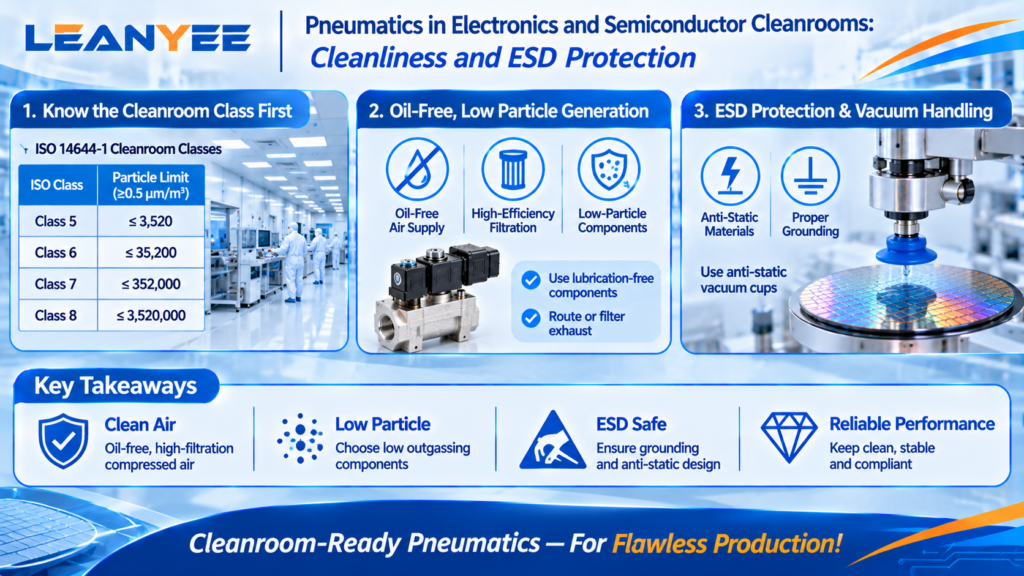 29 Oct, 2026Pneumatics in Electronics CleanroomsPneumatics in Electronics and Semiconductor Cleanrooms: Cleanliness and ESD ProtectionRead Article
-
Leanyee
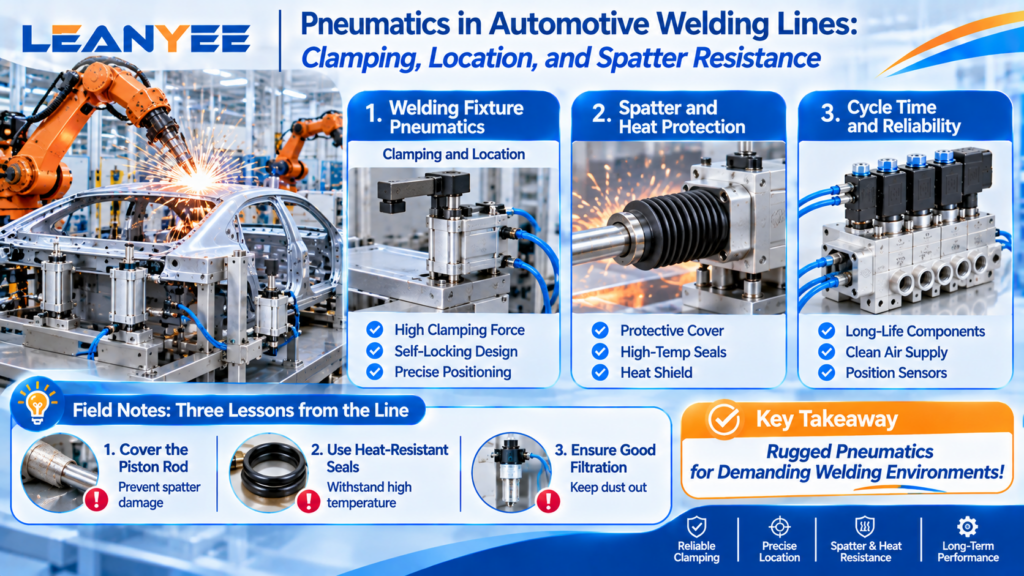 22 Oct, 2026Pneumatics in Automotive Welding LinesPneumatics in Automotive Welding Lines: Clamping, Location, and Spatter ResistanceRead Article
-
Leanyee
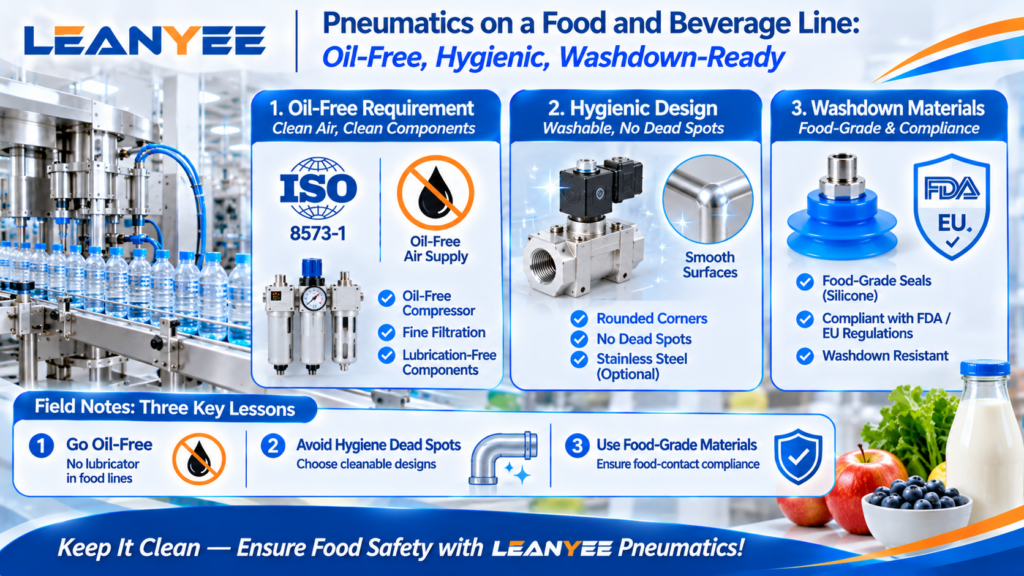 15 Oct, 2026Pneumatics for Food and Beverage LinesPneumatics on a Food and Beverage Line: Oil-Free, Hygienic, Washdown-ReadyRead Article