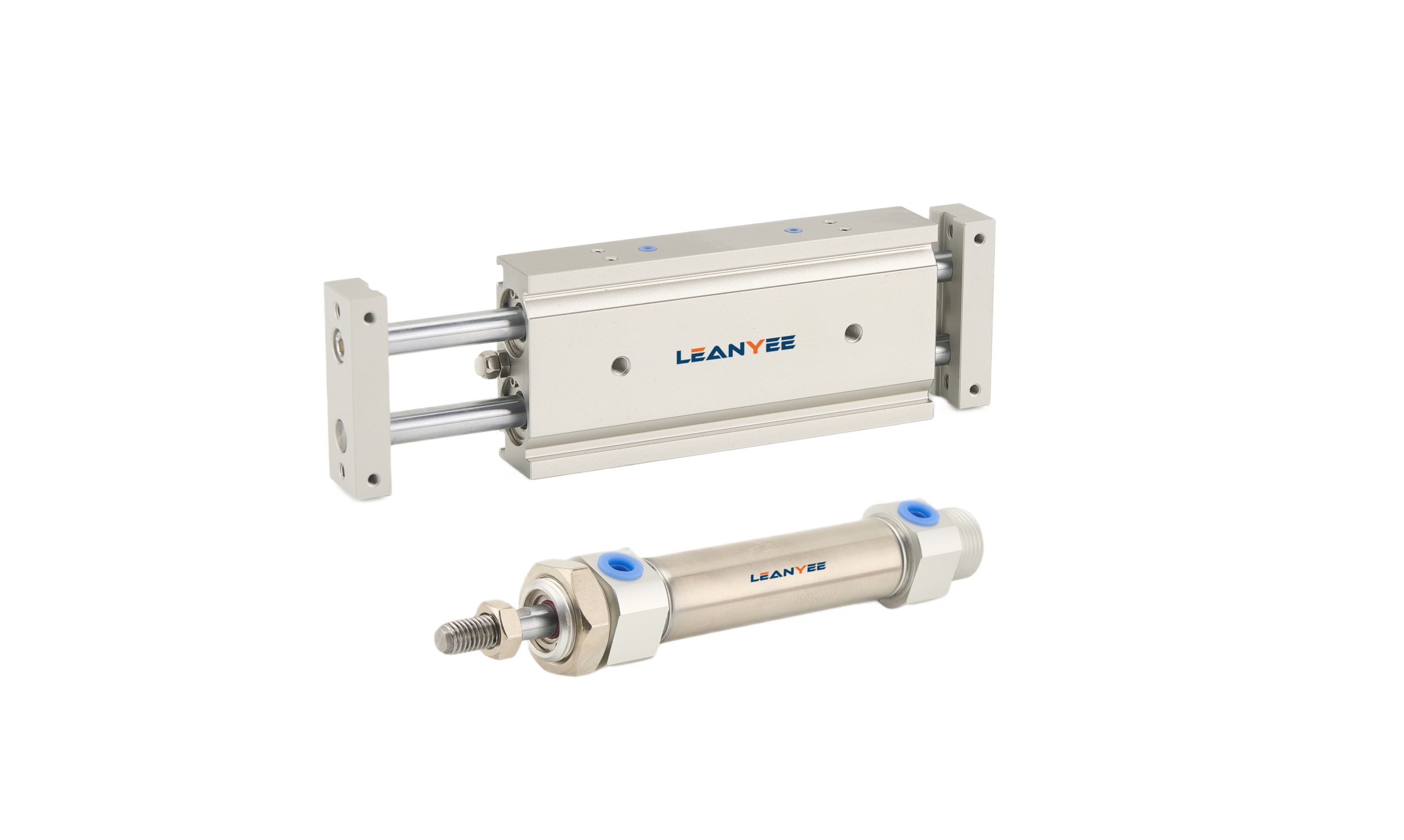
How to Determine Cylinder Bore and Stroke
How to Determine Cylinder Bore and Stroke: Three Steps to the Right Cylinder
-
26 Jun, 2025

-

How to Determine Cylinder Bore and Stroke: Three Steps to the Right Cylinder
Pneumatic Technology Explained · Pneumatic Cylinder Series
The short answer: do not start by asking “how big?” Work through three steps — calculate thrust to fix the bore, set the stroke from the process motion, then verify against load and speed. Once the three steps are done, bore and stroke are essentially settled, and what remains are installation and cushioning details.
The Three-Step Selection Method
Step one — thrust sets the bore: work back from load weight, friction, and acceleration to the required bore (solve F = P × A for D), with a 20–50% margin. Step two — the process sets the stroke: take the travel distance plus margin, generally 10–20 mm, or fine-tune with adjustable external stops. Step three — verify: speed is governed by throttling and piping; for long strokes and heavy loads, re-check piston rod buckling stability (to avoid bending) and cushioning capacity.
With the three steps complete, bore and stroke are fixed. ISO 4414 sets general requirements for cylinder selection and safety margins, and can be followed as a reference.
Bore vs. Stroke — How Each Is Set
| Item | Bore | Stroke |
| What determines it | Load and pressure | Process travel distance |
| If too large | Wastes air, higher cost | Wastes space, rod bends more easily |
| If too small | Cannot move the load | Falls short of position |
| Margin advised | 20–50% on thrust | Add 10–20 mm, or use adjustable stops |
Field Notes: Mistakes We Have Seen
- Sizing the bore by load weight alone. Friction and starting acceleration are forgotten, and the installed cylinder cannot move the load.
- Cutting the stroke too tight. With no margin, the first assembly error slams it into the stop or leaves it short of position.
- Ignoring rod buckling on long strokes with heavy loads. The rod bends — it needs a thicker rod or an intermediate guide.
- Demanding high speed without checking flow and pipe size. The cylinder is right, but the air supply cannot keep up, so it is still slow.
Frequently Asked Questions (FAQ)
Q1: How do I estimate the bore quickly from the load? First compute the required thrust = load × safety factor (typically 1.3–1.5), then solve F = P × A for the piston area and convert to a bore. Quick method: once the working pressure is fixed, look up the manufacturer’s “pressure–bore–output” table and pick the smallest bore whose output exceeds the required thrust. Example: a 100 kg load (about 980 N) at 0.5 MPa calls for a bore with extend thrust of at least about 1,300 N (roughly 63 mm). Calculate extend and retract separately, depending on which direction carries the load. Confirm against the catalog output table.
Q2: How much stroke margin is appropriate? Generally 10–20 mm, or whatever the process’s positioning adjustment needs. Too short risks falling short of position or slamming the stop; too long wastes space, and the longer the exposed rod, the poorer its stability. For accurate positioning, fine-tune with external stops (blocks, positioning screws) instead of forcing it with stroke. Long strokes also demand attention to installation space and rod stability. The principle: sufficient with a little margin — do not stretch the stroke “for safety” and end up with instability and cost. Follow the stroke sizes in the manufacturer’s catalog.
Q3: Does the rod of a long-stroke cylinder bend? How do I avoid it? Yes — this is rod buckling. With long strokes, heavy loads, or off-center loading, the piston rod in compression may buckle. Countermeasures: verify the rod diameter against load and stroke (choose a thicker rod for long strokes); use a guided cylinder type or add external linear guides to share radial forces; and avoid off-center loads so the force stays axial. The longer the stroke, the more the rod diameter and guiding matter. Give the manufacturer the stroke and load together for a stability check — do not select by thrust alone. Long-stroke duty especially deserves this.
Q4: What should I watch when high speed is required? Cylinder speed is governed mainly by flow. Verify three things at selection: the directional valve’s orifice size and Cv must match the cylinder’s air consumption — a small valve restricts flow; piping and fittings must not become the bottleneck — thin tubes, many elbows, and small orifices all throttle; and exhaust throttling must be set properly. High-speed duty also calls for a cushioned cylinder to prevent end-of-stroke impact. However big the cylinder, it cannot be fast if the air supply falls short. Size the valve and piping by flow characteristics (ISO 6358) where necessary, per the catalog.
Q5: Do the two strokes of a double-acting cylinder behave identically? The stroke — the maximum travel — is set by the cylinder body and piston, and is the same in both directions: the total distance the piston can move. But the forces differ (retract force is smaller than extend force) and so do the speeds (different areas and different fill/exhaust conditions). “Same stroke” does not mean “same performance.” Size the stroke by the process’s maximum travel, and verify force separately for extend and retract — do not conflate the two. Keep this in mind both at selection and at commissioning.
Prepared by the LEANYEE pneumatics technical team based on hands-on commissioning experience, for reference by industry peers.
Technical Disclaimer
The fitting selection, thread types, and technical parameters discussed in this article are based on applicable international standards, including ISO 4414 (Pneumatic Fluid Power — General Rules and Safety Requirements), ISO 8573 (compressed air quality), ISO 6358 (flow characteristics), and relevant thread standards such as ISO 7-1, ISO 228-1, and ANSI/ASME B1.20.1, together with publicly available technical information from international manufacturers such as SMC, Festo, and Parker.
This article is intended for general technical reference only. Actual performance may be affected by cylinder bore size, load, operating pressure, temperature, piping layout, and other application-specific factors.
On-site testing and commissioning are recommended where necessary. Always refer to the product documentation and technical parameters confirmed by the manufacturer for the specific product being used.
LEANYEE Technical Team
[Topic] Bore and stroke selection | [Intended readers] Design newcomers, assembly and maintenance personnel
More News & Insights
-
Leanyee
 29 Oct, 2026Pneumatics in Electronics CleanroomsPneumatics in Electronics and Semiconductor Cleanrooms: Cleanliness and ESD ProtectionRead Article
-
Leanyee
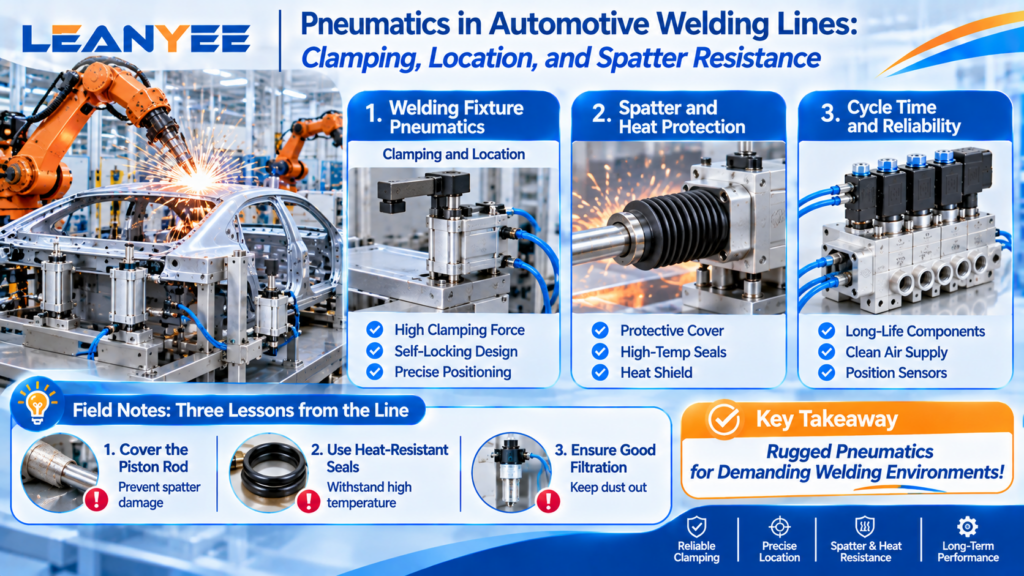 22 Oct, 2026Pneumatics in Automotive Welding LinesPneumatics in Automotive Welding Lines: Clamping, Location, and Spatter ResistanceRead Article
-
Leanyee
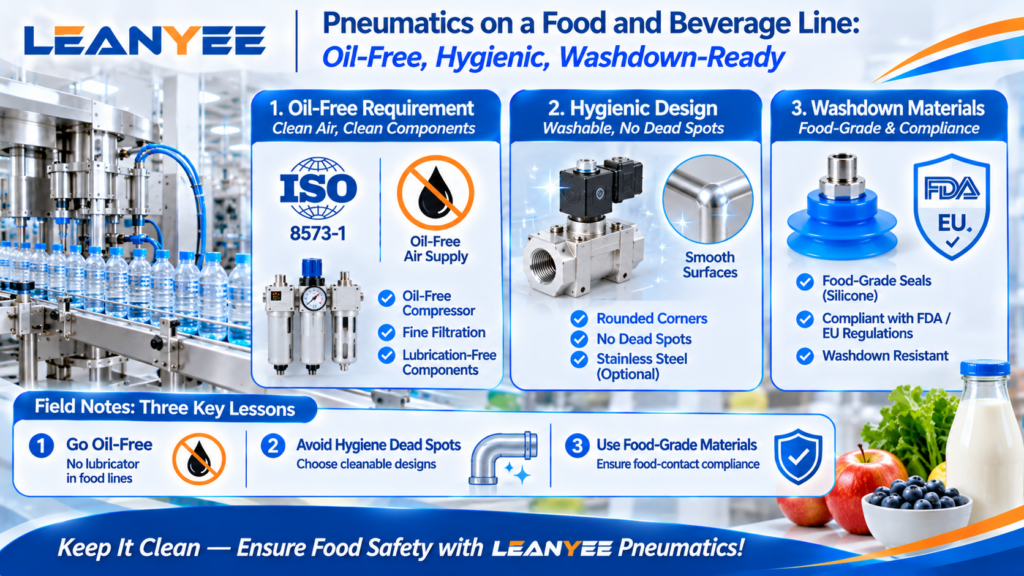 15 Oct, 2026Pneumatics for Food and Beverage LinesPneumatics on a Food and Beverage Line: Oil-Free, Hygienic, Washdown-ReadyRead Article