PT vs G vs NPT Threads: Differences and Applications
Incorrect Thread Types Cause Air Leaks: What Is the Difference Between PT, G, and NPT Threads?
-
24 Feb, 2025

-

Incorrect Thread Types Cause Air Leaks: What Is the Difference Between PT, G, and NPT Threads?
LEANYEE Technical Insights · Pneumatic Systems Series
Introduction: Why Can Incorrect Thread Types Leak Even When Tightened Firmly?
The most common cause of leakage in threaded fittings is using the wrong thread type.
PT, G, and NPT threads may appear compatible because they can sometimes be screwed together. However, they differ significantly in thread angle, taper, and sealing method. Mixing incompatible threads can create a connection that feels tight but still leaks.
Identifying the correct thread type before installation is far more important than simply tightening the fitting harder.
What Are the Differences Between PT, G, and NPT Threads?
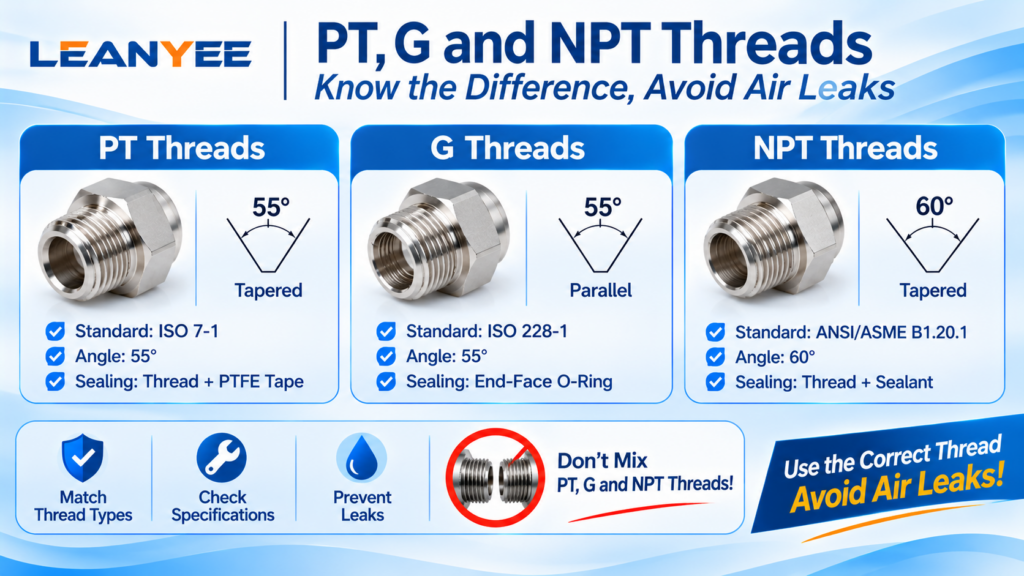
PT threads (associated with ISO 7-1, 55° thread angle, tapered threads) rely on the engagement of tapered thread surfaces. PTFE thread seal tape or thread sealant is used to help create a seal.
G threads (associated with ISO 228-1, 55° thread angle, parallel threads) do not seal through the threads themselves. Sealing is achieved by compressing an O-ring at the end face.
NPT threads (associated with ANSI/ASME B1.20.1, 60° thread angle, tapered threads) rely on tapered thread engagement to create a seal, typically with an appropriate thread sealant.
The key differences are the thread shape—tapered versus parallel—the thread angle—55° versus 60°—and the sealing mechanism.
Tapered threads rely on progressively tighter engagement as the fitting is screwed in, while parallel threads rely on a sealing ring compressed against the end face.
Screwing a PT fitting into a G port, or mixing PT and NPT threads, can result in gradual leakage because the thread profiles do not match correctly.
Comparison of PT, G, and NPT Threads
| Comparison Item | PT (Rc) | G | NPT |
|---|---|---|---|
| Applicable Standard | ISO 7-1 | ISO 228-1 | ANSI/ASME B1.20.1 |
| Thread Angle | 55° | 55° | 60° |
| Thread Type | Tapered thread | Parallel thread | Tapered thread |
| Sealing Method | Tapered thread engagement + PTFE tape or sealant | End-face O-ring | Tapered thread engagement + sealant |
Identifying the Thread Type Is Not Enough — Common Problems in Practice
1. Do not judge compatibility simply because the threads can be screwed together.
Tapered and parallel threads may sometimes engage, but their sealing mechanisms are fundamentally different.
2. Do not wrap PTFE thread seal tape around G threads as a substitute for the proper seal.
G threads rely on an end-face O-ring for sealing. Adding thread seal tape can interfere with proper contact between the sealing surfaces.
3. Do not mix PT and NPT threads.
Their thread angles differ by 5°. Forcing them together can cause poor thread engagement, thread damage, and gradual leakage.
4. Check the thread designation on the technical drawing before purchasing.
Confirm whether the thread is specified as Rc, G, or NPT. Do not place an order based on nominal size alone.
Have you ever experienced a leak caused by mixing PT and G threads? How did you identify the problem? Share your experience in the comments.
Frequently Asked Questions (FAQ)
Q1: How Can You Quickly Tell Whether a Fitting Has PT or G Threads?
The most straightforward method is to examine the thread profile.
PT threads are tapered. Their outside diameter increases from the tip toward the base, creating a tapered profile.
G threads are parallel. Their diameter remains consistent along the threaded section.
You can also check the sealing area near the base of the fitting. G-thread fittings commonly have a groove for an end-face O-ring or sealing washer, whereas PT fittings generally do not use this same end-face sealing arrangement.
For greater accuracy, use a thread gauge to identify the thread profile and angle. PT and G threads have a 55° thread angle, while NPT threads have a 60° thread angle.
If you are unsure, check the thread designation against ISO 7-1 or ISO 228-1, or consult the manufacturer’s product catalog. Do not rely on feel alone or force the fitting into place.
Q2: Are PT and NPT Threads Interchangeable?
No. They cannot be considered reliably interchangeable.
Although both are tapered threads, they differ in thread angle—55° for PT and 60° for NPT—as well as in pitch and taper specifications.
In some cases, the threads may engage for one or two turns, making the connection appear tight. However, the thread surfaces may not engage properly, resulting in gradual leakage. Repeated assembly and disassembly can also damage the threads.
This is particularly important when assembling export equipment or combining imported components from different manufacturers.
If the port size or thread type does not match, use a suitable, properly specified thread adapter rather than forcing the connection.
Verify the thread specifications against ISO 7-1 and ASME B1.20.1, as applicable. Never force incompatible threads together as a workaround.
Q3: Why Does a G-Thread Fitting Need an O-Ring?
G threads are parallel threads, so the threads themselves do not provide a tapered self-sealing mechanism.
Their primary function is to hold the connection together, not to create the seal.
Sealing is achieved by compressing an end-face O-ring or flat sealing washer located near the base of the fitting.
Therefore, when installing a G-thread fitting, always confirm that the O-ring is present and undamaged, and tighten the fitting sufficiently to compress the sealing element against the mating surface.
Wrapping PTFE thread seal tape around G threads is a common mistake. The tape can interfere with the intended sealing arrangement and prevent the end-face O-ring from being compressed properly.
This is fundamentally different from the sealing principle of PT tapered threads, so the two systems should not be confused.
Before installation, check whether the base of the fitting has a groove for a sealing ring. This can help you identify the sealing arrangement quickly.
Q4: What Should You Do If the Wrong Thread Type Has Already Been Installed and the Connection Is Leaking?
First, depressurize the system and remove the fitting. Inspect both the fitting and the port for thread damage caused by the incompatible connection.
If the threads are stripped, deformed, or visibly damaged, the fitting or mating component may no longer be usable. Replacement with a new component of the correct thread type is recommended. Simply adding more PTFE thread seal tape is unlikely to solve the problem.
If the threads were only lightly engaged incorrectly and remain undamaged, clean the connection and reinstall a fitting with the correct thread type.
The key to resolving the problem is to identify the thread designation of both the port and the fitting, then ensure they match before reassembly.
After installation, pressurize the system and use soapy water to check for leakage. The repair should only be considered complete once the connection has been tested and no leakage is detected.
If the threads are damaged, do not continue reusing the components in an attempt to make them work.
Q5: How Do Chinese “Fen” Pipe Thread Sizes Correspond to International Thread Types?
In Chinese industrial terminology, expressions such as “1 fen,” “2 fen,” “3 fen,” and “4 fen” commonly refer to nominal pipe sizes expressed in fractions of an inch.
Typical examples include:
- 1 fen: Approximately 1/8 inch
- 2 fen: Approximately 1/4 inch
- 3 fen: Approximately 3/8 inch
- 4 fen: Approximately 1/2 inch
These expressions indicate nominal size, not thread type.
The same nominal size may be available with PT, G, or NPT threads. Therefore, nominal size alone is not sufficient for correct fitting selection.
When selecting or purchasing fittings, confirm both the nominal port size and the thread designation, such as Rc, G, or NPT.
Then verify the specifications against ISO 7-1, ISO 228-1, or ASME B1.20.1, as applicable.
Always include both the nominal size and thread type in purchase orders and technical documentation to avoid ordering incompatible components.
Technical Disclaimer
The fitting selection recommendations, thread specifications, and technical parameters described above are based on current international standards, including ISO 4414 (Pneumatic fluid power — General rules and safety requirements), ISO 8573 (Compressed air quality), and ISO 6358 (Flow characteristics), as well as thread standards ISO 7-1, ISO 228-1, and ANSI/ASME B1.20.1, together with publicly available technical information from international manufacturers such as SMC, Festo, and Parker.
This information is provided for reference purposes only.
Actual performance may be affected by cylinder bore size, load, operating pressure, temperature, tubing layout, and other factors. On-site testing and commissioning are recommended. Always refer to the product catalog and confirm the technical parameters with the manufacturer before making a final selection.
LEANYEE Technical Team
More News & Insights
-
Leanyee
 29 Oct, 2026Pneumatics in Electronics CleanroomsPneumatics in Electronics and Semiconductor Cleanrooms: Cleanliness and ESD ProtectionRead Article
-
Leanyee
 22 Oct, 2026Pneumatics in Automotive Welding LinesPneumatics in Automotive Welding Lines: Clamping, Location, and Spatter ResistanceRead Article
-
Leanyee
 15 Oct, 2026Pneumatics for Food and Beverage LinesPneumatics on a Food and Beverage Line: Oil-Free, Hygienic, Washdown-ReadyRead Article