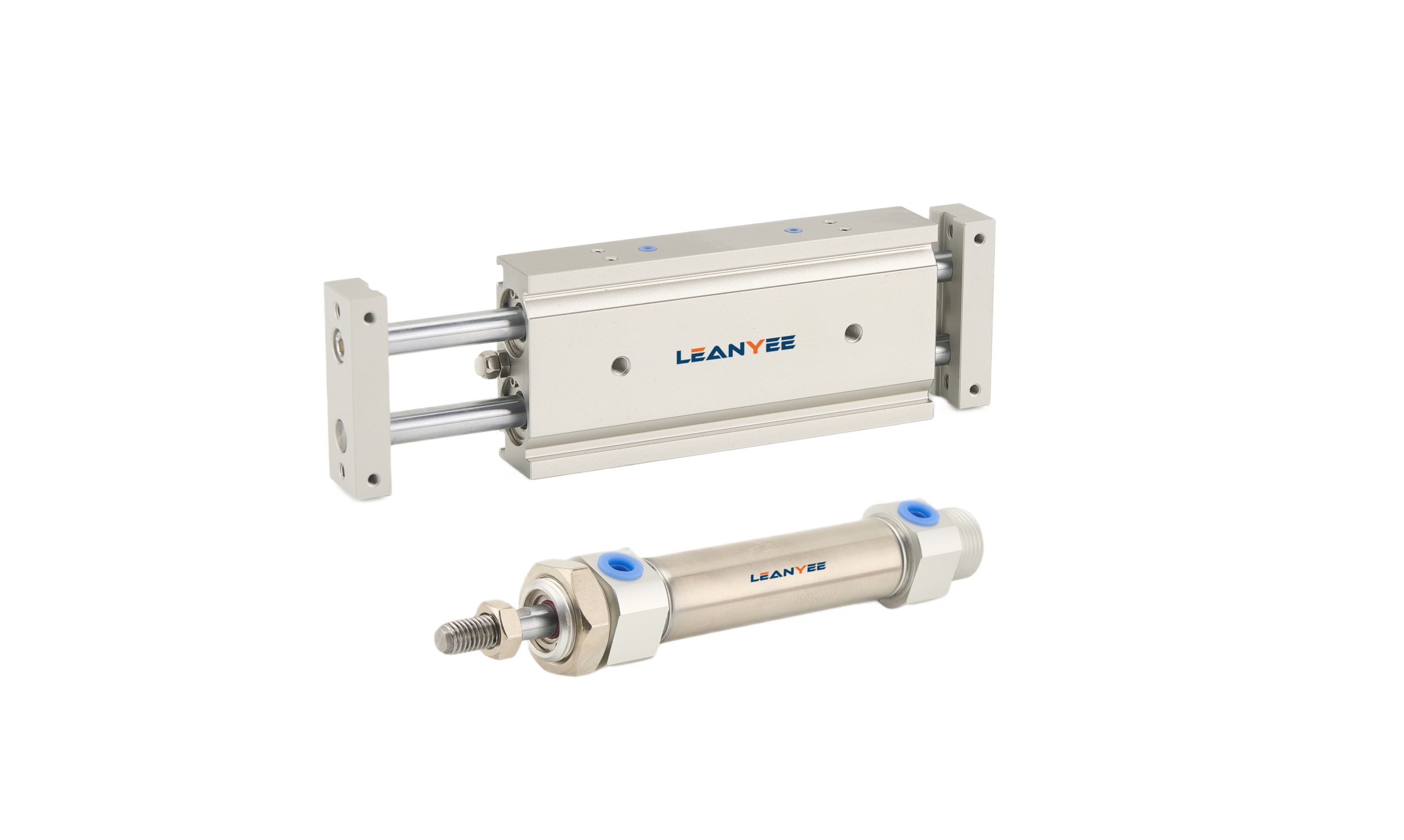
Industry Requirements for Air Supply
From Food to Electronics: What Different Industries Demand from the Air Supply
-
13 Nov, 2025

-

From Food to Electronics: What Different Industries Demand from the Air Supply
Pneumatic Technology Explained · Air Supply Series
Let’s get straight to the conclusion: the same air supply means different things to different plants — a food plant needs oil-free hygiene, an electronics plant needs oil-free dryness, an automotive plant needs large volume and stability, a textile plant needs continuous reliability. Requirements for quality, stability, and cleanliness differ completely by industry, so selection must be tailored to the industry.
What Four Key Industries Differently Demand
Food and beverage: air that touches product must be oil-free and hygienic — usually oil-free compressors plus sterile filtration. Electronics and semiconductor: oil-free and low dew point (dry), with strict particle and oil limits. Automotive: large air volume and stable pressure, valuing continuous supply. Textile and chemical: continuous operation, stability first.
Industry selection is essentially “matching the air quality class and the stability requirement”, with classes set per ISO 8573-1.
Air Supply Requirements Across Four Industries
| Industry | Food & beverage | Electronics / semiconductor | Automotive | Textile / chemical |
| Core requirement | Oil-free hygiene | Oil-free, low dew point | Large volume, stable | Continuous reliability |
| Focus | Oil-free + sterile filtration | Drying + filtration | Storage + stabilization | Stability |
Field Notes: Mistakes We Have Seen
- Applying a general-purpose air supply to a food plant. Oil contaminates product and compliance fails.
- Ignoring dew point in an electronics plant. Air not dry enough — moisture hits the product.
- Under-sizing storage in an automotive plant. Pressure sags at peak demand.
- Ignoring continuity in a textile plant. Air supply drops and the whole line stops.
Frequently Asked Questions (FAQ)
Q1: What are the hard requirements for food-industry air?
The core is “oil-free and hygienic”. Air that directly touches food or packaging must be oil-free to keep lubricating oil off the product, and sterile filtration is needed to keep microorganisms out with the air. The usual configuration is an oil-free compressor + oil-removal and sterile filtration + refrigerated or desiccant drying, reaching a high class per ISO 8573-1 (oil class 1, with particles and water equally strict). Even with downstream oil-removal filtration, an oil-lubricated compressor can hardly satisfy food-hygiene compliance. So a food plant’s air supply should prioritize oil-free at the source, with sterile filtration retained — a compliance floor, not an option.
Q2: How strict is the electronics/semiconductor industry about air?
Very strict — chiefly “oil-free + low dew point + low particles”. Compressed air that carries oil, particles, or moisture contaminates chips and adsorbs water vapor, causing defects. Typical requirements are oil class 1, particle class 1, and a dew point of −40 °C or lower, calling for an oil-free compressor + high-precision filtration + a desiccant dryer, sometimes with multi-stage treatment. Electronics/semiconductor is among the most sensitive industries to air quality anywhere — substandard air shows up directly in yield. So configure to the strictest class; ordinary pneumatic standards do not apply.
Q3: How should an automotive plant configure its air supply?
Automotive manufacturing consumes large volumes with big fluctuations, so it values “large volume + stable pressure”. Welding, stamping, and assembly consume heavily, with frequent starts and stops and wide gaps between peak and trough — so provide ample receiver tank buffering, size compressor delivery correctly, and where necessary run multiple compressors under joint control or with VFD regulation. Pressure stability is critical: the moment pressure sags, welding and clamping become unreliable. Cleanliness demands in automotive are not as extreme as elsewhere — air volume and stability come first. The selection focus is “sufficient + stable”, not chasing the highest cleanliness class.
Q4: How do I determine the air quality class for my industry?
Three steps. First, look at industry regulations and process requirements to identify what is most sensitive — oil, water, or particles (food fears oil; electronics fears water and particles). Second, map “the most sensitive item” to a specific class using the ISO 8573-1 tables, taking the strict value for the other items as needed. Third, have the air-supply supplier or equipment manufacturer review whether the after-treatment configuration can stably achieve that class. The core is “work backwards from the sensitivity point” rather than picking a vague notion of “clean”. Set the class correctly and you avoid both over-configuration waste and under-configuration quality and compliance problems.
Q5: Which industries suit oil-free compressors?
Those sensitive to oil: food and beverage, pharmaceuticals, electronics and semiconductor, precision spray painting, laboratories, and pharmaceutical manufacturing. In these settings even trace oil in compressed air can contaminate product or disturb the process, so an oil-free compressor is required to keep oil out at the source. Conversely, in general machining and ordinary pneumatics where oil is not a concern, an oil-lubricated compressor is cheaper and more durable, and with oil-removal filtration it suffices. So oil-free is not “the more premium the better” — it is a genuine need only in oil-sensitive industries. Choose by industry demand; don’t chase oil-free blindly.
Conclusion
Tailor air supply selection to the industry — first fix the quality class and stability requirement, then match oil-free, drying, and storage configurations. Only then is the result both compliant and economical.
Suggested Illustrations
- Industry requirements matrix: how food / electronics / automotive / textile differ on oil, water, particles, and volume.
- Oil-free vs oil-lubricated applications: which industries must be oil-free and where oil-lubricated + filtration suffices.
The above content was compiled by the LEANYEE pneumatic technical team from hands-on commissioning experience, for reference by industry peers.
Technical Disclaimer
The fitting selection, thread types, and technical parameters discussed in this article are based on applicable international standards, including ISO 4414 (Pneumatic Fluid Power — General Rules and Safety Requirements), ISO 8573 (compressed air quality), ISO 6358 (flow characteristics), and relevant thread standards such as ISO 7-1, ISO 228-1, and ANSI/ASME B1.20.1, together with publicly available technical information from international manufacturers such as SMC, Festo, and Parker.
This article is intended for general technical reference only. Actual performance may be affected by cylinder bore size, load, operating pressure, temperature, piping layout, and other application-specific factors.
On-site testing and commissioning are recommended where necessary. Always refer to the product documentation and technical parameters confirmed by the manufacturer for the specific product being used.
LEANYEE Technical Team
Topic: Industry applications and differentiated selection | Target readers: industry engineers, sales staff
More News & Insights
-
Leanyee
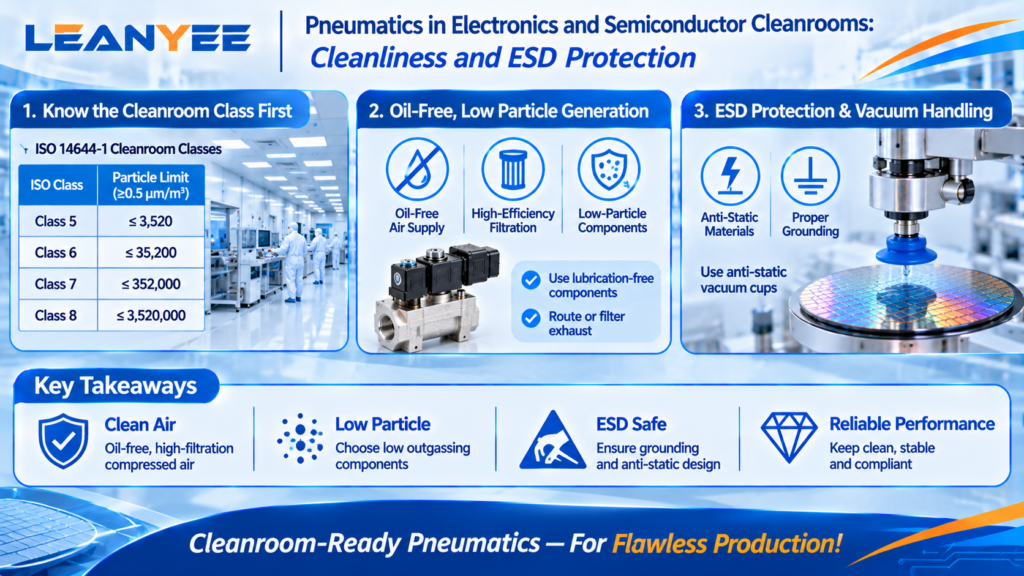 29 Oct, 2026Pneumatics in Electronics CleanroomsPneumatics in Electronics and Semiconductor Cleanrooms: Cleanliness and ESD ProtectionRead Article
-
Leanyee
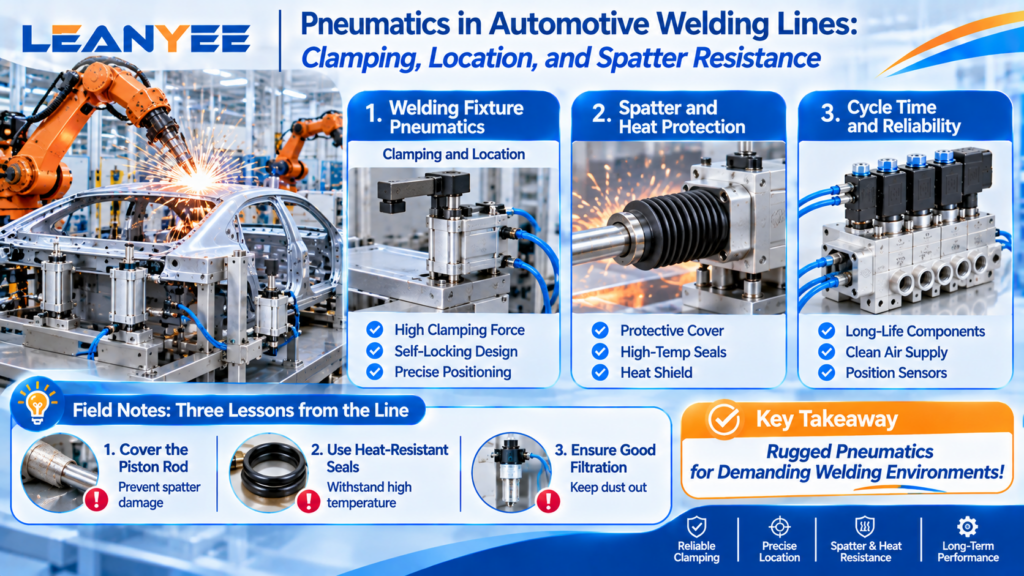 22 Oct, 2026Pneumatics in Automotive Welding LinesPneumatics in Automotive Welding Lines: Clamping, Location, and Spatter ResistanceRead Article
-
Leanyee
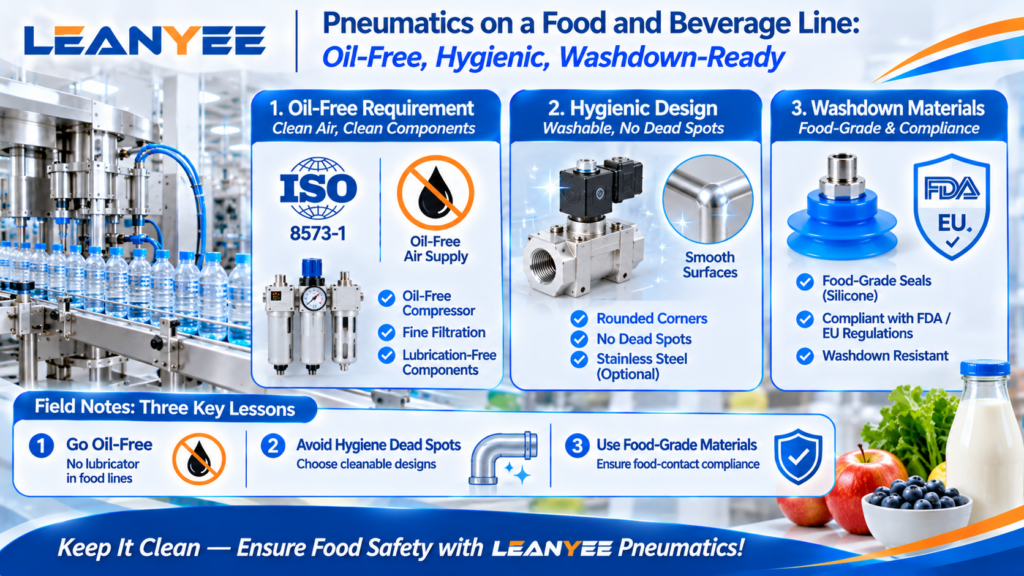 15 Oct, 2026Pneumatics for Food and Beverage LinesPneumatics on a Food and Beverage Line: Oil-Free, Hygienic, Washdown-ReadyRead Article