Installation and Wiring Practice
Solenoid Valve Installation and Wiring: Orientation, Grounding, and Explosion Protection All Matter
-
24 Apr, 2025

-

Solenoid Valve Installation and Wiring: Orientation, Grounding, and Explosion Protection All Matter
Pneumatic Technology Explained · Solenoid Valve Series
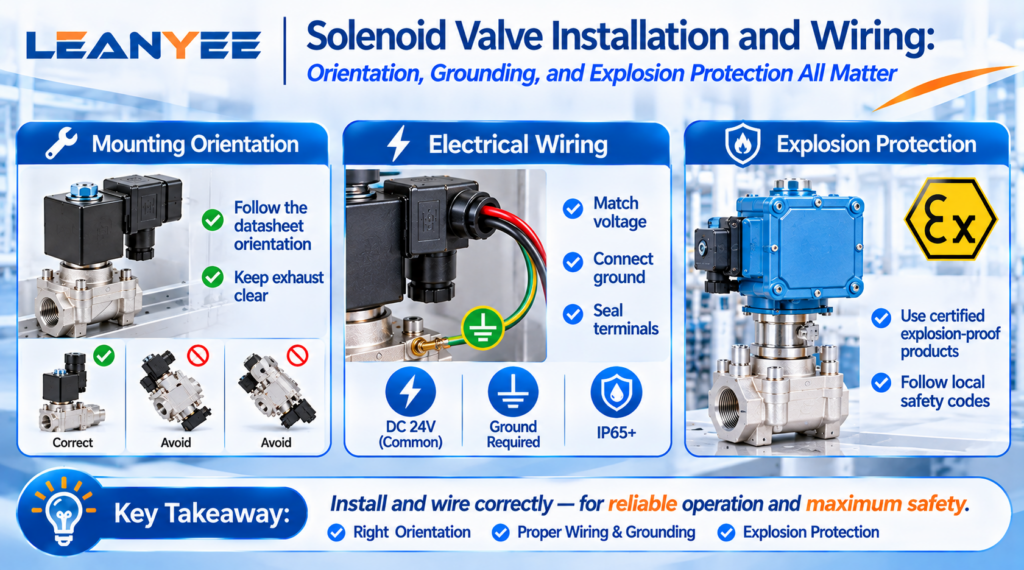
The short answer: a good valve is wasted if it is installed badly. Mount it in the right orientation (so gravity and debris do not affect the spool), wire it with a proper ground and the correct voltage, and in hazardous areas use a certified explosion-proof version wired to code. Install it correctly and the valve will be reliable.
Three Essentials of Installation and Wiring
Mounting orientation: most solenoid valves have a preferred orientation. Spring-return valves are affected by gravity, so mount them in the direction the datasheet specifies. Pilot-operated valves need a clear, water-free exhaust path.
Electrical wiring: confirm that coil voltage matches the supply, ground the valve properly, keep terminals waterproof and dust-tight, and select connectors or cable entries to suit the required ingress protection.
Explosion protection: in hazardous areas, use coils and valves with the appropriate explosion-protection certification, wire them according to the relevant code, and never substitute a coil or simplify the protection at will.
Installation and Wiring at a Glance
| Item | Mounting orientation | Electrical wiring | Explosion protection |
| Key point | Follow the datasheet orientation | Voltage match + grounding | Certification + compliant wiring |
| Common error | Inverted mounting / water trap | Wrong voltage / no ground | Standard valve in a hazardous area |
| Consequence | Poor or sticking return | Burnt coil / electric shock | Safety hazard |
Field Notes: Mistakes We Have Seen
- Mounting a spring-return valve at an arbitrary angle. Gravity interferes with the return and the valve behaves erratically.
- Fitting a pilot-operated valve with the exhaust port facing up, so condensate collects. Water blocks the pilot passage.
- Wiring without a ground and without sealing. Leakage current and water ingress lead to short circuits.
- Using a standard valve in a hazardous area. Where explosion protection is required, only certified products may be used.
Frequently Asked Questions (FAQ)
Q1: Does mounting orientation really matter? Yes, especially for spring-return direct-acting valves. Spring return relies on spring force overcoming gravity to push the spool back; if the valve is mounted upside down or at too steep an angle, gravity either adds to or cancels the spring force, so the return becomes slow, incomplete, or the spool jams. Most datasheets therefore specify the permitted mounting orientation (usually coil up, or a particular attitude). Pilot-operated valves are less sensitive to gravity, but their exhaust port must not face up where water can collect. Check the orientation marking in the datasheet before mounting — do not invert or side-mount a valve just because it is convenient.
Q2: What should I watch on the exhaust port of a pilot-operated valve? The exhaust port (pilot exhaust) must not be blocked, and must not face upward where water can collect. A blocked exhaust prevents the pilot chamber from venting, so shifting becomes sluggish or the valve sticks. Mounted facing up, condensate and oil mist run back down the exhaust and accumulate in the pilot passage, eventually clogging the spool. The correct practice is to point the exhaust downward, or fit a silencer or splash cap so that air escapes freely and no debris enters. Some valves offer internal or external pilot supply, which are piped differently — distinguish them according to the datasheet during installation.
Q3: Does a solenoid valve need grounding, and how is it done? Yes. The coil and metal body are electrical equipment, and proper grounding diverts fault current to earth if insulation fails or leakage occurs, preventing electric shock and equipment damage. Points to check: first, verify that coil voltage matches the supply; second, run the ground conductor to the dedicated ground terminal and never combine it with signal wiring; third, seal the terminals against water and dust, choosing connectors or cable glands that suit the coil’s ingress protection rating (the IP code in IEC 60529); fourth, check the wiring with a multimeter before applying power, then test.
Q4: Where are explosion-proof solenoid valves required? In hazardous areas where flammable gas, dust, or volatile media are present — typically chemical plants, paint and coating lines, spray booths, fuel stations, and dust-handling workshops. In these locations an ordinary coil can produce a spark when it switches, igniting the explosive atmosphere. An explosion-proof valve has a certified coil and enclosure (marked Ex, for example), and together with a certified terminal box and compliant wiring it suppresses sparks and limits surface temperature. Selection must match the certification to the area’s explosion-protection class and the gas or dust group. A standard valve is not an acceptable substitute — this is a mandatory safety requirement.
Q5: How do I read a coil’s IP rating? Ingress protection is defined by IEC 60529 as IP plus two digits: the first digit covers solids (6 means dust-tight), the second covers water (5 means protected against water jets, 7 means protected against temporary immersion). Solenoid coils are commonly IP65 (dust-tight and jet-proof); outdoor or washdown applications may need IP67 or higher. Note that the IP rating applies to the assembly as a whole, so the sealing at the cable entry matters just as much — the connector or cable gland must match, or the assembly will not achieve its rated protection. Choose the IP grade to suit humidity and dust levels in the environment, and confirm against the datasheet.
Prepared by the LEANYEE pneumatics technical team based on hands-on commissioning experience, for reference by industry peers.
Technical Disclaimer
The fitting selection, thread types, and technical parameters discussed in this article are based on applicable international standards, including ISO 4414 (Pneumatic Fluid Power — General Rules and Safety Requirements), ISO 8573 (compressed air quality), ISO 6358 (flow characteristics), and relevant thread standards such as ISO 7-1, ISO 228-1, and ANSI/ASME B1.20.1, together with publicly available technical information from international manufacturers such as SMC, Festo, and Parker.
This article is intended for general technical reference only. Actual performance may be affected by cylinder bore size, load, operating pressure, temperature, piping layout, and other application-specific factors.
On-site testing and commissioning are recommended where necessary. Always refer to the product documentation and technical parameters confirmed by the manufacturer for the specific product being used.
LEANYEE Technical Team
[Topic] Installation and wiring practice | [Intended readers] Assembly and maintenance personnel
More News & Insights
-
Leanyee
 29 Oct, 2026Pneumatics in Electronics CleanroomsPneumatics in Electronics and Semiconductor Cleanrooms: Cleanliness and ESD ProtectionRead Article
-
Leanyee
 22 Oct, 2026Pneumatics in Automotive Welding LinesPneumatics in Automotive Welding Lines: Clamping, Location, and Spatter ResistanceRead Article
-
Leanyee
 15 Oct, 2026Pneumatics for Food and Beverage LinesPneumatics on a Food and Beverage Line: Oil-Free, Hygienic, Washdown-ReadyRead Article