ISO 4414 Pneumatic Safety
ISO 4414 Pneumatic Safety: From Standard Clauses to Shop-Floor Practice
-
03 Sep, 2026

-

ISO 4414 Pneumatic Safety: From Standard Clauses to Shop-Floor Practice
A pneumatic system looks “electricity-free”, yet it hides real risks: stored pressure, runaway motion, crushing at clamping points. ISO 4414 is the international standard for the general rules and safety requirements of pneumatic systems, and it moves pneumatic safety from “experience” to “clauses”. This article is not about dry clause text — it is about what those clauses mean on the shop floor.
1. What ISO 4414 Covers
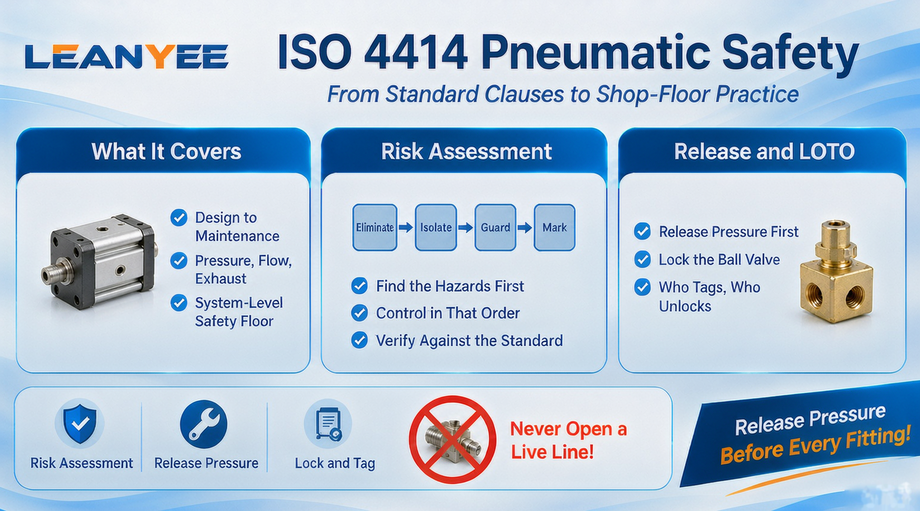
ISO 4414 sets out general rules and safety requirements for the design, installation, use, and maintenance of pneumatic systems, covering pressure, flow, exhaust, guarding, and marking. It does not replace product-specific safety standards; it provides a system-level “safety floor” and is the baseline reference for pneumatic compliance.
2. Start with Risk Assessment: Find the Hazards
Safety design starts with risk assessment: identify which conditions in a pneumatic system can injure people — high-pressure air escaping, release of residual pressure, uncontrolled cylinder motion, crushing at clamping points, whipping hoses, and so on. Grade each risk, then apply controls in the order eliminate, isolate, guard, mark — and finally check against the standard to confirm compliance.
3. Residual Pressure Release and Lockout/Tagout (LOTO)
The most dangerous thing in pneumatic maintenance is residual pressure: after the air is shut off, compressed air remains in the lines, and opening a fitting can release it in an instant. A residual pressure release valve is essential, and pressure must be released before any maintenance. Pair it with lockout/tagout (LOTO): isolate the air supply, release residual pressure, lock the ball valve, attach a tag — “whoever tags it, unlocks it” — to prevent the air being restored by mistake.
Field Notes: Three Lessons from the Line
- Opening a line without releasing pressure first — residual air escapes and injures. Always release pressure before maintenance.
- Safety functions “temporarily bypassed” — jumping out a safety valve to save time is like removing the fuse. Never allowed.
- Locking without tagging, or without handover — unclear handover leads to air being restored by mistake. LOTO has to be owned by a named person.
Conclusion
Pneumatic safety comes down to three things: set the baseline with ISO 4414, do the risk assessment first, and build residual pressure release and LOTO into every maintenance action. Safety is not a slogan; it is the “release the pressure first” before every fitting is opened.
Suggested Illustrations
- Framework diagram of the pneumatic safety elements covered by ISO 4414.
- Installation location of a residual pressure release valve.
- The lockout/tagout (LOTO) operating sequence.
The above content was compiled by the LEANYEE pneumatic technical team from hands-on commissioning experience, for reference by industry peers.
Technical Disclaimer
The fitting selection, thread types, and technical parameters discussed in this article are based on applicable international standards, including ISO 4414 (Pneumatic Fluid Power — General Rules and Safety Requirements), ISO 8573 (compressed air quality), ISO 6358 (flow characteristics), and relevant thread standards such as ISO 7-1, ISO 228-1, and ANSI/ASME B1.20.1, together with publicly available technical information from international manufacturers such as SMC, Festo, and Parker.
This article is intended for general technical reference only. Actual performance may be affected by cylinder bore size, load, operating pressure, temperature, piping layout, and other application-specific factors.
On-site testing and commissioning are recommended where necessary. Always refer to the product documentation and technical parameters confirmed by the manufacturer for the specific product being used.
LEANYEE Technical Team
More News & Insights
-
Leanyee
 29 Oct, 2026Pneumatics in Electronics CleanroomsPneumatics in Electronics and Semiconductor Cleanrooms: Cleanliness and ESD ProtectionRead Article
-
Leanyee
 22 Oct, 2026Pneumatics in Automotive Welding LinesPneumatics in Automotive Welding Lines: Clamping, Location, and Spatter ResistanceRead Article
-
Leanyee
 15 Oct, 2026Pneumatics for Food and Beverage LinesPneumatics on a Food and Beverage Line: Oil-Free, Hygienic, Washdown-ReadyRead Article