Maintenance Intervals and Inspection Checklist
How Often Should a Solenoid Valve Be Maintained? Coils, Spools, and an Inspection Checklist
-
22 May, 2025

-

How Often Should a Solenoid Valve Be Maintained? Coils, Spools, and an Inspection Checklist
Pneumatic Technology Explained · Solenoid Valve Series
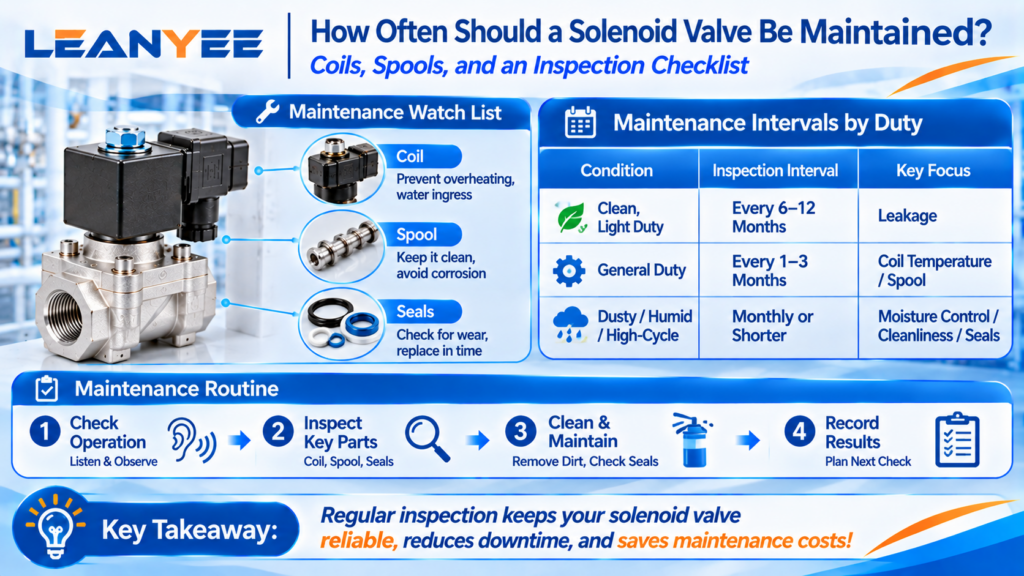
The short answer: there is no one-size-fits-all maintenance interval — it depends on the duty. In clean, light-duty service a valve can go a long time untouched; in dusty, humid, high-cycle applications it needs monthly inspection. Watch three things above all: the coil, the spool, and the seals. Inspecting ahead of failure costs far less than waiting for downtime.
Maintenance Watch List: Coil, Spool, and Seals
The coil is an electrical wear item — it suffers from overheating, water ingress, and abnormal voltage. The spool suffers from contamination, corrosion, and dried-out lubrication. Seals age over time; the tell-tale signs are leakage and slowing response.
Set the maintenance interval by duty cycle and environment: shorten it for high-cycle, heavy-load, dusty, or humid conditions, and extend it for clean, light-duty service. ISO 4414 sets general requirements for the periodic inspection and maintenance of pneumatic systems.
Maintenance Rhythm for Different Conditions
| Item | Clean, light duty | General duty | Dusty / humid / high-cycle |
| Inspection interval | Every 6–12 months | Every 1–3 months | Monthly or shorter |
| Focus | Leakage | Coil temperature rise / spool | Moisture control / cleanliness / seals |
| Typical actions | Visual check + leak check | Cleaning + re-greasing | Replace seals / moisture control |
Field Notes: Mistakes We Have Seen
- Leaving the valve alone as long as it does not leak. Seal aging is gradual — by the time it leaks, the spool is usually damaged too.
- Ignoring coil temperature rise. Long-term overheating is the warning sign before burnout.
- Inspecting only by appearance. Listen to the shift, feel the temperature rise, watch the exhaust.
- Replacing seals without checking the spool. A scratched spool will ruin new seals immediately.
Frequently Asked Questions (FAQ)
Q1: How often should a solenoid valve actually be maintained? Set the interval by duty: clean, light-load, low-cycle service needs inspection only every 6 to 12 months; general duty every 1 to 3 months; dusty, humid, high-cycle, or heavy-load applications every month or even less. The guide is the actual rate of wear: start with a denser inspection cycle, learn this equipment’s pattern, then adjust. Keep continuous inspection records and derive your own interval from them — that is more scientific than applying one blanket schedule.
Q2: How do I know when seals need replacing? Three signals. First, leakage: perceptible air escape at fittings or the exhaust port, or a steady discharge sound. Second, slower response and less crisp shifting, indicating worn spool sealing and internal leakage. Third, on strip-down, seals that have hardened, cracked, lost elasticity, or taken a permanent set. When the first two appear, replacement is generally due. Remember seals are consumables — replacing them proactively at end of life costs less than waiting for failure, downtime, and collateral damage. When replacing, check the spool and body for scratches at the same time; deal with any damage first, or the new seals will fail quickly.
Q3: Does the coil need its own maintenance? Yes — the focus is preventing overheating, dampness, and abnormal voltage. Feel the coil’s temperature rise during routine inspection: warm is normal, hot calls for checking whether the voltage is high, whether it is energized continuously for long periods, or whether heat dissipation is poor. Inspect the coil housing for cracks, discoloration, or a burnt smell. Keep the coil and terminals dry; in humid or washdown locations use a high-IP coil (IEC 60529) with proper sealing. A coil has no mechanical wear, so its life is protected by watching temperature rise, verifying voltage, and keeping it dry — abnormal temperature rise is the warning before burnout and must be dealt with promptly.
Q4: How should the spool be maintained day to day? The core is keeping it clean and rust-free. First, keep the air supply clean — filtration and a dryer to ISO 8573 reduce contamination at the source. Second, listen to the shifting sound regularly and note whether action remains crisp; clean promptly if it turns sluggish. Third, operate valves that stand idle a few times periodically to prevent the spool from corroding and seizing. Fourth, when cleaning, blow with compressed air or use a dedicated cleaning agent — never scrape with anything hard. The spool and body are precision-mated parts, and a scratched surface will leak. Maintenance should therefore be gentle and clean, with prevention rather than repair as the goal.
Q5: What spares and tools should maintenance keep on hand? Recommended stock: a seal kit for the relevant model, a spool (or complete valve), a coil, and silencers — plus extra wear parts for high-cycle use. Main tools: hex keys, a multimeter (for coil checks), a torque wrench, cleaning cloth, dedicated cleaning agent, and soapy water for leak testing. Set up a one-record-per-valve inspection sheet logging replacement dates and operating conditions, so consumption patterns become visible. Ask your supplier for a recommended spare-parts list and stock ahead of the cycle to cut unplanned downtime.
Prepared by the LEANYEE pneumatics technical team based on hands-on commissioning experience, for reference by industry peers.
Technical Disclaimer
The fitting selection, thread types, and technical parameters discussed in this article are based on applicable international standards, including ISO 4414 (Pneumatic Fluid Power — General Rules and Safety Requirements), ISO 8573 (compressed air quality), ISO 6358 (flow characteristics), and relevant thread standards such as ISO 7-1, ISO 228-1, and ANSI/ASME B1.20.1, together with publicly available technical information from international manufacturers such as SMC, Festo, and Parker.
This article is intended for general technical reference only. Actual performance may be affected by cylinder bore size, load, operating pressure, temperature, piping layout, and other application-specific factors.
On-site testing and commissioning are recommended where necessary. Always refer to the product documentation and technical parameters confirmed by the manufacturer for the specific product being used.
LEANYEE Technical Team
| [Topic] Maintenance and inspection | [Intended readers] Equipment management and TPM personnel |
More News & Insights
-
Leanyee
 29 Oct, 2026Pneumatics in Electronics CleanroomsPneumatics in Electronics and Semiconductor Cleanrooms: Cleanliness and ESD ProtectionRead Article
-
Leanyee
 22 Oct, 2026Pneumatics in Automotive Welding LinesPneumatics in Automotive Welding Lines: Clamping, Location, and Spatter ResistanceRead Article
-
Leanyee
 15 Oct, 2026Pneumatics for Food and Beverage LinesPneumatics on a Food and Beverage Line: Oil-Free, Hygienic, Washdown-ReadyRead Article