Selection Parameters for Pneumatic Fittings
Pneumatic Fitting Selection Guide Bore Size, Pressure, Temperature, and Media Compatibility
-
03 Mar, 2025

-

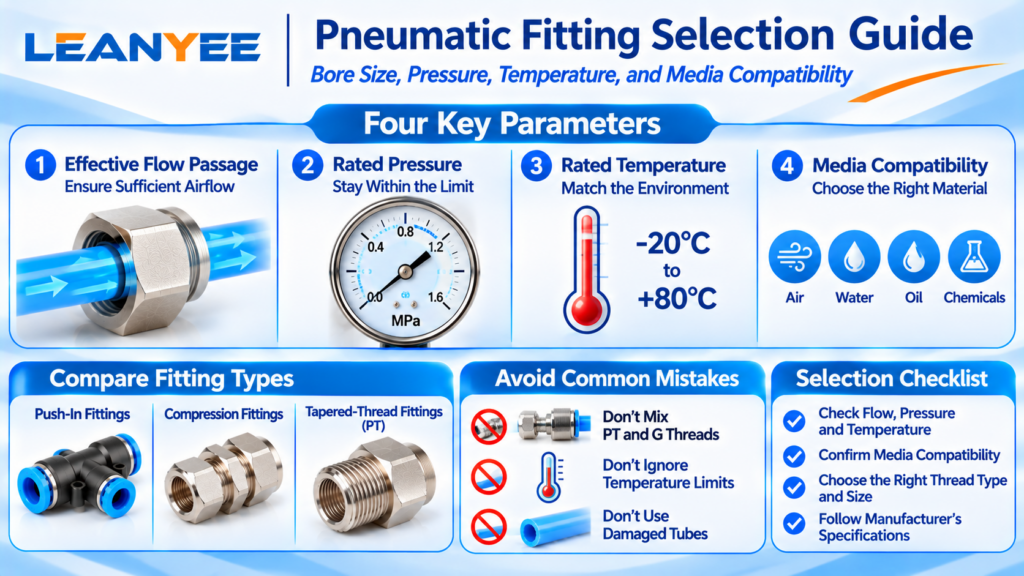
Pneumatic Fitting Selection Guide Bore Size, Pressure, Temperature, and Media Compatibility
LEANYEE Technical Guide | Pneumatic Systems Series
Introduction
One of the most common mistakes when selecting pneumatic fittings is choosing a fitting simply because the tube can be inserted into it. However, physical compatibility does not guarantee long-term reliability.
Four key parameters determine whether a pneumatic fitting is suitable for an application: effective flow passage, rated pressure, rated temperature, and media compatibility.
The effective flow passage determines the available airflow. Rated pressure and temperature define the operating limits of the fitting, while media compatibility determines which materials and sealing components are appropriate.
All four parameters must remain within the fitting’s specified operating range, with an appropriate safety margin.
A fitting that physically fits but does not meet the system requirements may appear to work initially, yet create potential problems during long-term operation. ISO 4414 provides general requirements concerning the selection and safety of pneumatic system components and can be used as a reference.
1. What Are the Four Key Parameters for Pneumatic Fitting Selection?
1.1 Effective Flow Passage: Make Sure the Fitting Can Deliver Sufficient Airflow
The effective flow passage determines how much air can pass through a fitting.
If the passage is too small, the fitting may restrict airflow and cause excessive pressure loss. As a result, a pneumatic cylinder may not receive sufficient air to operate at the required speed or performance level.
An important point is that the tube’s outer diameter is not the same as the fitting’s effective internal flow diameter.
For example, a fitting designed for an 8 mm tube does not necessarily have an 8 mm internal flow passage. Its internal gripping components and sealing structures may reduce the available passage.
When selecting fittings for high-flow applications, check the manufacturer’s specified effective flow passage rather than relying only on the tube size.
1.2 Rated Pressure: Stay Within the Safe Operating Limit
The rated pressure defines the pressure at which a fitting is designed to operate within its specified limits.
If the system pressure exceeds the fitting’s rated pressure, the consequences may include accelerated seal deterioration, leakage, loosening of compression components, fitting cracks, or even tube rupture.
When selecting a fitting, ensure that the system’s maximum operating pressure remains below the fitting’s rated pressure and that an appropriate safety margin is maintained.
This is particularly important in systems with pressure fluctuations.
Also, remember that the rated pressure of a fitting may decrease as the operating temperature increases. For high-temperature applications, consult the manufacturer’s pressure-temperature derating curve instead of relying solely on the rated pressure at room temperature.
1.3 Rated Temperature: Match the Fitting to the Operating Environment
Temperature affects both the fitting material and its sealing components.
Ordinary engineering-plastic push-in fittings and standard nitrile rubber seals have limited temperature resistance. At elevated temperatures, some materials may soften, deform, or deteriorate more quickly.
For applications near ovens, heated equipment, or high-temperature pipelines, consider metal fittings made from suitable materials, such as nickel-plated brass or stainless steel, combined with temperature-resistant sealing materials such as fluorocarbon rubber (FKM).
However, the entire fitting assembly must be suitable for the actual operating temperature. Selecting a temperature-resistant seal alone does not guarantee that the complete fitting can withstand the conditions.
Always verify the manufacturer’s specified temperature range and apply the appropriate pressure derating when required. For demanding applications, on-site temperature-rise testing may also be necessary.
1.4 Media Compatibility: Choose Materials That Match the Working Fluid
The working medium determines which fitting materials and sealing components should be used.
Different applications may involve:
- Compressed air
- Water
- Oil
- Corrosive gases
A fitting suitable for ordinary compressed air may not be appropriate for water, oil, or corrosive media.
For example, certain metal fittings may be vulnerable to corrosion in continuously wet environments, while standard nitrile rubber seals may swell or deteriorate after prolonged exposure to particular oils.
For applications involving moisture, oil, or corrosive media, consider corrosion-resistant materials and compatible sealing compounds, such as suitable stainless steel fittings with FKM seals where appropriate.
Always check the manufacturer’s media compatibility table. Do not assume that every pneumatic fitting can safely handle water or oil.
2. Choosing Fittings by Appearance vs. Selecting Them by Technical Parameters
The following table compares two approaches to pneumatic fitting selection.
| Comparison | Choosing Only Because the Tube Fits — Incorrect | Selecting According to Technical Parameters — Correct |
|---|---|---|
| Effective flow passage | May restrict airflow and cause excessive pressure loss | Meets the required airflow demand |
| Pressure and temperature | May exceed operating limits and lead to tube disconnection or rupture | Maintains an appropriate safety margin |
| Media compatibility | May cause corrosion, seal deterioration, or material aging | Uses compatible materials and sealing components |
| Long-term reliability | Lower reliability and greater potential risks | Higher reliability with traceable specifications |
The main lesson is simple: a fitting that can be assembled is not necessarily a fitting that is suitable for the application.
Proper selection requires checking all relevant technical parameters before installation.
3. Four Common Selection Mistakes to Avoid
Even when the basic specifications appear correct, several application-specific factors can affect fitting performance.
3.1 Do Not Use Ordinary Plastic Push-In Fittings in High-Temperature Areas
Ordinary plastic push-in fittings may not be suitable for locations near heat sources or high-temperature pipelines.
Elevated temperatures can affect the fitting body, gripping mechanism, and sealing components.
For these applications, select fittings made from temperature-resistant materials and confirm that the rated temperature of the complete assembly covers the actual operating conditions.
Where pressure and temperature are both elevated, check the manufacturer’s pressure-temperature derating data before installation.
3.2 Use Dedicated Vacuum Fittings for Vacuum Systems
Ordinary push-in fittings are generally designed for positive-pressure applications. Their sealing and gripping structures may not perform adequately under vacuum conditions.
In a vacuum system, an unsuitable fitting may allow air to enter the line, making it difficult to maintain the required vacuum level.
Use dedicated vacuum-rated push-in fittings with sealing and retention structures designed for negative-pressure service.
The effective flow passage must also meet the vacuum system’s requirements.
If the application involves only occasional, low-level suction and the manufacturer explicitly approves the fitting for vacuum use, it may be considered after careful verification and testing. For continuous vacuum operation, dedicated vacuum fittings should be used, and their specified vacuum ratings must be confirmed.
3.3 Select Corrosion-Resistant Materials and Compatible Seals for Water, Oil, or Corrosive Media
Applications involving water, oil, or corrosive substances place additional demands on fitting materials and sealing components.
Ordinary nickel-plated brass fittings may be vulnerable to corrosion in certain wet environments. Standard nitrile rubber seals may also swell or fail after prolonged exposure to some oils.
Depending on the actual medium and operating conditions, consider stainless steel fittings and chemically compatible, oil-resistant or corrosion-resistant sealing materials, such as FKM seals.
For food-processing or clean applications, the fitting design should also be easy to clean and suitable for the required hygiene conditions, including any restrictions on material release or contamination.
Always verify compatibility against the manufacturer’s media table rather than assuming that a fitting designed for pneumatic applications is automatically suitable for every fluid.
3.4 Calculate the Required Flow Passage Instead of Choosing by Tube Diameter Alone
The fitting should not become the bottleneck of the entire pneumatic circuit.
Tube outer diameter identifies the nominal tube size, but the effective flow passage is the internal opening available for air to pass through the fitting.
Internal gripping and sealing structures can reduce this opening. Consequently, an 8 mm push-in fitting designed for an 8 mm tube may have an effective flow passage of only 5–6 mm, depending on the product design.
For high-flow applications, an undersized effective passage can restrict airflow and slow pneumatic cylinder operation.
Check the manufacturer’s specified effective flow passage and confirm that it meets the system’s airflow requirements.
Which parameter do you check first when selecting a pneumatic fitting: pressure, effective flow passage, or material? Share your experience with us.
4. Frequently Asked Questions About Pneumatic Fitting Selection
Q1: How Do I Check a Fitting’s Rated Pressure? What Happens If the Pressure Is Too High?
The rated pressure is generally specified in the product catalogue, technical datasheet, or on the fitting itself. It indicates the maximum pressure permitted for operation within the manufacturer’s stated conditions.
Operating above the rated pressure can cause several problems:
- Sealing rings may deteriorate more quickly, leading to leakage.
- Compression components may loosen.
- The fitting body may crack.
- The tube may rupture, potentially causing injury.
When selecting a fitting, ensure that the system’s maximum operating pressure remains below the fitting’s rated pressure and maintain an appropriate safety margin, particularly in applications with pressure fluctuations.
It is also important to consider temperature. A fitting’s rated pressure may decrease as its operating temperature rises.
For high-temperature applications, use the manufacturer’s pressure-temperature derating curve to determine the allowable operating pressure. Do not rely only on the pressure rating specified at room temperature.
Q2: How Should I Select Pneumatic Fittings for High-Temperature Environments?
High temperatures primarily affect the fitting material and the sealing ring.
Ordinary engineering-plastic push-in fittings and standard nitrile rubber seals have limited temperature resistance. Under elevated temperatures, they may soften, deform, or age more rapidly.
For applications near ovens, heated machinery, or high-temperature equipment, consider:
- Metal fittings made from suitable materials, such as nickel-plated brass or stainless steel.
- Temperature-resistant sealing materials, such as FKM, where compatible with the medium.
- Complete fitting assemblies whose specified temperature range covers the actual operating conditions.
The fitting body, gripping components, and sealing elements must all be suitable for the application.
In addition, high temperatures may reduce the allowable operating pressure. Follow the manufacturer’s pressure-temperature derating curve when selecting the fitting.
The exact temperature resistance must be confirmed using the manufacturer’s technical documentation. For demanding applications, on-site temperature-rise verification may be necessary.
Q3: Are the Effective Flow Passage and Tube Outer Diameter the Same Thing?
No. They are two different dimensions.
Tube outer diameter is the nominal outside dimension of the tube, such as 8 mm.
Effective flow passage is the internal opening available for air to flow through the fitting. It is often smaller than the tube’s outer diameter because push-in fittings contain internal gripping components and sealing structures that reduce the available passage.
For example, an 8 mm fitting used with an 8 mm tube may have an effective flow passage of only 5–6 mm, depending on the design.
Therefore, the fact that an 8 mm tube fits into an 8 mm fitting does not mean that the fitting provides an 8 mm flow passage.
When selecting fittings, check the manufacturer’s effective flow passage specification rather than relying solely on the tube outer diameter.
This is particularly important in high-flow applications, where an undersized fitting may restrict airflow and slow cylinder operation.
Q4: How Should I Select Fittings for Applications Involving Both Air and Water or Oil?
Applications involving air-water mixtures or oil-contaminated media place demands on both the fitting material and the sealing components.
Ordinary nickel-plated brass fittings may corrode in certain humid or water-exposed environments. Standard nitrile rubber seals may also swell or fail after prolonged contact with some oils.
Depending on the actual medium, consider stainless steel fittings combined with compatible corrosion-resistant and oil-resistant seals, such as FKM.
Before selection, confirm that the fitting is explicitly suitable for the intended medium, whether water, oil, or another substance.
For food-processing and clean applications, also consider whether the fitting is easy to clean and whether its materials and design meet the required hygiene and contamination-control requirements.
Always consult the manufacturer’s media compatibility table. Never assume that all pneumatic fittings are suitable for water or oil simply because they are designed for pneumatic systems.
Q5: Can Ordinary Push-In Fittings Be Used in Vacuum Systems?
They are generally not recommended unless the manufacturer explicitly specifies that the fitting is suitable for vacuum service.
Ordinary push-in fittings are commonly designed for positive-pressure applications. Their sealing rings and gripping structures are intended to prevent air from escaping outward.
Vacuum applications create a different operating condition: air can be drawn into the system from outside. An ordinary fitting may not provide the required sealing performance, making it difficult to maintain the target vacuum level.
For vacuum systems, select dedicated vacuum-rated push-in fittings whose sealing and retention structures are designed for negative-pressure operation.
Also, calculate whether the effective flow passage is sufficient for the system’s required pumping speed and vacuum performance.
For occasional, low-level suction, an ordinary fitting may be considered only if the manufacturer’s documentation explicitly confirms vacuum compatibility and the application is verified through testing.
For continuous vacuum operation, use dedicated vacuum fittings and confirm the specified vacuum rating in the manufacturer’s technical documentation.
5. A Practical Checklist Before Purchasing Pneumatic Fittings
Before ordering pneumatic fittings for an industrial application, verify the following items.
Fitting Selection Checklist
Confirm the tube outer diameter and fitting connection size.
Check the effective flow passage against the required airflow.
Verify the maximum system pressure and the fitting’s rated pressure.
Confirm the operating temperature and any pressure-temperature derating requirements.
Identify the working medium, including air, water, oil, or corrosive substances.
Check the compatibility of fitting materials and sealing rings.
Determine whether the application requires a dedicated vacuum-rated fitting.
Review the manufacturer’s datasheet and applicable operating limits.
Checking these parameters before purchasing and installing fittings helps reduce the risk of airflow restrictions, leakage, premature component deterioration, and incompatible connections.
Conclusion
Reliable pneumatic fitting selection requires more than matching the tube size to the fitting.
The four key factors are effective flow passage, rated pressure, rated temperature, and media compatibility. Each affects the fitting’s ability to operate safely and reliably over time.
For high-temperature applications, choose materials and seals rated for the operating conditions. For water, oil, or corrosive media, verify material and seal compatibility. For vacuum systems, use dedicated vacuum-rated fittings when required. For high-flow applications, pay particular attention to the effective flow passage.
By checking these parameters against the manufacturer’s specifications before installation, you can reduce unnecessary maintenance, improve pneumatic system reliability, and avoid selecting a fitting that fits physically but does not meet the application’s requirements.
Technical Disclaimer
The fitting selection guidance and technical parameters in this article are based on the original technical material and general international standards and publicly available technical documentation from manufacturers such as SMC, Festo, and Parker.
References include ISO 4414, Pneumatic fluid power — General rules and safety requirements for systems and their components; ISO 8573, concerning compressed air quality; ISO 6358, concerning flow-rate characteristics; and thread standards including ISO 7-1, ISO 228-1, and ANSI/ASME B1.20.1.
This article is provided for general technical reference only. Actual performance may be affected by cylinder bore, load, operating pressure, temperature, piping configuration, and other application-specific factors. Always consult the applicable product catalogue and confirm the technical parameters with the manufacturer. Final suitability should be verified under actual operating conditions.
LEANYEE Technical Team
More News & Insights
-
Leanyee
 29 Oct, 2026Pneumatics in Electronics CleanroomsPneumatics in Electronics and Semiconductor Cleanrooms: Cleanliness and ESD ProtectionRead Article
-
Leanyee
 22 Oct, 2026Pneumatics in Automotive Welding LinesPneumatics in Automotive Welding Lines: Clamping, Location, and Spatter ResistanceRead Article
-
Leanyee
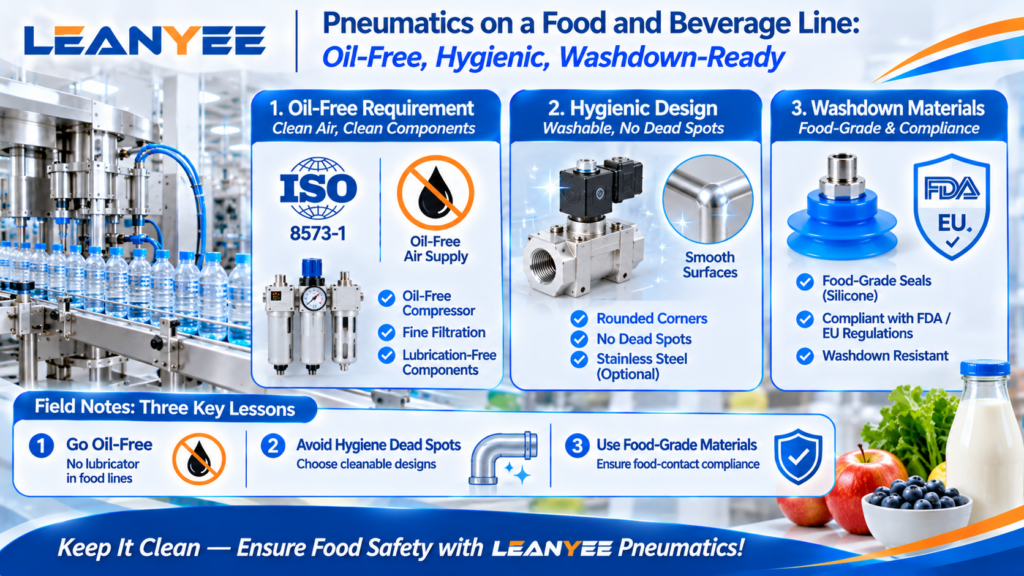 15 Oct, 2026Pneumatics for Food and Beverage LinesPneumatics on a Food and Beverage Line: Oil-Free, Hygienic, Washdown-ReadyRead Article