Maintenance and Service Life of Pneumatic Fittings
Pneumatic Fittings Need Maintenance Too: How to Determine Service Life and Replacement Intervals
-
17 Mar, 2025

-

Pneumatic Fittings Need Maintenance Too: How to Determine Service Life and Replacement Intervals
LEANYEE Technical Guide · Pneumatic Systems Series
The Key Takeaway
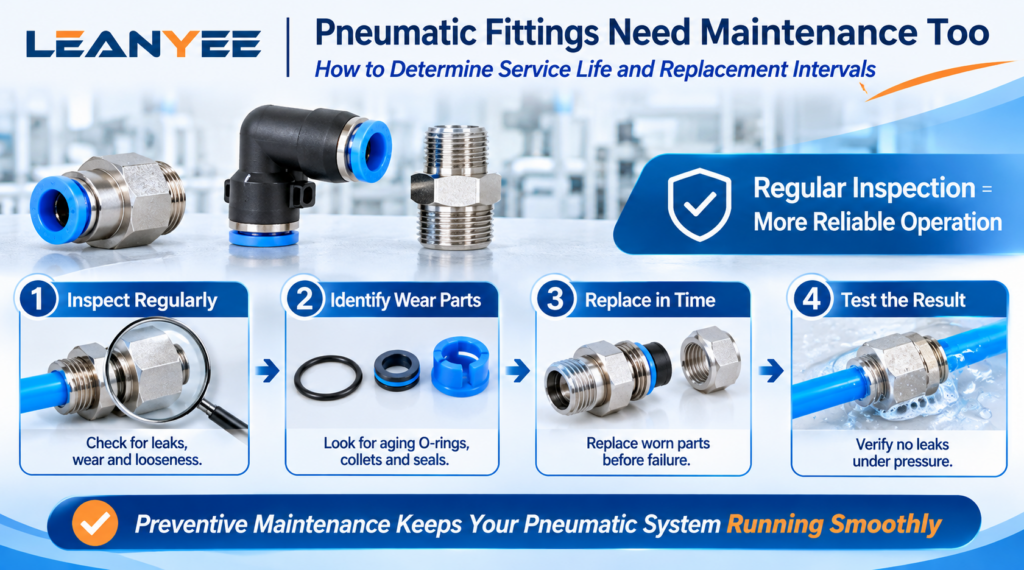
Pneumatic fittings are not components that can be installed and forgotten about forever. Sealing rings can age, gripping collets can suffer fatigue, and ferrules or threaded connections can loosen. Over time, these problems can turn a reliable fitting into a source of air leakage.
Regular inspection and timely replacement are usually more cost-effective than waiting for an air leak to cause equipment downtime and emergency repairs.
What Causes Pneumatic Fittings to Wear Out?
Different parts of a pneumatic fitting deteriorate in different ways.
1. Sealing Components: O-Rings and Sealing Rings
Sealing components are affected by temperature, the working medium, ultraviolet (UV) exposure, and aging over time. These factors can cause sealing rings to harden, crack, or lose their elasticity, reducing their ability to maintain a reliable seal.
2. Gripping Collets
The gripping collet in a push-in fitting repeatedly grips and releases the tubing. Repeated insertion and removal can cause elastic fatigue or deformation, reducing the collet’s ability to hold the tubing securely.
3. Ferrules and Threaded Connections
Vibration can contribute to loosening at ferrule-type and threaded connections. Incorrect tightening torque and repeated mechanical stress can also affect connection reliability.
4. Operating Conditions Affect Service Life
The service life of a pneumatic fitting varies considerably depending on the operating environment. Applications involving frequent operation, high temperatures, oil, water, or substantial vibration can shorten the service life of fittings and their sealing components.
For this reason, effective fitting maintenance should follow three principles:
- Set inspection intervals according to actual operating conditions.
- Keep replacement parts matched to the correct fitting model.
- Replace worn components before they cause equipment failure.
Rather than waiting for a leak to appear, establish a preventive maintenance schedule. ISO 4414 includes general requirements relating to the safe operation and maintenance of pneumatic systems and can serve as a reference.
Failure Mechanisms of Common Wear Parts
| Comparison Item | Sealing Rings / O-Rings | Gripping Collets | Ferrules / Threaded Connections |
|---|---|---|---|
| Failure mechanism | Hardening, cracking, and aging | Elastic fatigue or deformation | Loosening caused by vibration |
| Factors affecting service life | Temperature, working medium, and time | Number of insertion and removal cycles | Vibration and tightening torque |
| Typical signs of failure | Slow air leakage or air seepage | Tubing slips out or the collet can no longer grip securely | Leakage at the connection |
| Maintenance approach | Replace worn or aged sealing components periodically | Inspect for deformation and wear caused by repeated insertion, removal, or pulling | Retighten only when appropriate, or replace damaged components |
Knowing the Service Life Is Not Enough: Common Maintenance Mistakes
1. Shorten Inspection Intervals in High-Temperature and Oil-Contaminated Environments
Do not apply maintenance intervals intended for normal room-temperature conditions to applications involving high temperatures or oil contamination.
These environments can accelerate the deterioration of sealing components and other fitting parts. Adjust the inspection schedule to suit the actual operating conditions.
2. Stock Spare Parts According to the Exact Fitting Model
Keep replacement fittings and wear parts matched to the original model.
Do not substitute an arbitrary fitting simply because it appears similar. Differences in thread type, port size, tubing outside diameter, sealing material, or other specifications can create compatibility problems and lead to further leakage.
3. Replace Aged Sealing Components Along With the Relevant Parts
When replacing a fitting or servicing a connection, inspect the sealing components as well.
Replacing the fitting body while leaving a deteriorated sealing ring in place may not resolve the leakage problem. Replace aged or damaged sealing components whenever required by the inspection results and the manufacturer’s maintenance instructions.
4. Establish a Regular Inspection Checklist
Do not rely solely on experience or memory.
Maintain records of inspection dates, observed problems, replaced components, and replacement dates. These records make it easier to identify recurring failures and adjust maintenance intervals based on actual equipment performance.
How often does your workshop inspect pneumatic fittings? Has a production line ever stopped because of a small fitting failure? Share your experience with us.
Frequently Asked Questions (FAQ)
Q1: How Often Should Pneumatic Fittings Be Inspected?
The appropriate inspection interval depends on the operating conditions. There is no single interval suitable for every application.
As a general starting point, the original guide suggests the following intervals:
- Normal-temperature, low-pressure, low-frequency applications: Inspect approximately every 6–12 months.
- Applications involving frequent insertion and removal, high temperatures, oil or water exposure, or substantial vibration: Consider inspections every 1–3 months.
These intervals are general recommendations from the original guide, not universal requirements. Actual intervals should be adjusted according to the fitting manufacturer’s recommendations, operating conditions, failure history, and the consequences of equipment downtime.
During inspection, check the following:
- Air leakage: Perform an appropriate leak test to identify air seepage.
- Collet gripping performance: Check whether the tubing is held securely and whether the connection shows signs of looseness.
- Sealing ring condition: Inspect for hardening, cracking, deformation, or other visible signs of deterioration.
Include pneumatic fittings in the equipment maintenance checklist and record each inspection and replacement date. Adjust the inspection interval as actual leakage trends and component conditions become clearer.
Refer to the manufacturer’s maintenance recommendations and consider the potential cost of production downtime when establishing a schedule.
Q2: What Are the Early Signs of an Aging Sealing Ring?
Several observable signs may indicate that a sealing ring is deteriorating:
- The material becomes harder and loses elasticity.
- Cracks appear on the surface.
- The surface becomes sticky or shows other abnormal changes.
- The tubing feels unusually loose or the insertion and removal resistance changes.
- Slight air leakage begins to appear around the fitting. Soapy water or a dedicated leak-detection solution may help reveal small leaks.
Replace a sealing ring when signs of deterioration are identified rather than waiting for a major leak to develop.
The rate of aging is strongly influenced by temperature, the working medium, and UV exposure. Sealing components may deteriorate more quickly in high-temperature environments, where oil is present, or where fittings are exposed to direct sunlight outdoors.
Keep replacement sealing components matched to the relevant fitting model. When servicing a fitting, replace the sealing components as required to restore reliable sealing performance.
Q3: Can I Replace Only the Sealing Ring Without Replacing the Entire Fitting?
It depends on the fitting design and the condition of the remaining components.
For many fittings, sealing rings and other wear parts can be replaced individually, provided that the fitting body and related components remain in good condition.
Replacing only the sealing ring may be appropriate when:
- The fitting body is intact.
- The threads are undamaged.
- The collet seat and other supporting surfaces are not deformed.
- The fitting design allows the sealing component to be replaced separately.
Replace the entire fitting when:
- The threads are stripped or severely damaged.
- The collet seat is deformed.
- The fitting body is cracked.
- Other structural damage prevents reliable sealing or gripping.
Before deciding, disassemble the connection safely and inspect the fitting body. If the body remains in good condition, replacing the sealing component alone may reduce maintenance costs. If structural damage is present, replacing only the sealing ring will not solve the underlying problem.
Where possible, purchase replacement sealing kits specified by the fitting manufacturer to ensure that the dimensions and materials are compatible.
Q4: How Much Does High Temperature Reduce the Service Life of a Pneumatic Fitting?
High temperatures can significantly shorten the service life of pneumatic fittings, but there is no universal percentage by which service life decreases. The actual effect depends on the operating temperature, component materials, sealing material, pressure, and other application conditions.
The general pattern is that higher temperatures accelerate sealing-ring aging and may reduce the mechanical strength of plastic components.
For example, under conditions approaching their rated temperature limits, ordinary plastic push-in fittings and fittings using nitrile rubber (NBR) sealing rings may experience a substantial reduction in service life. In some applications, components that last for years at normal temperatures may deteriorate within months under more severe conditions. These are illustrative possibilities, not guaranteed service-life figures.
For high-temperature applications, consider selecting materials specifically rated for the required operating conditions. Depending on the application, a metal fitting with a suitable fluorocarbon rubber (FKM) seal may be appropriate.
Also consider the manufacturer’s temperature-versus-service-life data and any pressure derating requirements. Shorten inspection intervals when operating conditions are more demanding.
Always determine the actual service life using the manufacturer’s specifications and observed field conditions. Do not assume that a particular fitting material is suitable for high temperatures without checking its rated limits and compatibility with the working medium.
Q5: How Can I Establish Inspection and Replacement Standards for Pneumatic Fittings?
A practical inspection and replacement standard can be established in four steps.
Step 1: Classify fittings according to operating conditions.
Group fittings by their working environment, for example:
- Normal-temperature, low-frequency applications.
- High-frequency or high-temperature applications.
- Applications involving vibration or corrosive environments.
Assign shorter inspection intervals to fittings operating under more demanding conditions.
Step 2: Define inspection items and create a record sheet.
Specify the checks that must be performed, including:
- Leak detection.
- Tubing retention and collet gripping performance.
- Visual inspection of sealing rings.
- Inspection of ferrules, threads, and other relevant components for damage or loosening.
Create a maintenance record to document the results and inspection dates.
Step 3: Define the conditions that trigger replacement.
Replace the relevant component when any of the following conditions is identified:
- Air leakage or persistent air seepage.
- The collet can no longer grip the tubing securely.
- The sealing ring has hardened or cracked.
- The collet is deformed.
- Threads, the fitting body, or other structural components are damaged.
Do not continue using a damaged component simply because the leak is currently small.
Step 4: Stock model-specific spare parts and record replacement dates.
Maintain spare parts matched to the relevant fitting models. Record when components are replaced and why they failed.
Over time, use these records to identify recurring problems and optimize inspection intervals based on actual operating conditions.
The initial maintenance standard can refer to ISO 4414 and the fitting manufacturer’s documentation, then be refined as more field data becomes available.
Technical Disclaimer
The fitting selection, thread types, and technical parameters discussed in this article are based on applicable international standards, including ISO 4414 (Pneumatic Fluid Power — General Rules and Safety Requirements), ISO 8573 (compressed air quality), ISO 6358 (flow characteristics), and relevant thread standards such as ISO 7-1, ISO 228-1, and ANSI/ASME B1.20.1, together with publicly available technical information from international manufacturers such as SMC, Festo, and Parker.
This article is intended for general technical reference only. Actual performance may be affected by cylinder bore size, load, operating pressure, temperature, piping layout, and other application-specific factors.
On-site testing and commissioning are recommended where necessary. Always refer to the product documentation and technical parameters confirmed by the manufacturer for the specific product being used.
LEANYEE Technical Team
More News & Insights
-
Leanyee
 29 Oct, 2026Pneumatics in Electronics CleanroomsPneumatics in Electronics and Semiconductor Cleanrooms: Cleanliness and ESD ProtectionRead Article
-
Leanyee
 22 Oct, 2026Pneumatics in Automotive Welding LinesPneumatics in Automotive Welding Lines: Clamping, Location, and Spatter ResistanceRead Article
-
Leanyee
 15 Oct, 2026Pneumatics for Food and Beverage LinesPneumatics on a Food and Beverage Line: Oil-Free, Hygienic, Washdown-ReadyRead Article