Pneumatic Fittings: Types and Basic Knowledge
Pneumatic Fittings: Small Components, Big Air Leaks — What Are the Main Types of Pneumatic Fittings?
-
17 Feb, 2025

-

Pneumatic Fittings: Small Components, Big Air Leaks — What Are the Main Types of Pneumatic Fittings?
LEANYEE Technical Insights · Pneumatic Systems Series
Introduction: Why Is Fitting Classification Important?
Pneumatic fittings may look insignificant, but they are one of the most common sources of air leakage and tubing disconnection in pneumatic systems.
To select the right fitting, you first need to understand its classification.
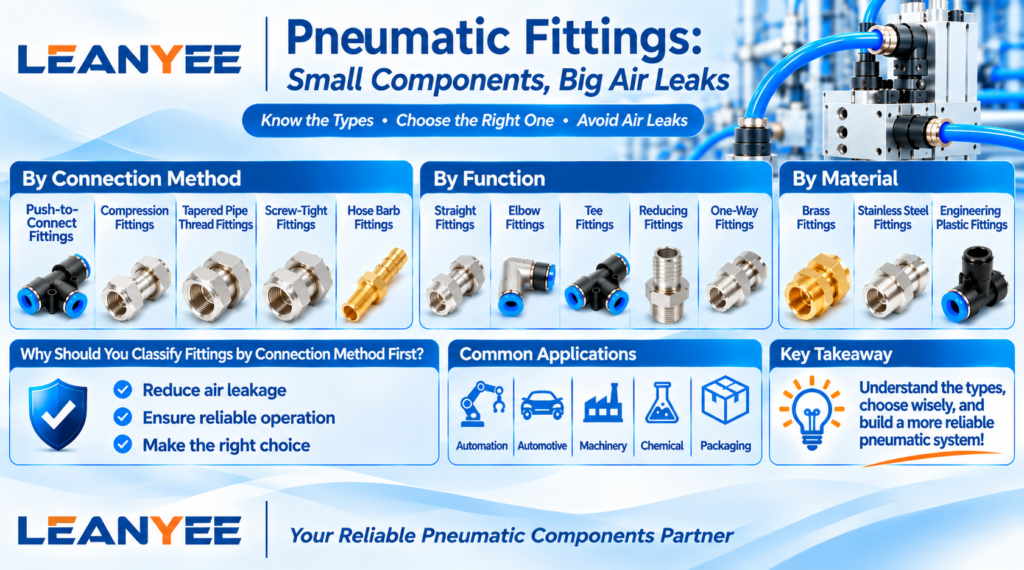
By connection method, pneumatic fittings include push-to-connect fittings, compression fittings, tapered pipe thread fittings, screw-tight fittings, and hose barb fittings.
By function, they include straight fittings, elbow fittings, tee fittings, reducing fittings, and one-way fittings.
By material, they include brass fittings, stainless steel fittings, and engineering plastic fittings.
For most general-purpose production lines, push-to-connect fittings are the primary choice.
Why Should You Classify Fittings by Connection Method First?
Different connection methods rely on different sealing and locking mechanisms:
- Push-to-connect fittings: Use a gripping collet and a sealing O-ring.
- Compression fittings: Rely on a metal ferrule gripping and sealing against the tubing.
- Tapered pipe thread fittings: Use tapered threads together with PTFE thread seal tape or thread sealant.
- Screw-tight fittings: Secure the tubing by tightening a nut.
- Hose barb fittings: Grip the inside of the hose with barbed surfaces, usually secured with a hose clamp.
Because their sealing and locking mechanisms differ, these fittings are suitable for different operating conditions.
Therefore, the first step in selecting a fitting is not to look at its dimensions. You should first determine the connection method, then choose the function and material.
If you get the sequence wrong, the subsequent selection may be ineffective or unsuitable.
What Are the Main Types of Pneumatic Fittings, and How Do They Differ?
| Comparison Item | Push-to-Connect Fittings | Compression Fittings | Tapered Pipe Thread Fittings | Screw-Tight / Hose Barb Fittings |
|---|---|---|---|---|
| Connection and Sealing Principle | Collet grips the tubing + sealing O-ring | Metal ferrule grips the tubing | Tapered threads + PTFE tape or sealant | Nut compression / hose clamp |
| Installation Convenience | Easiest; no tools required | Requires tightening | Requires thread seal tape and tightening | Requires tightening |
| Suitable Operating Conditions | Low pressure, normal temperatures, frequent disconnection | High pressure, vibration, or high temperatures | Fixed high-pressure piping | Low-pressure hose connections |
| Typical Applications | Pneumatic tubing connections for production-line cylinders | High-pressure, corrosive, or high-temperature applications | Fixed equipment connections | Low-pressure hose connections |
Understanding the Classifications Is Not Enough — Common Problems in Real-World Applications
1. Determine the connection method before selecting specifications.
Do not use push-to-connect fittings in high-pressure, high-vibration applications without verifying their suitability. A mismatch between the connection mechanism and the operating conditions can lead to problems.
2. Do not combine functional fittings incorrectly.
If a tee fitting is required, do not substitute two straight fittings and PTFE thread seal tape to create an improvised connection. This can increase both potential leakage points and flow resistance.
3. Select materials according to the working medium and environment.
In corrosive environments, cleanroom applications, and food-processing environments, ordinary nickel-plated brass fittings may not be suitable.
4. Standardize the fitting system wherever possible.
Using a consistent fitting system throughout the same pneumatic installation reduces the number of spare parts required and lowers the risk of errors caused by mixing thread types and specifications.
Which type of pneumatic fitting is used most frequently in your workshop: push-to-connect fittings or threaded fittings? Share your experience in the comments.
Frequently Asked Questions (FAQ)
Q1: What Is the Most Practical Way to Classify Pneumatic Fittings?
For practical industrial applications, the most useful approach is to classify pneumatic fittings according to three criteria.
1. Connection method
Examples include push-to-connect fittings, compression fittings, tapered pipe thread fittings, screw-tight fittings, and hose barb fittings.
The connection method determines the sealing and locking mechanism.
2. Function
Examples include straight fittings, elbow fittings, tee fittings, reducing fittings, and one-way fittings.
The function determines how the tubing is routed and connected.
3. Material
Examples include brass, stainless steel, and engineering plastics.
The material determines corrosion resistance, temperature resistance, and suitability for clean applications.
First, determine the main fitting category according to the connection method. Next, select the structure according to its function. Finally, choose the material based on the working medium and operating environment.
Following these three steps will help you avoid most fitting selection errors.
For specific rated parameters, always refer to the manufacturer’s product catalog.
Q2: Are Push-to-Connect Fittings and Screw-Tight Fittings the Same Thing?
No. They are different types of fittings.
Push-to-connect fittings use an internal gripping collet to hold the outside of the tubing and a sealing O-ring to prevent leakage. The tubing locks into place when inserted and can be released by pressing the release ring. These fittings require no tools and allow quick connection and disconnection.
Screw-tight fittings, on the other hand, use a nut that is tightened to compress and secure the tubing against the fitting body. Their structure is similar to a simplified compression fitting.
Push-to-connect fittings offer the advantage of fast installation and removal, while screw-tight fittings have a relatively simple structure and may offer a slightly lower cost.
The two types also differ in flow passage size, pressure rating, and compatible tubing materials.
They should not be used interchangeably simply because they look similar. During selection, always check the manufacturer’s specifications for compatible tubing materials and rated operating parameters.
Q3: When Should Stainless Steel Pneumatic Fittings Be Used?
Stainless steel fittings are recommended for three main types of applications.
1. Corrosive environments
These include humid environments, areas exposed to acidic or alkaline fumes, and applications involving cleaning agents.
2. Food processing, pharmaceutical production, and cleanroom environments
These applications require corrosion resistance, easy cleaning, and materials that do not release contaminants.
3. High-temperature environments
Ordinary nickel-plated brass or plastic fittings may not provide sufficient temperature resistance.
Although stainless steel fittings generally cost more, they are often essential for reliable operation under these conditions.
The sealing rings must also be selected to withstand the operating temperature and working medium. Fluoroelastomer (FKM) is one example of a suitable sealing material for certain applications.
Always refer to the manufacturer’s product catalog for the specific material grade and operating temperature range.
Q4: How Should Reducing Fittings, Tee Fittings, and Elbow Fittings Be Selected?
The basic principle is to keep the tubing route as smooth as possible and minimize unnecessary changes in diameter.
- Use a tee fitting when the pipeline needs to branch into multiple directions.
- Use an elbow fitting when the pipeline needs to change direction.
- Use a reducing fitting when the connection needs to transition between different tube or port sizes.
Avoid assembling multiple straight fittings with PTFE thread seal tape to create an improvised connection. Every additional connection point introduces another potential leakage point and may increase flow resistance.
Pay attention to the angle of elbow fittings. A 90° elbow and a 45° elbow can produce different flow resistance.
Whenever possible, complete a diameter reduction in a single step rather than using multiple successive reductions.
When selecting functional fittings, ensure that their flow passage sizes match the pipeline requirements. Avoid reducing the passage size to the point where it becomes a bottleneck in the pneumatic system.
If you are unsure which fitting to use, consult the manufacturer’s fitting selection table to reduce installation errors and rework.
Q5: Are There International Standards for Pneumatic Fittings?
Yes. Several international standards are relevant to pneumatic fitting threads and pneumatic systems.
- PT (Rc) tapered pipe threads: Covered by ISO 7-1.
- G parallel pipe threads: Covered by ISO 228-1.
- NPT American pipe threads: Covered by ANSI/ASME B1.20.1.
- ISO 4414: General rules and safety requirements for pneumatic fluid power systems.
- ISO 8573: Standards relating to compressed air quality.
During purchasing and acceptance inspections, these standards can be used to verify thread types and rated parameters. You should also consult the product catalogs of manufacturers such as SMC, Festo, and Parker to confirm the specific model.
For international projects in particular, using consistent international standards helps ensure compatibility and reduces confusion during equipment selection and procurement.
Technical Disclaimer
The fitting selection recommendations, thread specifications, and technical parameters described above are based on current international standards, including ISO 4414 (Pneumatic fluid power — General rules and safety requirements), ISO 8573 (Compressed air quality), and ISO 6358 (Flow characteristics), as well as thread standards ISO 7-1, ISO 228-1, and ANSI/ASME B1.20.1, together with publicly available technical information from international manufacturers such as SMC, Festo, and Parker.
This information is provided for reference purposes only.
Actual performance may be affected by cylinder bore size, load, operating pressure, temperature, tubing layout, and other factors. On-site testing and commissioning are recommended. Always refer to the product catalog and confirm the technical parameters with the manufacturer before making a final selection.
LEANYEE Technical Team
More News & Insights
-
Leanyee
 29 Oct, 2026Pneumatics in Electronics CleanroomsPneumatics in Electronics and Semiconductor Cleanrooms: Cleanliness and ESD ProtectionRead Article
-
Leanyee
 22 Oct, 2026Pneumatics in Automotive Welding LinesPneumatics in Automotive Welding Lines: Clamping, Location, and Spatter ResistanceRead Article
-
Leanyee
 15 Oct, 2026Pneumatics for Food and Beverage LinesPneumatics on a Food and Beverage Line: Oil-Free, Hygienic, Washdown-ReadyRead Article