Single or Double Solenoid, NO or NC
Single-Solenoid or Double-Solenoid? Normally Open or Normally Closed? Get This Selection Right
-
10 Apr, 2025

-

Single-Solenoid or Double-Solenoid? Normally Open or Normally Closed? Get This Selection Right
Pneumatic Technology Explained · Solenoid Valve Series
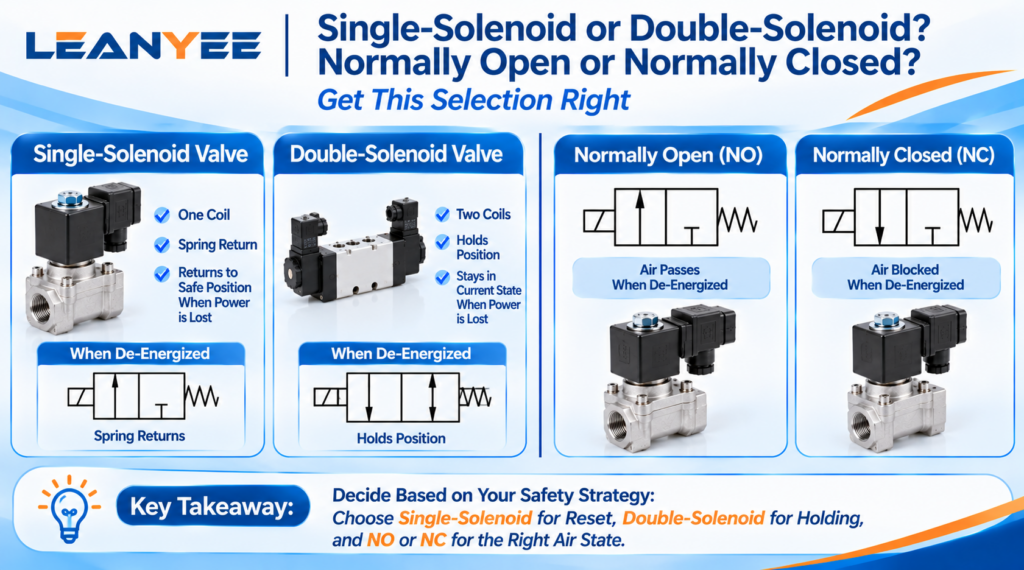
The short answer: a single-solenoid valve resets automatically when power is lost, while a double-solenoid valve holds its position. A normally open (NO) valve passes air when de-energized, while a normally closed (NC) valve blocks it. These concepts directly determine what the machine does at power loss or emergency stop — get one wrong and, at best, the machine does the wrong thing, and at worst it becomes a safety incident.
Reset Method and Valve Function: The Logic Behind the Choice
Single-solenoid: one coil. Energize it and the valve shifts; cut power and a spring returns it. This suits applications where the machine must go back to a safe position when power is lost.
Double-solenoid: two coils. A pulse shifts the valve and it stays there; on power loss it remains exactly where it was. This suits applications where the state must be held when power is lost.
Normally open (NO) passes air in the de-energized state; normally closed (NC) blocks it. The choice should be driven by “what state should the machine be in when power is off,” not by “what I want it to do when power is on.”
Single-Solenoid vs. Double-Solenoid, Normally Open vs. Normally Closed
| Item | Single-solenoid | Double-solenoid | Normally open (NO) | Normally closed (NC) |
| De-energized state | Spring return | Holds position | Air passes | Air blocked |
| Number of coils | 1 | 2 | Depends on valve function | Depends on valve function |
| Best suited to | Fail-safe reset | Holding a state | Safe air shut-off | Continuous air supply |
Field Notes: Mistakes We Have Seen
- Choosing a single-solenoid valve where the position must be held on power loss. The valve resets by itself, and the cylinder position is lost.
- Getting NO and NC the wrong way round. Air is supplied when it should be shut off — a genuine safety hazard.
- Wiring only one coil on a double-solenoid valve. The second coil is left floating and shifting becomes unreliable.
- Ignoring the state after an emergency stop. Before selecting the valve, decide exactly how the machine should stop when power is lost.
Frequently Asked Questions (FAQ)
Q1: What applications suit single-solenoid and double-solenoid valves respectively? A single-solenoid (spring-return) valve suits applications where the machine must return to a fixed safe position when power is lost — releasing a clamp, retracting an ejector pin, retracting a cylinder. On power loss or emergency stop, the spring resets it automatically and the motion is predictable. A double-solenoid (pulse-holding) valve suits applications where the current position must be held when power is lost — holding a located position, or preventing a cylinder from moving on its own after a power failure. The core of the decision is one question: “where should the cylinder stop when power is lost?” If it should move, choose single-solenoid; if it should stay, choose double-solenoid. This decision is tightly coupled to process safety.
Q2: How exactly do I choose between normally open and normally closed? Decide on the basis of “should the air path be open or closed when de-energized.” Normally closed (NC) blocks air when de-energized, which suits applications where the air supply must be cut on power loss to prevent unintended motion — safety first. Normally open (NO) passes air when de-energized, which suits applications where air must stay on to hold a clamp closed or to let the system exhaust. A simple rule: fix the power-loss safety strategy first — choose NC for “air off on power loss,” NO for “air on on power loss.” Do not choose on the basis of “what I want it to do when energized,” or you will almost certainly get it backwards.
Q3: Can I use only one coil on a double-solenoid valve? No. A double-solenoid valve has two coils, each driving one direction of shift, and both must be wired and both must be controlled. With only one coil connected, the opposite direction cannot be triggered electrically; the valve moves in one direction only, which defeats the whole point of bidirectional holding, and a coil left floating can leave the state indeterminate. When wiring, connect the two coils to two separate outputs of the control system, and make sure they can never be energized at the same time — simultaneous energization puts a double-solenoid valve in an undefined state and must be avoided.
Q4: After an emergency stop, where should the solenoid valve leave the cylinder? This goes back to process safety analysis, and there is no single answer. If the cylinder is gripping a workpiece and releasing it would drop the part and injure someone, use a double-solenoid valve or a locking arrangement so the clamp stays closed. If holding the cylinder extended would itself be dangerous, use a single-solenoid spring-return valve so it retracts to a safe position. If the requirement is to relieve pressure and force immediately, choose an exhaust-on-power-loss (exhaust center) function. So “where it stops on power loss” is the starting point for choosing both reset method and valve function: complete the safety assessment first, then translate it into a selection.
Q5: Is spring return on a single-solenoid valve reliable? Under normal conditions, yes — spring return is a mature mechanical method. But it depends on a few preconditions: first, correct mounting orientation, since spring return is affected by gravity, and an inverted or heavily tilted installation makes the return slow or incomplete; second, clean air, since contamination jamming the spool will make the return stick; third, a spring that is neither fatigued nor broken. The reliability of single-solenoid reset therefore rests on “mounted correctly, clean air, healthy spring.” For safety-critical applications that demand very high reliability, spring return alone may not be enough — combine it with a double-solenoid valve, a mechanical lock, or a safety valve in a redundant design.
Prepared by the LEANYEE pneumatics technical team based on hands-on commissioning experience, for reference by industry peers.
Technical Disclaimer
The fitting selection, thread types, and technical parameters discussed in this article are based on applicable international standards, including ISO 4414 (Pneumatic Fluid Power — General Rules and Safety Requirements), ISO 8573 (compressed air quality), ISO 6358 (flow characteristics), and relevant thread standards such as ISO 7-1, ISO 228-1, and ANSI/ASME B1.20.1, together with publicly available technical information from international manufacturers such as SMC, Festo, and Parker.
This article is intended for general technical reference only. Actual performance may be affected by cylinder bore size, load, operating pressure, temperature, piping layout, and other application-specific factors.
On-site testing and commissioning are recommended where necessary. Always refer to the product documentation and technical parameters confirmed by the manufacturer for the specific product being used.
LEANYEE Technical Team
More News & Insights
-
Leanyee
 29 Oct, 2026Pneumatics in Electronics CleanroomsPneumatics in Electronics and Semiconductor Cleanrooms: Cleanliness and ESD ProtectionRead Article
-
Leanyee
 22 Oct, 2026Pneumatics in Automotive Welding LinesPneumatics in Automotive Welding Lines: Clamping, Location, and Spatter ResistanceRead Article
-
Leanyee
 15 Oct, 2026Pneumatics for Food and Beverage LinesPneumatics on a Food and Beverage Line: Oil-Free, Hygienic, Washdown-ReadyRead Article