Troubleshooting No Shift, Leaks, Burnt Coil
Solenoid Valve Troubleshooting: Won't Shift, Leaking Air, or a Burnt Coil — One Diagnostic Routine
-
08 May, 2025

-

Solenoid Valve Troubleshooting: Won’t Shift, Leaking Air, or a Burnt Coil — One Diagnostic Routine
Pneumatic Technology Explained · Solenoid Valve Series
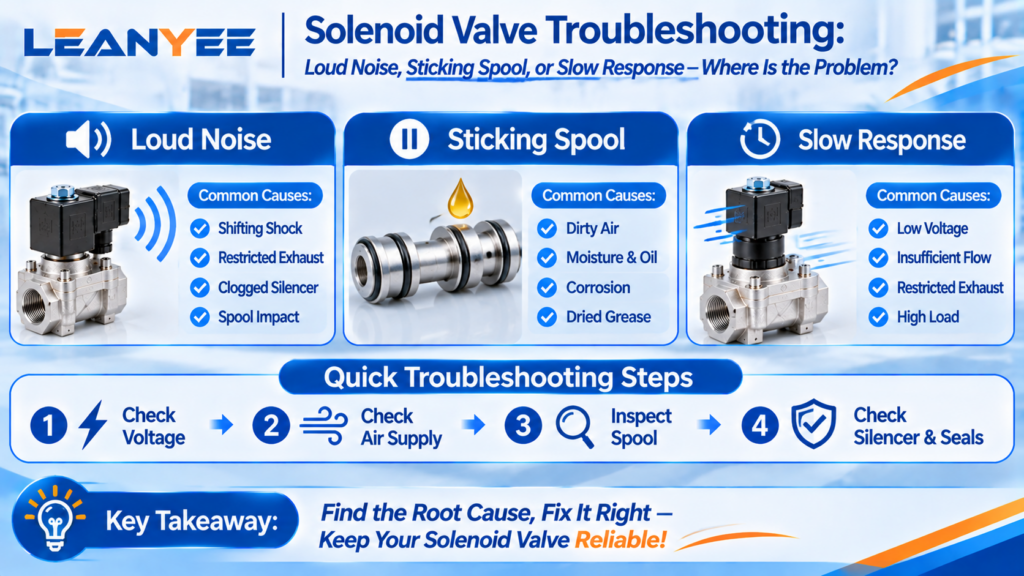
The short answer: when a solenoid valve will not shift, leaks, or burns out its coil, following the order “electricity → air → spool → seals” locates the fault in most cases. Do not swap the valve first — check whether voltage arrives, whether the air supply is adequate, and whether the spool is stuck, and most problems can be found within ten minutes.
Diagnostic Order: From Electricity to Air to Spool
Won’t shift: first confirm the coil is energized (voltage, wiring, coil continuity), then check whether pilot / supply pressure is sufficient, and finally check whether the spool is stuck (dirt, corrosion).
Air leakage: for external leaks, inspect ports, seals, and the exhaust port; an internal leak comes from worn spool sealing, and shows up as continuous leaking at the exhaust and a weak-acting cylinder. Burnt coil: usually caused by wrong voltage, overheating from long continuous energization, water ingress and short circuit, or a jammed pilot valve driving the current up.
Locating the Three Fault Types
| Item | Won’t shift | Air leakage | Burnt coil |
| Most common cause | Voltage / air supply / spool | Worn seals / fittings | Wrong voltage / overheating / water |
| Check first | Electricity → air → spool | External leak → internal leak | Voltage / temperature rise / waterproofing |
| Typical fix | Check power and air, clean the spool | Replace seals, tighten fittings | Verify voltage, replace coil |
Field Notes: Mistakes We Have Seen
- Replacing the valve as soon as it will not shift. Check power and air first — in most cases the valve itself is fine.
- Overlooking pilot pressure. A pilot-operated valve cannot shift at low pressure and gets wrongly condemned as faulty.
- Fixing external leaks but never checking for internal ones. Internal leakage hurts performance more — do not miss it.
- Swapping a burnt coil without finding out why. With wrong voltage or overheating, the new coil will burn too.
Frequently Asked Questions (FAQ)
Q1: The valve will not shift — what do I check first? Follow the order “electricity → air → spool.” First, electricity: is the voltage across the coil normal, are the connections tight, and is the coil continuous (measure its resistance with a multimeter — an open circuit means it has burned out). Second, air: is the supply pressure adequate, and for a pilot-operated valve, is it above the minimum pilot pressure? Third, the spool: de-energize and press the spool with the manual override button — if the valve shifts, the spool is fine and the problem is electrical or in the pilot supply; if even the manual override will not move it, the spool is most likely stuck. In this order, most no-shift faults can be located within ten minutes.
Q2: How do I tell an external leak from an internal one? External leaks can be seen and heard: air escapes or hisses at fittings, seals, or body joints, and dabbing soapy water on a suspected point shows bubbles at the exact spot. Internal leaks are invisible: the spool-to-body seal is worn, so air passes straight from the inlet to the exhaust. Symptoms are a continuously leaking exhaust, a weak-acting cylinder, and a mid-position that will not hold. To confirm an internal leak, listen at the exhaust port while the cylinder is stopped for a steady discharge, or measure with a flow meter. External leaks call for new seals and tightened fittings; internal leaks call for a new spool or a new valve — the two are fixed in different places.
Q3: What are the common causes of a burnt coil? Mainly these: wrong voltage — a DC coil wired to AC or a voltage beyond the rating makes the current spike and burns the coil instantly; overheating from long continuous energization and poor heat dissipation, aging the insulation until it fails; a jammed pilot valve keeping the coil at sustained overload current; water ingress or dampness causing a short circuit; and frequent switching that hammers the coil electrically. When investigating, look first for a blackened coil and a burnt smell, then verify the voltage nameplate and the wiring. Always find the cause before fitting a new coil — otherwise it will burn again, especially in the wrong-voltage and overheating cases.
Q4: Why won’t a pilot-operated valve shift at low pressure? That is an inherent characteristic of pilot operation, not a fault. The main spool of a pilot-operated valve is pushed by pilot air drawn from the inlet supply. If system pressure falls below the manufacturer’s stated minimum pilot pressure, the pilot flow does not generate enough force to move the main spool, and the valve will not shift. The tell-tale sign: the valve “goes silent” at low pressure and behaves normally once pressure recovers. Remedies: raise system pressure above the minimum pilot pressure, switch to an external pilot supply where the datasheet permits, or, for this low-pressure duty, simply use a direct-acting valve. Do not misjudge it as a broken valve and start dismantling.
Q5: What should I do about a stuck spool? De-energize and depressurize before doing anything. For slight sticking, try operating the manual override button a few times to see whether it frees up. If it remains stuck, remove the spool and blow it clean with dry compressed air or wash it with anhydrous alcohol or a dedicated cleaning agent to remove dirt, oil, and rust. Do not scrape the spool with anything hard — it will scratch the surface and the seals. After cleaning, inspect the spool for scratches and the seals for damage, and replace them if necessary. The root cause is dirty air: fit filtration and a dryer to ISO 8573, or the spool will stick again after cleaning.
Prepared by the LEANYEE pneumatics technical team based on hands-on commissioning experience, for reference by industry peers.
Technical Disclaimer
The fitting selection, thread types, and technical parameters discussed in this article are based on applicable international standards, including ISO 4414 (Pneumatic Fluid Power — General Rules and Safety Requirements), ISO 8573 (compressed air quality), ISO 6358 (flow characteristics), and relevant thread standards such as ISO 7-1, ISO 228-1, and ANSI/ASME B1.20.1, together with publicly available technical information from international manufacturers such as SMC, Festo, and Parker.
This article is intended for general technical reference only. Actual performance may be affected by cylinder bore size, load, operating pressure, temperature, piping layout, and other application-specific factors.
On-site testing and commissioning are recommended where necessary. Always refer to the product documentation and technical parameters confirmed by the manufacturer for the specific product being used.
LEANYEE Technical Team
| [Topic] Troubleshooting: no shift / air leakage / burnt coil | [Intended readers] Maintenance and repair personnel |
More News & Insights
-
Leanyee
 29 Oct, 2026Pneumatics in Electronics CleanroomsPneumatics in Electronics and Semiconductor Cleanrooms: Cleanliness and ESD ProtectionRead Article
-
Leanyee
 22 Oct, 2026Pneumatics in Automotive Welding LinesPneumatics in Automotive Welding Lines: Clamping, Location, and Spatter ResistanceRead Article
-
Leanyee
 15 Oct, 2026Pneumatics for Food and Beverage LinesPneumatics on a Food and Beverage Line: Oil-Free, Hygienic, Washdown-ReadyRead Article