Troubleshooting Noise, Sticking, Slow Response
Loud Noise, Sticking Spool, Slow Response — Where Is the Problem? Pneumatic Technology Explained · Solenoid Valve Series The short answer: excessive noise, sticking, and slow response almost always trace back to a few root causes — dirty air, low voltage, and restricted exhaust. Noise is usually shifting shock or blocked exhaust; sticking comes from […]
-
15 May, 2025

-

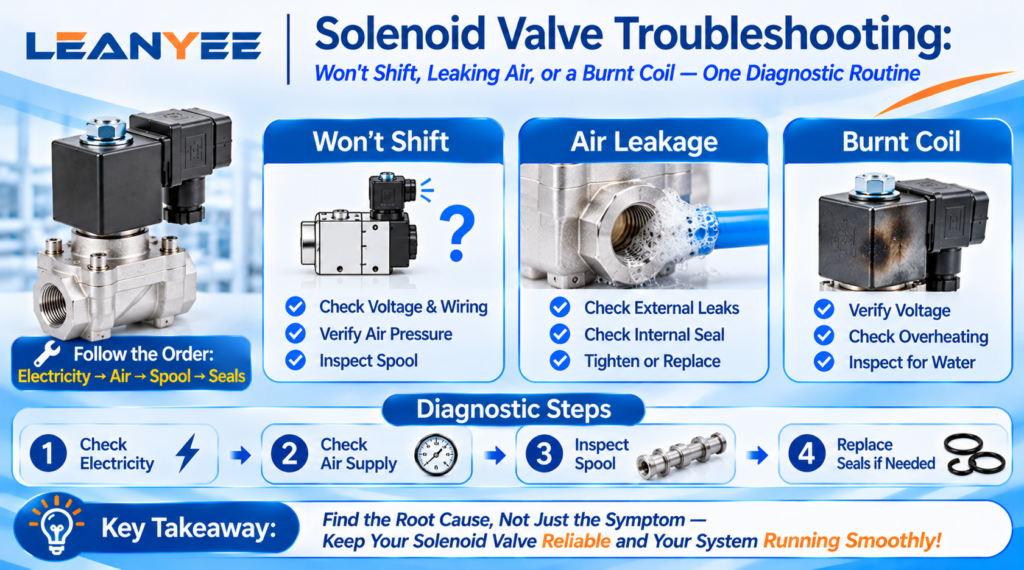
Loud Noise, Sticking Spool, Slow Response — Where Is the Problem?
Pneumatic Technology Explained · Solenoid Valve Series
The short answer: excessive noise, sticking, and slow response almost always trace back to a few root causes — dirty air, low voltage, and restricted exhaust. Noise is usually shifting shock or blocked exhaust; sticking comes from contamination or corrosion; slow response points to flow or voltage shortfall. Aim in the right direction and most of these can be fixed on the spot.
Locating the Three Symptoms
Loud noise: airflow shock when shifting (present even in a healthy valve, but too much is a problem), a clogged silencer, restricted pilot exhaust, or spool impact.
Sticking spool: moisture, oil mist, and particles in the supply adhering to the spool, corrosion after long idle periods, or dried-out grease. Slow response: low voltage weakening the magnetic pull, insufficient pilot flow, restricted exhaust, or high resistance on the load side.
Telling Noise, Sticking, and Slow Response Apart
| Item | Loud noise | Sticking spool | Slow response |
| Main cause | Shifting shock / restricted exhaust | Contamination / corrosion | Voltage / flow / exhaust |
| Typical sign | Humming / impact noise | Sluggish shifting | Slow response |
| Fix | Check silencer / exhaust | Clean / dry the air supply | Check voltage / flow |
Field Notes: Mistakes We Have Seen
- Only ever replacing the silencer for noise. Shifting shock and restricted exhaust remain, and so does the noise.
- Forcing a stuck spool by brute strength. Forcing it scratches the spool and the seals.
- Blaming the valve alone for slow response. Low voltage, undersized piping, and a blocked exhaust are all candidates.
- Overlooking air quality. Dirty air is the root of sticking and wear — get the FRL unit in place first.
Frequently Asked Questions (FAQ)
Q1: Is it normal for a solenoid valve to be noisy when shifting? A light hiss of air and a single “click” on shifting are normal, especially on high-flow valves. But a continuous buzz, sharp banging, or whistling is not. Common causes: a clogged silencer restricting exhaust, excessive shifting shock (no cushioning, or shifting too fast), restricted pilot exhaust, the spool striking the body, or a loose coil vibrating. Fix: check the silencer for blockage and the exhaust for free flow first, then localize the sound, and if necessary change to a cushioned valve or reduce the shifting shock. Long-term abnormal noise shortens valve life — do not ignore it.
Q2: What makes a spool stick, and how is it fixed? The main cause is dirty air — moisture, oil mist, and particles enter the valve and settle in the gap between spool and body, adding friction until the spool jams. Long idle periods cause corrosion, and grease can dry out. Fix: de-energize and depressurize, remove the spool, blow it clean with compressed air and wash it with a dedicated cleaning agent to remove contamination and rust, then inspect the seals and the spool surface. For slight sticking, try working the manual override button a few times first. The lasting fix is clean air — filtration and a dryer to ISO 8573 to control oil mist and particles, otherwise it will stick again after cleaning.
Q3: The valve responds slowly — what could be the cause? Check in three directions. First, low voltage: weak magnetic pull makes the spool sluggish. Second, insufficient flow: the orifice is too small or pilot flow is inadequate, so supply cannot keep up. Third, restricted exhaust: a blocked exhaust port or silencer prevents air from escaping and slows the shift. High resistance on the load side and long, narrow piping also slow things down. Diagnostic order: measure the coil voltage against the rated range, then check whether supply pressure and valve Cv are matched, and finally inspect the exhaust port and silencer. Do not replace the valve at the first sign of slowness — find the bottleneck first.
Q4: What happens when the silencer clogs? The silencer sits on the exhaust port, and when it clogs it raises exhaust back pressure directly, setting off a chain of problems: restricted exhaust → slower shifting → slower cylinder motion. Blocked exhaust can also unbalance internal pressures, causing abnormal noise and leakage, and even affecting return. A silencer that is never replaced becomes saturated with oil mist and dust until it is completely blocked. The silencer is a wear part: inspect, clean, or replace it regularly, especially in dusty or oil-mist-heavy environments. If the exhaust sounds weaker and the valve gets slower, check the silencer first.
Q5: How do I keep the air supply clean and reduce sticking? The key is a complete air preparation unit (FRL) and controlling compressed air quality to ISO 8573: first, a filter to remove particles and water, with the right filtration grade; second, a dryer to control the dew point and remove moisture; third, a lubricator where lubrication is required — or oil-free supply for lubrication-free valves; fourth, drain the piping regularly, emptying accumulated water and oil from the bottom of the filter. In dusty or humid environments, shorten the drain and filter-change intervals. Clean air is the foundation of a valve that sticks less and lasts longer — far cheaper than repeated strip-downs.
Prepared by the LEANYEE pneumatics technical team based on hands-on commissioning experience, for reference by industry peers.
Technical Disclaimer
The fitting selection, thread types, and technical parameters discussed in this article are based on applicable international standards, including ISO 4414 (Pneumatic Fluid Power — General Rules and Safety Requirements), ISO 8573 (compressed air quality), ISO 6358 (flow characteristics), and relevant thread standards such as ISO 7-1, ISO 228-1, and ANSI/ASME B1.20.1, together with publicly available technical information from international manufacturers such as SMC, Festo, and Parker.
This article is intended for general technical reference only. Actual performance may be affected by cylinder bore size, load, operating pressure, temperature, piping layout, and other application-specific factors.
On-site testing and commissioning are recommended where necessary. Always refer to the product documentation and technical parameters confirmed by the manufacturer for the specific product being used.
LEANYEE Technical Team
| [Topic] Troubleshooting: noise / sticking / slow response | [Intended readers] Maintenance and repair personnel |
More News & Insights
-
Leanyee
 29 Oct, 2026Pneumatics in Electronics CleanroomsPneumatics in Electronics and Semiconductor Cleanrooms: Cleanliness and ESD ProtectionRead Article
-
Leanyee
 22 Oct, 2026Pneumatics in Automotive Welding LinesPneumatics in Automotive Welding Lines: Clamping, Location, and Spatter ResistanceRead Article
-
Leanyee
 15 Oct, 2026Pneumatics for Food and Beverage LinesPneumatics on a Food and Beverage Line: Oil-Free, Hygienic, Washdown-ReadyRead Article