Pneumatic Fitting Selection Parameters
Why Do Pneumatic Tubes Keep Leaking or Coming Loose? A Guide to Fitting Selection and Installation
-
27 Feb, 2025

-

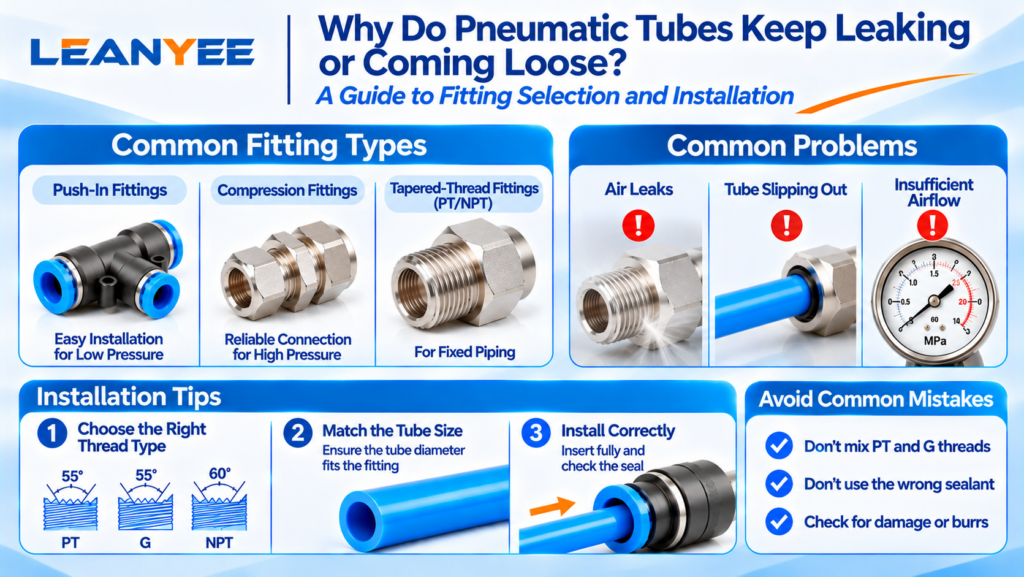
Why Do Pneumatic Tubes Keep Leaking or Coming Loose? A Guide to Fitting Selection and Installation
LEANYEE Technical Guide | Pneumatic Systems Series
Introduction
If pneumatic tubing keeps leaking, slipping out of fittings, or failing to deliver sufficient airflow, the problem may not be the tube or valve itself. In many cases, the real cause is an incorrectly selected or improperly installed pneumatic fitting.
For general production lines, push-in fittings are a convenient choice for low-pressure applications that require frequent disconnection and reconnection. For high-pressure, high-temperature, or high-vibration environments, metal compression fittings or tapered-thread metal fittings may provide a more reliable connection.
The key is to match three things correctly: thread type, tube diameter, and sealing method. If any of these are incompatible, leakage can occur even when the fitting appears to be fully tightened.
1. Why Do Pneumatic Fittings Leak? Understanding Two Key Factors
The sealing performance of a pneumatic fitting depends primarily on two factors: the sealing method and the compatibility between the fitting size and the tube diameter.
1.1 Understand the sealing method
Different pneumatic fittings use different sealing mechanisms.
- Tapered threads (PT/NPT): These rely on threaded engagement and typically require thread seal tape or an appropriate thread sealant.
- Parallel threads (G): These generally rely on an O-ring compressed against an end face to create a seal.
- Push-in fittings: These use an internal gripping mechanism to hold the tube in place and an internal sealing ring to prevent air leakage.
Understanding these differences is essential when selecting and installing pneumatic fittings. Using the wrong sealing method can lead to leaks, even if the connection feels tight.
1.2 Match the fitting size to the tube diameter
The tube diameter must match the fitting specification. If the tube and fitting are incompatible, the tube may not enter the fitting properly or the gripping mechanism may fail to hold it securely.
For example, a tube that is too small for a push-in fitting may not be gripped securely, while a tube that is too large may not fit into the fitting at all.
1.3 Why can a fitting feel tight but still leak?
One common cause is a mismatch between thread types.
For example, forcing a PT tapered thread into a G parallel-thread port may create the impression that the connection is tight. However, the threads and sealing surfaces do not match correctly. The result can be poor engagement and gradual air leakage.
Many seemingly unexplained pneumatic leaks are caused by incompatible thread types or incorrect sealing methods rather than defective components.
2. Push-In Fittings vs. Compression Fittings vs. Tapered-Thread Fittings
Choosing the right type of fitting is essential for reliable pneumatic system performance. The following comparison explains their main differences.
| Comparison | Push-in fittings | Compression fittings | Tapered-thread fittings (PT) |
|---|---|---|---|
| Installation convenience | Most convenient; generally requires no tools for tube connection | Requires tightening | Requires thread seal tape or sealant and tightening |
| Sealing reliability | Moderate; depends on tube outer diameter and sealing ring condition | High; relies on metal gripping engagement | High; relies on tapered-thread engagement and appropriate sealing |
| Typical applications | General low-pressure systems and frequent disconnection | High-pressure, high-vibration, or high-temperature applications | Fixed high-pressure piping connections |
| Cost and disassembly | Low cost; allows repeated disconnection and reconnection | Moderate cost; disassembly can be more involved | Low cost in the source comparison; sealing materials may need replacement |
2.1 Push-in fittings
Push-in fittings are easy to install and convenient for applications requiring frequent tube replacement or maintenance.
They are commonly used in general low-pressure pneumatic systems where quick installation and disconnection are important.
However, their performance depends on the tube’s outer diameter, surface condition, and the condition of the internal sealing ring and gripping mechanism. Incorrect tube dimensions, scratches, or worn components can lead to leakage or tube disconnection.
2.2 Compression fittings
Compression fittings use a mechanical gripping mechanism to secure the tube. Metal-to-metal engagement can provide a reliable connection when the fitting is correctly selected and installed.
They are worth considering for applications involving higher pressure, vibration, or elevated temperatures, provided that the fitting material and specifications are suitable for the actual operating conditions.
Correct tightening is important. Excessive tightening can damage the tube or fitting, while insufficient tightening may compromise the connection.
2.3 Tapered-thread fittings
Tapered-thread fittings, such as PT fittings, are commonly used for fixed piping connections. Their sealing performance depends on compatible threads, proper engagement, and the appropriate sealing material.
PT threads generally require thread seal tape or a suitable thread sealant. Incorrect thread matching or improper sealant application can result in leakage.
These fittings are particularly important to consider when connecting pneumatic components with threaded ports.
3. Four Common Mistakes to Avoid When Installing Pneumatic Fittings
Selecting the correct fitting is only the first step. Installation errors can still cause leakage, tube disconnection, and other pneumatic system problems.
3.1 Check the thread type before tightening
PT and G threads can look similar, but they have different thread geometries and sealing methods. Mixing them can result in a connection that feels tight but still leaks.
The main differences are:
- PT: A 55° tapered pipe thread that generally requires thread seal tape or an appropriate sealant.
- G: A 55° parallel pipe thread that generally relies on an end-face O-ring for sealing.
- NPT: A 60° tapered pipe thread with a different thread profile from PT.
PT and NPT are both tapered threads, but their thread angles differ. Forcing them together can cause poor engagement, thread damage, and leakage.
Do not apply thread seal tape indiscriminately to every threaded connection. For a G-thread connection designed to seal with an end-face O-ring, applying tape to the threads does not replace the required O-ring seal and may interfere with proper assembly.
Always identify the thread type before installation.
3.2 Check the effective flow passage and tube tolerances
When selecting a push-in fitting, consider both the effective flow passage and the tube’s dimensional tolerances.
A tube with an oversized outer diameter, scratches, water residue, or other surface contamination may not be gripped securely and could slip out of the fitting.
Before inserting the tube:
- Cut the tube end squarely.
- Remove burrs and ensure the cut is clean.
- Check that the tube surface is in good condition.
- Confirm that the tube outer diameter matches the fitting specification.
- Insert the tube straight into the fitting until it reaches the proper insertion position. A click may be heard, depending on the fitting design.
Correct tube preparation helps improve connection reliability and reduce the risk of leakage.
3.3 Do not assume that tighter is always better
Excessive tightening can damage pneumatic fittings and connected components.
For tapered-thread connections, overtightening may cause the fitting body or the threaded port of a cylinder to crack.
For compression fittings, excessive tightening can cut into or damage the tube.
Use a torque wrench and follow the manufacturer’s specified tightening torque whenever this information is available. If the appropriate torque is unknown, do not rely on arbitrary tightening force. Consult the manufacturer’s installation instructions for the correct procedure.
The objective is to achieve the specified connection, not to apply as much force as possible.
3.4 Do not rely on push-in fittings alone in high-vibration environments
In environments with significant vibration, elevated temperatures, or oil contamination, the internal sealing ring of a push-in fitting may deteriorate more quickly, depending on the material and operating conditions.
For such applications, consider suitable metal compression fittings or additional tube clamps to reduce mechanical stress on the connection.
The final choice should be based on the actual operating pressure, temperature, vibration level, fluid compatibility, and manufacturer’s specifications.
4. Frequently Asked Questions About Pneumatic Fittings
Q1: Why does a pneumatic fitting still leak after being tightened?
Start by locating the leak. Apply soapy water to the suspected connection and observe where bubbles form. This helps distinguish leakage at the threaded connection from leakage around the tube entry.
If the leak is around the threads:
- A PT connection may have insufficient thread seal tape.
- The tape may have been wrapped in the wrong direction.
- The thread types may be incompatible, such as a PT fitting installed in a G-thread port.
- A G-thread connection may have a missing, worn, or improperly compressed end-face O-ring.
If the leak is around the tube entry of a push-in fitting:
- The gripping mechanism may not be holding the tube securely.
- The internal sealing ring may be worn.
- The tube end may be cut at an angle or have burrs.
- The tube may not be fully inserted.
After identifying the cause, take the appropriate corrective action. For threaded leaks, reapply the appropriate sealant or replace the damaged or worn sealing component. For tube-entry leaks, recut the tube squarely, insert it correctly, or replace the fitting if necessary.
Pressure and temperature can affect sealing performance. After making repairs, carry out a suitable pressure test and recheck the connection under the actual operating conditions, following the applicable safety procedures and manufacturer’s instructions.
Q2: Can PT, G, and NPT threads be screwed into one another and used interchangeably?
They should not be mixed unless the connection is specifically designed and approved for that purpose.
The main differences are:
- PT: 55° tapered pipe thread.
- G: 55° parallel pipe thread.
- NPT: 60° tapered pipe thread.
PT and NPT are both tapered, but their thread angles differ by 5°. Forcing them together can cause poor thread engagement, damage, and gradual leakage.
G threads are parallel and generally rely on an end-face O-ring for sealing. Their sealing mechanism differs from that of tapered-thread connections, so simply tightening a G-thread fitting into an incompatible tapered port will not ensure a reliable seal.
The correct approach is to match compatible thread types. If the port size or thread type differs, use a suitable, properly specified adapter rather than forcing the components together.
When purchasing pneumatic fittings, check the thread designation on the equipment drawing, connection diagram, or product specification to avoid compatibility problems after delivery.
Q3: How should I choose between push-in fittings and threaded fittings?
The choice should depend on the operating conditions.
For low-pressure, normal-temperature applications requiring frequent disconnection:
Push-in fittings are often convenient and efficient. As a general reference, the source article identifies applications at pressures of approximately 1.0 MPa or below as typical use cases, but the actual allowable pressure must be confirmed against the selected fitting’s rated specifications.
For high-pressure, high-temperature, high-vibration, or oil-contaminated environments:
Suitable metal compression fittings or tapered-thread fittings may be preferable because they can provide reliable mechanical connections when correctly specified and installed.
For food-processing, clean, or corrosive environments:
Consider stainless steel or other purpose-selected materials compatible with the operating environment, cleaning agents, and process requirements.
In all cases, the fitting’s effective flow passage must match the required airflow and the connection specifications of the cylinder or valve. An undersized passage can restrict flow, while a mismatch between the fitting and tube outer diameters can prevent secure gripping.
If the correct specification is uncertain, consult the manufacturer’s rated pressure, temperature, and flow-passage data, and verify performance under actual operating conditions.
Q4: Why does a tube keep coming out of a push-in fitting?
Tube disconnection commonly results from four causes.
1. Incorrect tube dimensions or poor surface condition
The tube outer diameter may be outside the required tolerance, or the surface may have scratches, oil, or water contamination. These conditions can prevent the gripping mechanism from holding the tube securely.
2. Improper tube preparation or insertion
The tube end may not be cut squarely, burrs may remain, or the tube may not have been inserted fully.
3. Incorrect tube and fitting sizes
The fitting specification must match the tube outer diameter. For example, an 8 mm tube should not be forced into a fitting designed for a 6 mm tube, nor should a 6 mm tube be used in a fitting designed for an 8 mm tube.
4. Worn gripping components
The fitting’s gripping mechanism may have deteriorated through use, requiring replacement.
To resolve the problem:
- Use a tube with the correct outer diameter and an undamaged surface.
- Cut the tube squarely with an appropriate tube cutter.
- Remove burrs and prepare the tube end properly.
- Insert the tube straight and fully into the fitting.
- Replace the fitting with a new unit of the correct specification if the gripping mechanism is worn.
- For high-vibration applications, consider a suitable metal compression fitting.
After replacement, conduct a suitable pressure test to confirm that the tube remains securely connected and no leakage occurs.
Q5: How should thread seal tape be applied to prevent leakage? How many turns are needed?
Thread seal tape should be used only for compatible threaded connections, such as PT tapered pipe threads, where the sealing design calls for it.
G parallel threads generally rely on an end-face O-ring. Applying thread seal tape to the threads does not replace the O-ring and may interfere with the intended sealing arrangement.
For PT tapered threads, follow these general steps:
- Identify the correct thread type and make sure the components are compatible.
- Wrap the tape in the direction of tightening, generally clockwise when viewed from the threaded end.
- Start near the end of the thread and leave the first one or two threads uncovered to reduce the risk of tape fragments entering the pneumatic passage and obstructing a valve.
- As a general reference, the source article suggests approximately 3–6 turns, depending on thread size and tape characteristics.
- Apply enough tape to provide appropriate resistance during tightening without excessive buildup.
- Tighten the connection according to the manufacturer’s instructions.
- Perform a suitable leak test after installation.
More tape does not necessarily produce a better seal. Excessive tape can increase installation resistance and may damage the female threaded component.
An appropriate thread sealant or anaerobic thread-sealing compound may be used as an alternative when compatible with the materials, media, and operating conditions. Follow the product instructions, including any required curing time.
The final sealing performance must be confirmed by testing under the applicable operating conditions.
5. How to Select Pneumatic Fittings for Reliable System Performance
Reliable pneumatic connections require more than choosing a fitting that physically fits the port. Thread compatibility, tube dimensions, sealing design, installation quality, and operating conditions must all be considered together.
Before selecting or installing a pneumatic fitting, check the following:
- Thread type: Confirm whether the connection uses PT, G, NPT, or another specified thread standard.
- Tube outer diameter: Ensure that the tube dimensions match the fitting specification and required tolerances.
- Sealing method: Determine whether the connection requires thread seal tape, an appropriate sealant, an O-ring, or another specified sealing arrangement.
- Effective flow passage: Make sure the fitting can support the required airflow without creating an unacceptable restriction.
- Operating pressure and temperature: Confirm that the fitting’s rated limits meet the actual application requirements.
- Vibration and environmental conditions: Consider mechanical support, material compatibility, and the suitability of the gripping and sealing mechanisms.
- Installation procedure: Follow the manufacturer’s requirements for tube preparation, insertion depth, tightening torque, and leak testing.
Taking these factors into account can help reduce air leakage, prevent tubes from coming loose, improve airflow performance, and simplify pneumatic system maintenance.
Conclusion
Pneumatic fitting problems are often caused by incorrect selection or installation rather than simply by insufficient tightening.
Push-in fittings are convenient for general low-pressure applications requiring frequent disconnection. Compression fittings and tapered-thread metal fittings may be more suitable for demanding conditions involving pressure, temperature, or vibration, provided their specifications meet the application requirements.
The most important principles are straightforward: match the thread type, match the tube diameter, use the correct sealing method, and follow the proper installation procedure.
Rather than tightening a leaking connection repeatedly, identify the actual cause and correct it. This approach helps improve connection reliability and maintain stable pneumatic system performance.
What type of pneumatic fitting causes the most leakage in your production facility: push-in fittings or threaded fittings? Share your experience and maintenance challenges with us.
Technical Disclaimer
The fitting selection, thread information, and sealing guidance in this article are based on the original technical material and general pneumatic industry references, including ISO international standards and technical materials from manufacturers such as SMC and Festo.
This article is intended for general technical reference only. Actual sealing and connection performance may be affected by operating pressure, temperature, vibration, tube dimensional tolerances, materials, and installation conditions. Always consult the applicable product documentation and confirm the technical specifications with the manufacturer. Verify the final connection under actual operating conditions.
LEANYEE Technical Team
More News & Insights
-
Leanyee
 29 Oct, 2026Pneumatics in Electronics CleanroomsPneumatics in Electronics and Semiconductor Cleanrooms: Cleanliness and ESD ProtectionRead Article
-
Leanyee
 22 Oct, 2026Pneumatics in Automotive Welding LinesPneumatics in Automotive Welding Lines: Clamping, Location, and Spatter ResistanceRead Article
-
Leanyee
 15 Oct, 2026Pneumatics for Food and Beverage LinesPneumatics on a Food and Beverage Line: Oil-Free, Hygienic, Washdown-ReadyRead Article