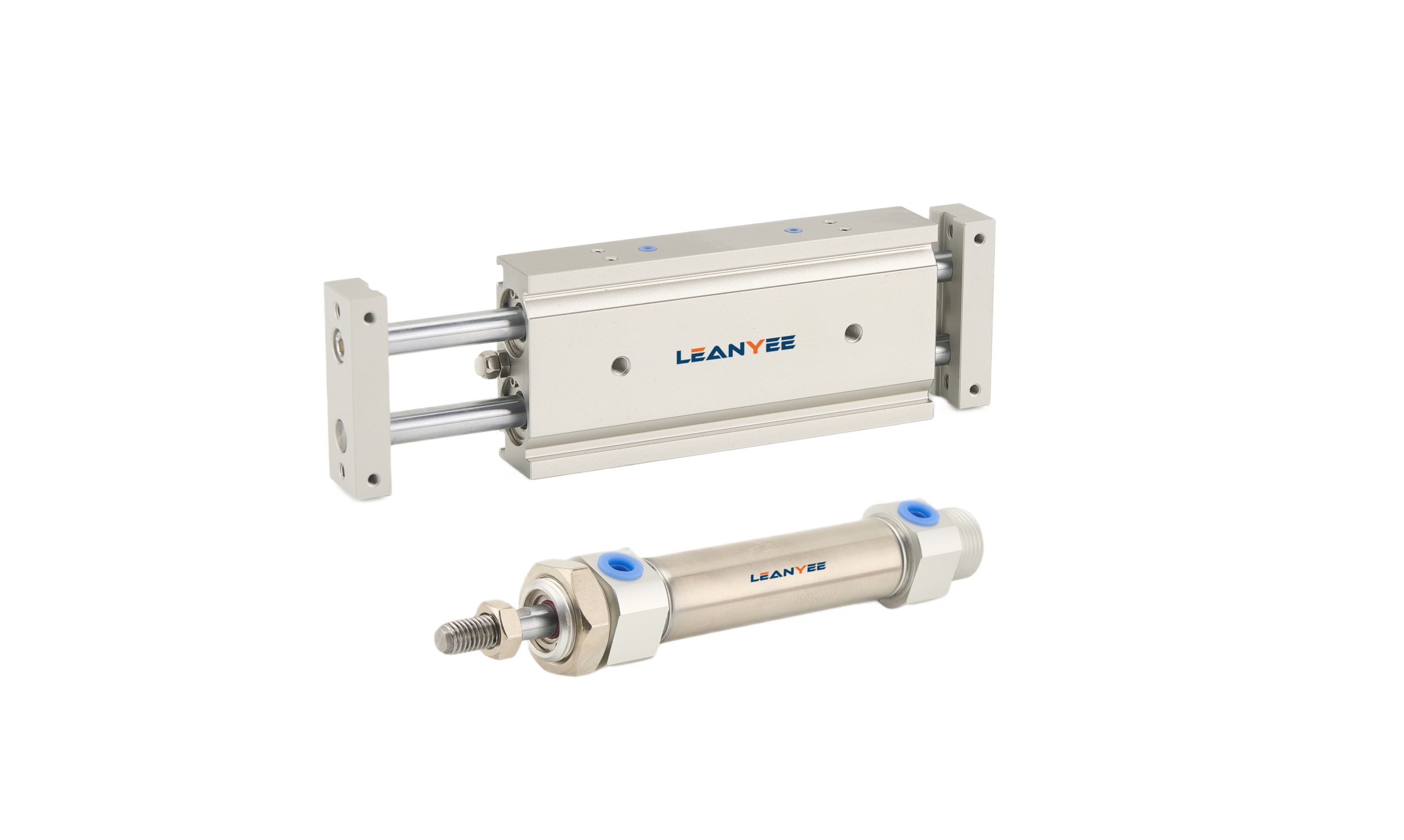
Will Electric Actuators Replace Pneumatic Cylinders
Will Electric Actuators Replace Pneumatic Cylinders? Servo Actuators, Integrated Sensing, and the Smart Direction Pneumatic Technology Explained · Pneumatic Cylinder Series The short answer: pneumatic cylinders will not be replaced wholesale by electric actuators — the two complement each other, each owning its territory. Cylinders run on compressed air: cheap, fast, rugged, ideal for point-to-point […]
-
21 Aug, 2025

-

Will Electric Actuators Replace Pneumatic Cylinders? Servo Actuators, Integrated Sensing, and the Smart Direction
Pneumatic Technology Explained · Pneumatic Cylinder Series
The short answer: pneumatic cylinders will not be replaced wholesale by electric actuators — the two complement each other, each owning its territory. Cylinders run on compressed air: cheap, fast, rugged, ideal for point-to-point push-pull. Electric actuators run on motor and screw: ideal for precise control of position, speed, and force. The choice comes down to whether you need “cheap motion” or “precise control.”
Cylinder vs. Electric Actuator: Where Is the Boundary?
The cylinder’s strengths: low cost, high speed, simple structure, tolerance of shock and overload, and broad environmental adaptability — ideal for gripping, pressing, reaching a position, and frequent fast actions. The electric actuator’s strengths: programmable, precise control of position, speed, and force; high efficiency; low energy use; traceable data — ideal for multi-position, variable-speed, high-precision applications.
The trend is not “one replaces the other” but convergence: cylinders gain sensors, manifolds, and diagnostic modules and turn smart, while electric actuators keep penetrating precision applications. Decide on total cost of ownership and control requirements — not on fashion.
Cylinder or Electric Actuator — How to Choose
| Item | Pneumatic cylinder | Electric actuator |
| Control precision | Point-to-point, moderate | Position / speed / force precisely controlled |
| Cost | Low | High (initial + maintenance) |
| Speed / cycle rate | Fast, high-frequency | Limited by motor and screw |
| Overload / shock | Shock-tolerant, overload-capable | Needs protection against overload |
| Best suited to | Gripping / pressing / fast push-pull | Multi-position / variable speed / high precision |
Field Notes: Mistakes We Have Seen
- Converting from air to electric blindly. For pure point-to-point push-pull, cylinders are cheaper and faster — converting wastes money.
- Blaming the cylinder for insufficient precision. Where an electric actuator is the right answer, forcing a cylinder leaves positioning repeatability short.
- Looking only at purchase price, not total cost. Electric actuators save energy but cost more to maintain and commission — count the whole bill.
- Overlooking the value of integrated sensing. Adding position switches and pressure sensors to a cylinder fills in much of the “smart” gap. When unsure, have an experienced engineer judge the air/electric boundary for the application — it saves taking the wrong route and paying for it.
Frequently Asked Questions (FAQ)
Q1: When is a cylinder enough, with no need for an electric actuator? For point-to-point motion, simple actions, and undemanding precision, cylinders are usually enough: gripping, pressing, reaching a position, fast frequent push-pull, and shock-prone duty. Cylinders are cheap, fast, and shock-tolerant; as long as you do not need intermediate positions or precise speed control, their value for money is clearly better. The test: if the motion is “extend to position, retract” — a two-point action — a cylinder suffices; only when you need to “stop at a precise intermediate position, vary speed, or control force” does an electric actuator come into play.
Q2: When is an electric actuator a must? Three cases favor it clearly. Multi-position precise positioning: a cylinder has only two ends, while an electric actuator can stop anywhere in the stroke. Precise control of speed, acceleration, or force: press-fitting, servo tracking, and the like. Data feedback and traceability: real-time capture of position and force. High-precision assembly and flexible process changeovers also lean electric. The core test is “do I need programmable, precise motion control?” If yes, go electric — the most direct criterion.
Q3: Can a cylinder become smart just by adding sensors? Yes — and this is an important direction of the cylinder’s evolution. Equipping a cylinder with magnetic switches, position sensors, pressure sensors, a valve manifold, and diagnostic modules allows real-time monitoring of position, speed, and pressure: end-of-stroke detection, fault prediction, life statistics, and remote diagnosis — turning a “silent” cylinder into a sensing, connected actuator. Much of the feedback that used to require an electric actuator can now be achieved more cheaply with “cylinder + sensors + smart manifold.” Include the sensor interfaces in the selection from the start.
Q4: What costs does air-to-electric conversion involve? Look beyond the actuator’s price tag to total cost of ownership. Purchase: the actuator plus servo drive and controller costs considerably more than a cylinder. Energy: electric actuators are efficient and save power long-term, but compressed air energy must also be counted for cylinders. Maintenance and commissioning: electric needs electrical commissioning and software, while cylinder maintenance is simple. Spares and training. Converting high-cycle point-to-point duty to electric is often not worthwhile; converting where precise control is needed is. Do the full arithmetic before deciding.
Q5: Where are cylinders heading? Four directions. Intelligence: integrated sensors, manifolds, and diagnostics for condition monitoring and predictive maintenance. Light weight and modularity: smaller bodies and standardized interfaces for easier integration. Energy efficiency: less air consumption, optimized cushioning and speed control. Convergence with electric: hybrid air-electric actuation that switches as needed. Overall, the cylinder will not disappear — it will become smarter, leaner, and easier to integrate, with electric actuators each playing to its strength. See the trend early and position accordingly.
Prepared by the LEANYEE pneumatics technical team based on hands-on commissioning experience, for reference by industry peers.
Technical Disclaimer
The fitting selection, thread types, and technical parameters discussed in this article are based on applicable international standards, including ISO 4414 (Pneumatic Fluid Power — General Rules and Safety Requirements), ISO 8573 (compressed air quality), ISO 6358 (flow characteristics), and relevant thread standards such as ISO 7-1, ISO 228-1, and ANSI/ASME B1.20.1, together with publicly available technical information from international manufacturers such as SMC, Festo, and Parker.
This article is intended for general technical reference only. Actual performance may be affected by cylinder bore size, load, operating pressure, temperature, piping layout, and other application-specific factors.
On-site testing and commissioning are recommended where necessary. Always refer to the product documentation and technical parameters confirmed by the manufacturer for the specific product being used.
LEANYEE Technical Team
[Topic] Cylinders vs. electric actuators and industry trends | [Intended readers] Technical management, R&D, and decision makers
More News & Insights
-
Leanyee
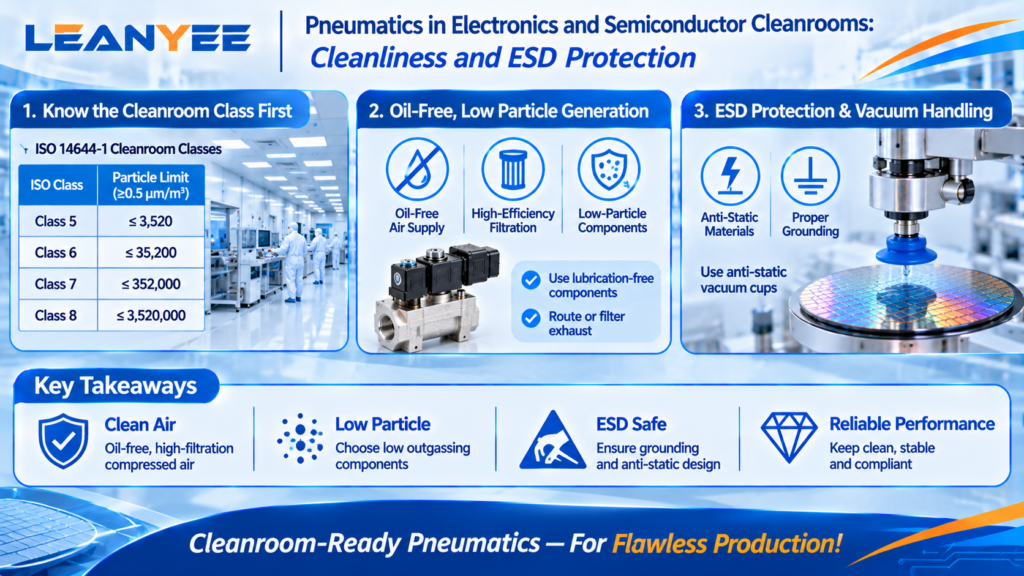 29 Oct, 2026Pneumatics in Electronics CleanroomsPneumatics in Electronics and Semiconductor Cleanrooms: Cleanliness and ESD ProtectionRead Article
-
Leanyee
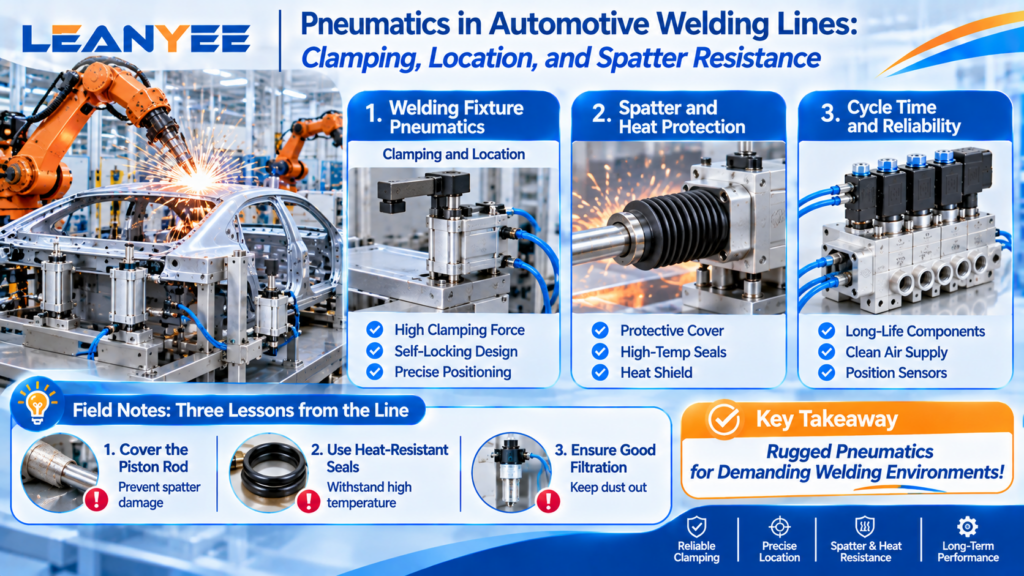 22 Oct, 2026Pneumatics in Automotive Welding LinesPneumatics in Automotive Welding Lines: Clamping, Location, and Spatter ResistanceRead Article
-
Leanyee
 15 Oct, 2026Pneumatics for Food and Beverage LinesPneumatics on a Food and Beverage Line: Oil-Free, Hygienic, Washdown-ReadyRead Article